



![Mercedes-Benz_eActros_600_(1)[1]](https://d2cohhpa0jt4tw.cloudfront.net/Pictures/274x183/8/1/8/17818_mercedesbenz_eactros_600_11_556244.jpg)




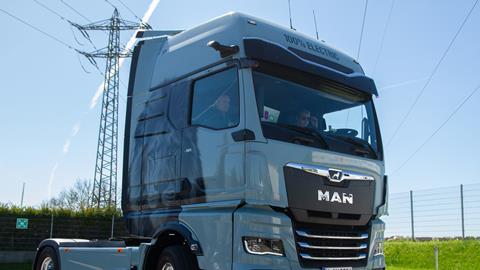

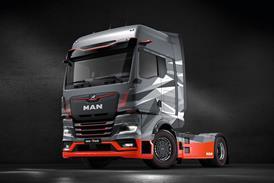
MAN Truck & Bus has become the first European truck manufacturer to demonstrate bidirectional charging - a technology which turns electric trucks into flexible energy storage systems, which the company said can cut electricity costs by up to 20%.
The demonstration is part of a research project MAN is carrying out in partnership with vehicle technology and energy consortium SPIRIT‑E.
It took place under real-world conditions using a battery-electric MAN eTGX with 480 kWh of usable energy at the premises of logistics company Spedition Schmid in Obertraubling near Regensburg in Germany.
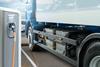
The technology enables electric trucks to store power and feed it back into other systems, such as the fleet operator’s facilities or back into the public grid to create a revenue stream.
It is estimated the technology can create energy savings of between 10% and 20%. With an annual mileage of 100,000 km, this saving corresponds to up to 20,000 kilometers driven effectively free of charge, MAN claims, making a significant contribution to improving the total cost of ownership of electric trucks compared to diesel vehicles.
Georg Grüneißl, MAN Truck & Bus head of product strategy, said: “Bidirectional charging is transforming the role of the electric truck.
“Our eTrucks effectively become power banks on wheels that can help lower energy costs while strengthening the energy system as a whole.
“SPIRIT‑E has demonstrated the substantial potential of this technology and how electric trucks can actively contribute to the energy transition in the future.”
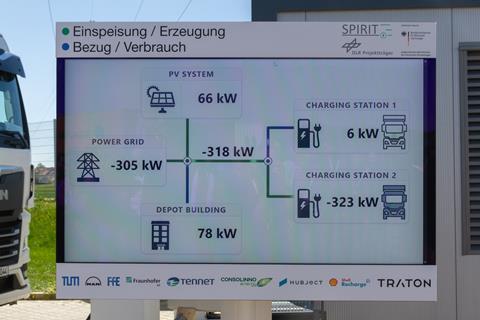
There are three ways to use the technology. Vehicle‑to‑Site (V2S) and Vehicle‑to‑Vehicle (V2V) allows companies to use the energy stored in the truck battery directly at their own facilities – for example to avoid peak loads, increase self-consumption of photovoltaic electricity or support building infrastructure. This can translate into savings of around 10 to 20% on electricity costs.
Using the Vehicle‑to‑Grid (V2G) application the eTruck can feed electricity back into the public grid – for instance during periods of high electricity prices or to support grid stability, allowing fleet operators to generate additional revenue streams in the future.
MAN said that by the end of this decade, V2G is expected to become an increasingly attractive business model as energy markets, grid services and logistics processes become more closely integrated.
As part of SPIRIT‑E project the technology has already supplied a building with electricity overnight using eTrucks and charged electric cars from a truck’s battery.
However, bidirectional charging is not suitable for all truck applications – for example, where operations do not allow for longer dwell times at a depot.
SPIRIT‑E is supported by a broad consortium covering the entire value chain, from vehicle technology and the energy industry to system integration. Partners include the Technical University of Munich (TUM) as consortium lead, Fraunhofer IEE, the Research Centre for Energy Economics (FfE), SBRS (Shell), TenneT, Hubject, Consolinno Energy, and MAN Truck & Bus.