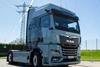





MAN Truck & Bus has pointed to signs of stabilisation in the UK HGV market and a sharp uplift in order intake, while warning that the pace of battery-electric adoption remains “too slow” due to infrastructure constraints, grid congestion and high upfront vehicle costs.
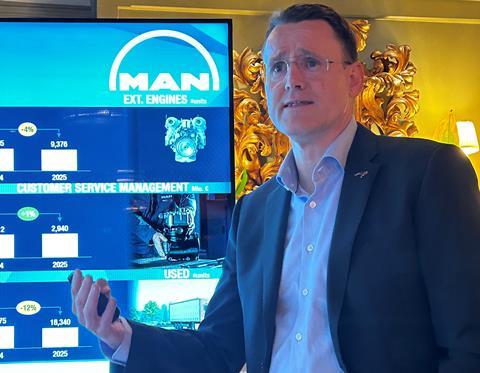
Speaking at a London press briefing, Alexander Vlaskamp (pictured right), chief executive of MAN Truck & Bus, was joined by Roman Sitte, senior vice president, head of area Europe, and UK MD Jan Kohlmeier to outline the group’s global performance, European market conditions and UK strategy, alongside wider commentary on decarbonisation and infrastructure challenges.
Globally, MAN reported a slight decline in truck volumes, with deliveries falling by around 1% from 63,665 units in 2024 to 63,296 in 2025. However, forward-looking indicators were significantly stronger, with truck order intake rising from 47,958 to 64,829 units. This represents an increase of 35%, signalling a clear rebound in demand following a subdued European market environment.
Van performance remained a relative growth engine, with units up 13% from 27,672 to 31,344, and order intake rising 28% to 29,150 units.
Vlaskamp said the shift reflected normalising demand conditions across Europe.
“From 2024 to 2025 on the truck side we had quite a sideways movement,” he said. “But order intake came back strongly in 2025 on a global perspective.”
The UK was described as a key focus market for MAN, with Vlaskamp emphasising steady growth rather than rapid expansion, supported by a deepening customer segmentation strategy and increased investment in service infrastructure.
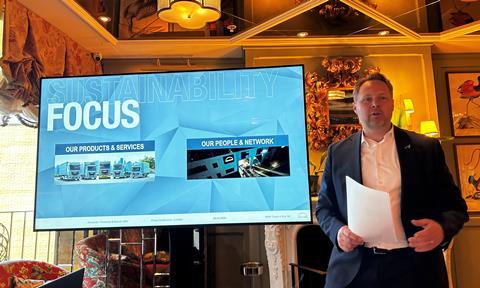
Kohlmeier (pictured left) said UK development was being driven through closer application-specific planning and long-term customer engagement.
“The UK is a focus market and remains a focus market,” he said. “We are growing step by step through segmentation, customers, applications and cooperation with bodybuilders.”
MAN confirmed UK truck volumes of around 4,000 units in 2025, within a broader UK commercial vehicle total of approximately 10,000 units, including vans and other products. The group is targeting around 30% growth by 2030.
A significant part of that strategy is investment in the UK service network, with around £40-45m committed to workshop expansion and upgrades, including new and expanded sites such as Aberdeen, Bristol and Stockton.
Electric route
While MAN acknowledged that battery-electric adoption remains slow, it pointed to early signs of commercial traction in the UK market.
Industry-wide, just 81 battery-electric HGVs were registered in the UK in the first three months of the year across all manufacturers — a figure cited during the discussion as evidence of the scale of the challenge.
However, MAN said it is already seeing early validation of its own electric truck offering, with repeat orders emerging from initial demonstration fleets and around 100 battery-electric vehicles expected to be operating on UK roads by year-end.
Sitte said momentum was building, albeit from a low base, and welcomed the UK Government’s enhanced Plug-in Truck Grant, including an £18m top-up to the scheme, which increases support to up to £86,000 per electric truck, depending on weight.
“We see strong progress currently in the market, but compared to other European markets the UK is lagging a bit behind,” he said. “It is still early, but confidence is developing.”
He added that operators were being encouraged to start with limited deployment.
“Our recommendation is to start with five to 10% of the fleet,” Sitte said. “That allows customers to learn and build confidence.”
However, a reduction in electric vehicle purchase prices was described as unlikely in the near term, with Vlaskamp pointing to the underlying cost of battery raw materials as the key driver.
“Prices are mostly dictated by raw material costs,” he said. “We will not see a significant reduction in battery-electric truck prices.”
This reinforces a structural shift in the economics of trucking, where operating costs — particularly energy and infrastructure access — will increasingly define competitiveness rather than upfront purchase price alone.
A consistent theme throughout the briefing was that infrastructure, rather than product availability, remains the primary constraint on faster electrification.
Vlaskamp said congestion on national grids and delays in securing connections were limiting operator readiness across multiple markets, including the UK.
“In many countries we see congestion on the grid and delays in infrastructure build-out,” he said. “We encourage governments to step change this because trucks will remain electric.”
Operators, he added, also face challenges in calculating total cost of ownership (TCO), which depends heavily on infrastructure access and energy pricing.
While battery-electric trucks remain significantly more expensive upfront than diesel equivalents, MAN said TCO parity is beginning to emerge in some markets.
Vlaskamp pointed to Germany and Austria, where toll exemptions and incentives are improving economics for operators.
“In some countries we now see over parity in TCO after two to three years of operation,” he said.
However, he warned that progress remains uneven and slow overall.
“Frankly, it is going too slow,” he added. “We have all the truck applications available, but only 2.1% of registrations in Europe are battery electric.”
The executives stressed that battery-electric trucks are already viable for a large proportion of applications, particularly in predictable urban and regional operations.
Its electric portfolio now covers most major applications including distribution, municipal services and refuse collection, with tractor units and rigid applications both supported.
Vlaskamp said the technology is already suitable for a majority of operational profiles.
“We believe up to 80% of transport can be electrified today,” he said, while encouraging operators to trial small-scale deployment.
Service opportunity
Contrary to concerns that electrification could reduce workshop revenue, MAN executives argued that service activity will evolve rather than decline.
While battery-electric vehicles typically require less traditional maintenance, they introduce new service requirements, particularly around battery systems, diagnostics and digital optimisation.
Sitte said MAN is investing heavily in this transition.
“We have invested in battery repair centres across Europe, including Manchester,” he said. “Battery management, diagnostics and optimisation will be a key part of future service revenue.”
MAN is also expanding digital services and predictive maintenance capabilities following the integration of its software operations in-house.
Kohlmeier highlighted that MAN has already completed full EV readiness upgrades across its UK workshop network, alongside broader investment in apprenticeship and training programmes.
The company currently employs around 180 apprentices in the UK, supported by its Manchester-based training centre.
“All service locations across the UK are EV ready,” he said. “That is a strong argument in front of customers during the transition phase.”
Sitte was also questioned on potential political risk, including the possibility of a shift away from net zero policy commitments in the UK following a future General Election.
However, he said that while political change could influence pace, it would not alter long-term direction.
“A political environment that is not supportive may slow the ramp-up, but it will not change the endgame,” he said.
Vlaskamp added that regulatory frameworks, including emissions trading systems and road pricing mechanisms, would continue to increase the cost of diesel transport over time, reinforcing the transition case.
The rise of Chinese manufacturers entering European and UK commercial vehicle markets was also addressed, with MAN acknowledging increased competition across segments.
Vlaskamp said competition should be welcomed but underlined that long-term success would depend on service capability as much as product pricing.
“They are competition not only in China but globally,” he said. “The key is innovation, durability and service network strength.”