




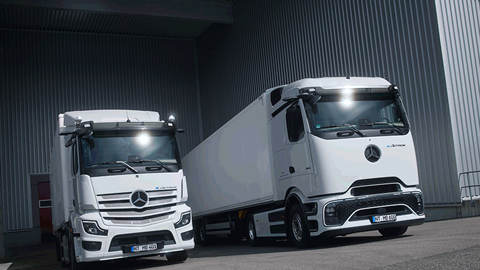
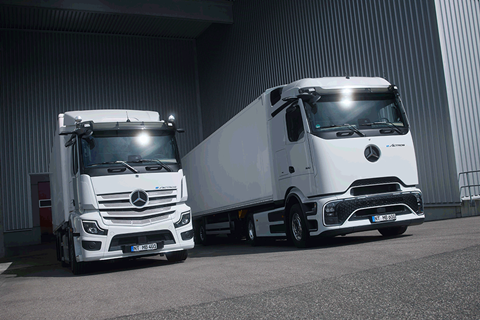
Mercedes-Benz Trucks’ approach with the eActros 400 and eActros 600 reflects that reality. Rather than offering a one-size-fits-all vehicle, the two models are designed to support different parts of the transport mix - giving fleets more flexibility as they begin to scale electrification.
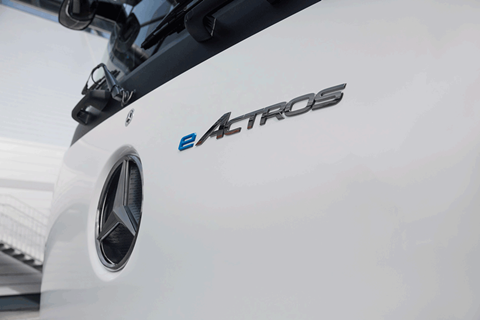
Both trucks are built on the same core electric platform, featuring an integrated e-axle and lithium iron phosphate (LFP) battery technology, chosen for durability and efficiency in heavy-duty applications. But beyond that shared foundation, their roles diverge.
The eActros 600 is engineered for long-haul operations. With three battery packs delivering 621 kWh of installed capacity, it offers a range of at least 500km – proven up to 700km - on a single charge. That positions it as a serious contender for trunking routes and higher-mileage work that has traditionally been difficult to electrify.
Charging strategy is key here. With planned megawatt charging capability, the eActros 600 is designed to take advantage of emerging high-power infrastructure, enabling operators to recharge during mandatory driver breaks. As that infrastructure develops, it has the potential to significantly reduce downtime and improve asset utilisation on longer routes.
By comparison, the eActros 400 is focused on regional distribution and return-to-base operations. Its two-battery configuration, at 414 kWh, reduces overall vehicle weight and allows for a payload of around 25 tonnes – with a range up to 500km - an important consideration for operators where every kilo directly impacts revenue.
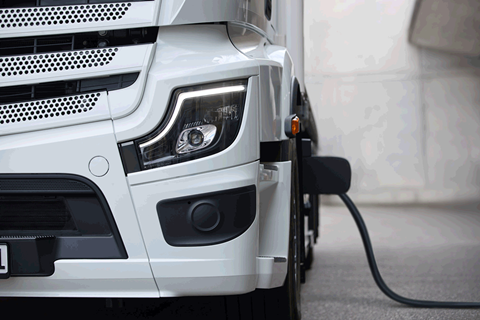
For fleets running fixed, predictable routes, this can be a more commercially efficient solution. Overnight depot charging is easier to integrate, and the balance between range and payload is often better aligned with day-to-day requirements.
In practical terms, the choice between the two comes down to operational priority. The eActros 600 extends electric viability into long-distance haulage, while the eActros 400 provides a more immediate, cost-effective pathway for high-frequency distribution work.
However, the vehicle itself is only part of the equation. Successful deployment depends on the wider ecosystem - particularly charging infrastructure, route planning and digital fleet management. Tools that provide real-time route optimisation, energy monitoring and predictive maintenance are becoming essential to maintain uptime and control operating costs.
Driver acceptance is another critical factor. Both variants incorporate modern cab designs, intuitive digital interfaces and advanced safety systems, helping to ensure that the transition to electric does not compromise comfort or usability.
For operators, the message is clear: electrification is no longer a future concept, but an operational reality. The challenge now is selecting the right technology for the right job. With both the eActros 400 and 600 available, fleets have a more practical route to doing exactly that - while continuing to move towards zero-emission transport.