





![Mercedes-Benz_eActros_600_(1)[1]](https://d2cohhpa0jt4tw.cloudfront.net/Pictures/274x183/8/1/8/17818_mercedesbenz_eactros_600_11_556244.jpg)




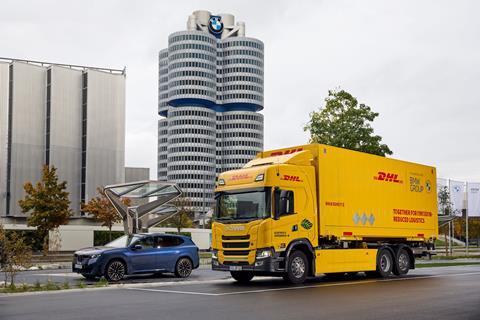
BMW Group Logistics has tested a Scania range-extended electric truck operated by DHL on its German automotive logistics routes, including the roughly 600 km Berlin–Munich corridor.
The truck is battery-electric but carries an onboard petrol generator that steps in when extra power is needed. At first glance, the set-up looks like the truck equivalent of a hybrid passenger car, and that comparison is not entirely wrong: both combine electric drive with a combustion engine.
The difference is in the engine’s role: here, it doesn’t turn the wheels but acts as a range extender, generating electricity for the electric drivetrain rather than providing mechanical propulsion.
In practical terms, the 40-tonne HGV is powered by a 416 kWh battery, with a 120 kW onboard generator providing extra electricity when the battery-electric system needs support. For that setup, BMW claims an operating range of 650 to 800 km, depending on route and operating conditions.
During the BMW pilot, the truck handled a mix of long-haul and short-distance work. Alongside the Berlin–Munich corridor, it also ran plant-related logistics routes in and around Munich, from short local movements up to trips of around 380 km.
DHL handled the day-to-day operation across all of those runs. Charging took place at DHL depots and at public charging points along the routes, with the petrol range extender available when the battery-electric system needed support.
“The range extender makes battery-electric long-distance transport operationally reliable for us. The decisive factor is not maximum range, but resilience in real operation,” Markus Voss, CEO of DHL Freight, said in BMW’s release. He said the truck could continue to run electrically when charging infrastructure was temporarily unavailable, schedules were tight or winter conditions applied.
On that mix of work, BMW says the truck can operate electrically for between 80% and more than 90% of driving time on recurring routes, even under difficult infrastructure conditions.
The BMW pilot is not the truck’s first time on a long-distance route. BMW confirmed to Freight Carbon Zero that the vehicle is the only Scania Extended Range Electric Vehicle currently in existence, and the same unit that DHL and Scania previously developed and tested on the Berlin–Hamburg corridor.
In a 100-day update from that earlier trial, DHL said the vehicle had covered nearly 22,000 km and operated electrically for more than 90% of the time. The range extender was used on 8.1% of the kilometres driven during the DHL and Scania test. DHL put the savings from that trial at nearly 16 tonnes of CO₂e compared with a diesel truck.
BMW said further tests of the concept may take place in the fourth quarter of 2026.