










![Mercedes-Benz_eActros_600_(1)[1]](https://d2cohhpa0jt4tw.cloudfront.net/Pictures/274x183/8/1/8/17818_mercedesbenz_eactros_600_11_556244.jpg)




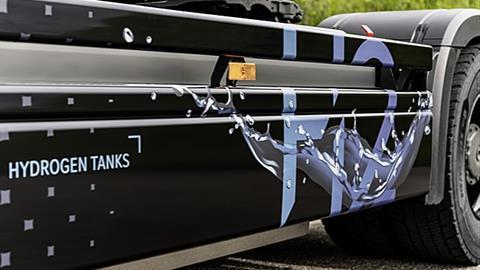

A combination of renewable hydrogen credits, road toll exemptions and funding for vehicles and refuelling infrastructure could narrow the total cost of ownership (TCO) gap between hydrogen and diesel trucks, according to a new policy paper from the H2Accelerate collaboration.
The group, which includes truck manufacturer Daimler Truck and Volvo Group, alongside energy and infrastructure companies, has published the first in a series of papers examining measures that could support the deployment of hydrogen-powered heavy-duty vehicles in Europe.
The paper focuses on three measures already being used in Germany and the Netherlands: credit mechanisms under the EU’s revised Renewable Energy Directive (RED III) for renewable hydrogen, road toll exemptions or reductions for zero-emission heavy-duty vehicles, and capital funding that supports both hydrogen trucks and refuelling stations.
H2Accelerate said the measures can help reduce the costs and risks associated with establishing an early hydrogen trucking market.
It points to Germany as an example where the combination of policy support and industry investment is helping to develop the market for hydrogen trucks and infrastructure.
Niklas Gustafsson, Volvo Group head of public policy and regulatory affairs, said: “Our recent joint announcement at IAA Transportation in September underlines the momentum now building around hydrogen trucking and, importantly, the need to develop the whole value chain together.
“Germany is demonstrating what can be achieved when vehicle deployment, hydrogen supply, refuelling infrastructure and supportive policy are aligned.
“For fleet operators, the decisive factor is the business case. Measures such as renewable fuel credits, toll exemptions and coordinated support for trucks and stations can work together to substantially bridge the TCO gap with diesel.
“Creating similarly robust conditions across more European markets will be essential to give customers the confidence to invest and allow the hydrogen trucking ecosystem to continue to scale.”
However, the measures are not applied consistently across European markets, resulting in different commercial conditions for operators considering hydrogen trucks, according to H2Accelerate.
The collaboration is calling for RED III credit mechanisms for renewable fuels of non-biological origin (RFNBO) hydrogen to be implemented across member states, as well as road toll exemptions in line with the Eurovignette Directive.
It also wants future Connecting Europe Facility Alternative Fuels Infrastructure Facility (CEF AFIF) funding rounds to provide joint support for hydrogen vehicles and refuelling stations.
A fourth proposal is a TCO Parity Certainty Mechanism, which H2Accelerate says would address any remaining cost gap and reduce exposure to policy and market volatility.
Hannah Bryson-Jones, H2Accelerate collaboration spokesperson, said: “We are seeing hydrogen-powered trucks and infrastructure move beyond technology validation and towards real-world commercial deployment.
“Germany and the Netherlands provide useful examples of how targeted support can improve the conditions for early projects and help vehicles and refuelling infrastructure scale together.
“When these measures are combined, hydrogen trucks can achieve competitive total costs of ownership compared with diesel, as demonstrated in Germany.
“The priority now is to replicate the policies that are working at a broader scale and provide the long-term certainty needed for industry to scale towards a fully commercial hydrogen trucking system.”
H2Accelerate is a collaboration between Daimler Truck, Linde, Mobility, TEAL Mobility, TotalEnergies and Volvo Group. It aims to support the deployment of hydrogen-powered long-haul trucks and associated infrastructure in Europe.
The full paper can be downloaded here.