







Hydrogen trucks are not dead. But they’re expensive. Four months into a trial with a hydrogen-powered Scania, an Italian haulier has found that energy costs are 3.5 times those of diesel. And the price is only part of the problem.
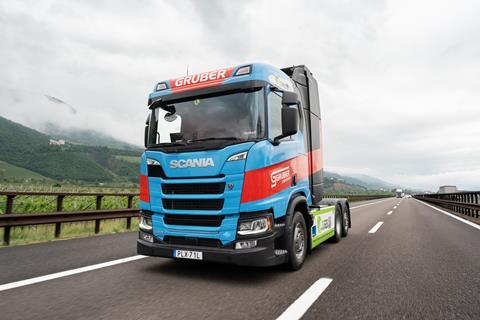
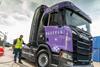
Gruber Logistics has been operating a hydrogen fuel-cell Scania since June as part of the EU-funded ZEFES project. The truck is covering around 8,000 km a month in everyday freight operations, typically carrying its maximum payload of 23 tonnes, and has completed a 750 km journey without refuelling. The trial is scheduled to continue until mid-November.
When comparing operating costs with those of a diesel truck doing similar work, Gruber found that the energy cost alone is 3.5 times higher when running on hydrogen. When the truck runs on battery power charged at €0.35/kWh, however, the energy cost is comparable with diesel. The company also points out that Italy offers no motorway toll discounts for zero-emission HGVs.
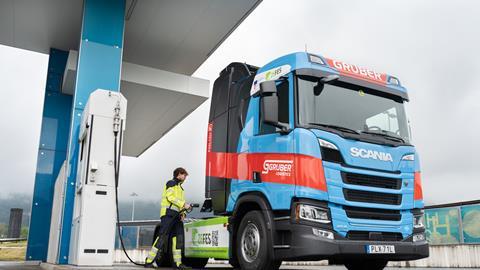
But cost is only one challenge. Finding somewhere reliable to refuel remains a problem as Italy’s hydrogen network is still developing. Gruber primarily uses the IIT Hydrogen station in Bolzano, which supplies green hydrogen produced using renewable electricity.
The limitations of the existing infrastructure became particularly relevant on 6 October, when Gruber used the Scania to deliver goods to cargo handlers BCUBE AIR CARGO and ALHA at Milan Malpensa Airport. The hydrogen for that operation also came from the Bolzano station, while a planned green hydrogen production and refuelling facility at Malpensa is still under development.
The airport delivery was a one-off demonstration. The truck has since returned to regular customer operations, with Gruber continuing to gather data on its performance.
Operating a prototype has also required the company to work through issues involving refuelling times, pressure management, safety procedures and energy management. A dedicated 700-bar, high-flow cooled hydrogen refuelling protocol has been developed and validated to enable fast and reliable refuelling.
The vehicle itself is a Scania 40 R FCEV, combining battery and hydrogen fuel-cell technology. It has a 416 kWh battery, a 300 kW fuel-cell system and storage for up to 56 kg of hydrogen. Its stated combined range is up to 1,000 km, although the full assessment of energy consumption will only be completed when the trial ends.
For Gruber, however, the main lesson so far has been less about the vehicle’s technical capabilities than the preparation needed to operate it.
“Nothing can be left to chance,” the company told Motor Transport, explaining that every activity, from refuelling to obtaining permits, requires clear procedures and back-up arrangements. The trial also depends on qualified staff and customers willing to accommodate the operational demands of testing new technology.