






![Mercedes-Benz_eActros_600_(1)[1]](https://d2cohhpa0jt4tw.cloudfront.net/Pictures/274x183/8/1/8/17818_mercedesbenz_eactros_600_11_556244.jpg)




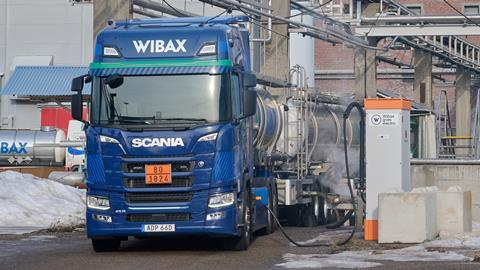

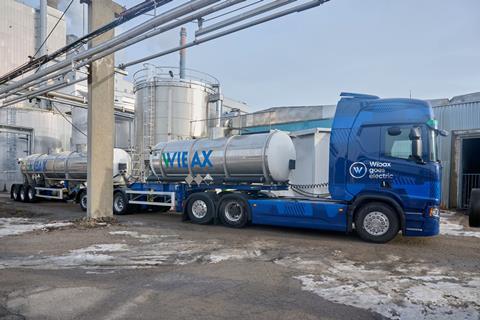
Scania has signed what it describes as the largest electric truck order for bulk transport in the EU to date, with Swedish chemicals and bio-oils distributor Wibax committing to 105 vehicles.
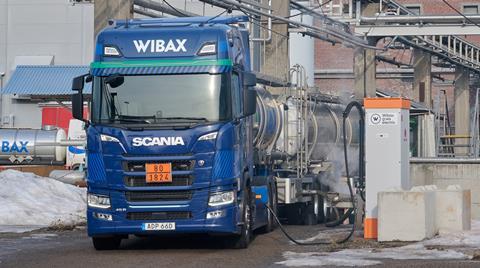
Wibax, which operates across Sweden, Finland and Norway, will use the trucks to move liquid products from its shore terminals to customers in Nordic basic industry. The vehicles will operate under Swedish regulations permitting combinations of up to 74 tonnes gross vehicle weight, with payload capacity of up to 50 tonnes.
The work involves large volumes and recurring, high-frequency transports that run around the clock. Wibax said this makes route planning and charging windows central to the deployment.
The first deliveries are scheduled for later this year, with the full rollout running through 2030. Wibax already operates six electric trucks, having begun electrifying its heavy transport in 2021.
Not all 105 vehicles will share the same specification. Wibax will deploy a mix of three- and four-axle chassis with varying battery capacities, matched to individual routes to optimise each transport operation. Annual distances are expected to range from about 93,000 to nearly 186,000 miles (150,000 km to nearly 300,000 km) per vehicle.
The agreement also covers Scania digital services and fleet optimisation, as well as cooperation on maintenance, charging solutions, route planning and energy consumption.
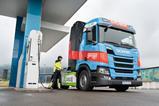
Charging infrastructure is central to the project. Wibax is building and operating its own network, primarily at its terminals.
“We will mainly charge at our terminals while loading and pumping products into our tanks,” the company told Freight Carbon Zero. “Our loading and unloading processes take a relatively long time, which provides ideal windows for charging the vehicles.”
Wibax is also establishing charging infrastructure at certain customer sites for cases where supplementary charging is needed to complete the return trip.
The company will manage most of this infrastructure in-house, supplemented by external charging operators where necessary. It also plans to develop its own electricity generation capacity, including solar installations at terminals, with energy storage systems used to buffer supply for truck charging. New grid connections and depot upgrades will be required in many cases.
Operations are centred on a marine terminal network, keeping most transport movements within 186 miles (300km) of their origin. Routes are repetitive, volumes are high, and the same corridors are served consistently.
Wibax said its electrification strategy is aimed at building a transport system that is both more cost-effective in the long run and lower in emissions.