



![Mercedes-Benz_eActros_600_(1)[1]](https://d2cohhpa0jt4tw.cloudfront.net/Pictures/274x183/8/1/8/17818_mercedesbenz_eactros_600_11_556244.jpg)




Retailer’s switch to biomethane-powered HGVs shows pragmatic decarbonisation in action, using proven technology and expanding UK infrastructure to deliver measurable emissions reductions today.
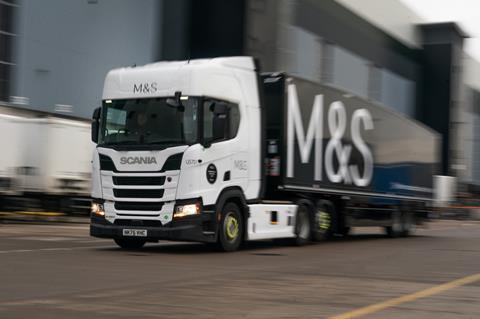
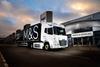
Decarbonising road freight is one of the hardest challenges facing British business. Heavy goods vehicles are workhorses of the economy, but they are also stubbornly carbon‑intensive, difficult to electrify at scale and vital to keeping shelves stocked. So when Marks & Spencer commits to replacing more than 120 diesel trucks with compressed gas vehicles from Scania in a single year, it is more than a fleet upgrade. It is a statement about what pragmatic decarbonisation looks like right now.
M&S’s decision forms part of its wider Plan A ambition: to become a net zero business across its value chain by 2040, with an interim goal of cutting CO₂ emissions by 50% by 2030. Those targets are bold, but the retailer’s approach to logistics is refreshingly grounded. This is not about betting everything on unproven future technologies; it is about using solutions that work today, can be deployed at pace and deliver measurable emissions savings.
By switching to Scania’s compressed gas-powered trucks, M&S estimates each vehicle could cut over 85% of CO₂ emissions compared to the diesel models they replace when running on biomethane. For a retailer operating hundreds of trucks nationwide, that adds up quickly. It also signals a broader shift in how leading organisations are thinking about sustainability: away from perfection, and towards progress.
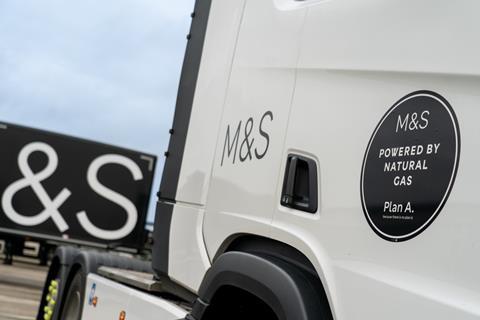
What makes this move particularly compelling is that it acknowledges the realities of heavy transport. Fully electric HGVs remain constrained by battery weight, charging times and infrastructure limitations, especially at 44‑tonne gross vehicle weight. Hydrogen, while promising, is still expensive and lacks the refuelling network required for large-scale adoption. Bio‑CNG, by contrast, is available now, compatible with existing logistics models and supported by a growing UK infrastructure.
Behind this partnership is a quieter story about expertise and collaboration. Scania’s involvement goes far beyond delivering trucks. The manufacturer has worked closely with M&S to align vehicle specification, fuel supply, infrastructure and total cost of ownership. That kind of systems thinking is essential if decarbonisation is to move beyond pilot projects and into everyday operations.
A key figure in this process is Simon Gray, Scania UK’s specialist sales manager, whose background in engineering and previous work on fleet transition at John Lewis gives him credibility on both technical and commercial grounds. His insight reflects a truth often missed in sustainability debates: cutting emissions only works if it also works economically. Fleets must remain reliable, drivers must be confident in the vehicles, and operators must understand maintenance, resale and fuel costs.
The trucks themselves show how far gas technology has come. Scania’s latest OC13 gas engines deliver diesel‑like performance, with up to 460 horsepower and torque curves tuned to bring power in earlier. Combined with components from Scania’s highly efficient Super diesel powertrain, the result narrows the performance gap between diesel and gas to a point that would have seemed ambitious just a few years ago.
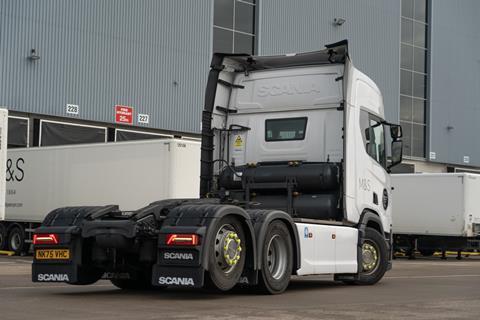
Crucially, changes to EU and UK vehicle dimension regulations have unlocked new configurations, including a 6x2 gas tractor capable of operating at 44 tonnes. This removes one of the last major barriers to gas adoption for long‑haul and trunking operations. With extended cabs, aerodynamic improvements and additional gas tanks mounted behind the cab, these trucks can now exceed 450 miles on a single fill while remaining manoeuvrable thanks to rear‑steer axles.
Infrastructure, often cited as the Achilles’ heel of alternative fuels, is also being tackled head‑on. While the UK’s compressed gas refuelling network is still modest compared to diesel, it is expanding along major arterial routes. More importantly, M&S has partnered with CNG Fuels to deploy mobile refuelling stations at distribution centres, providing on‑site capacity to fuel hundreds of trucks daily. That removes uncertainty for planners and drivers alike.
This points to a wider lesson for UK logistics: decarbonisation accelerates when fuel supply, vehicle technology and customer demand move in step. The growth of biomethane production, derived from waste such as food residues and agricultural by‑products, strengthens the environmental case further. It also keeps fuel production domestic, improving energy resilience while cutting emissions.
None of this suggests that gas is the final destination for road freight. Rather, it is an effective bridge. Scania itself is clear that reaching net zero will require multiple technologies operating in parallel over time. But bridges matter. They allow businesses to cut emissions now rather than waiting for perfect solutions tomorrow.
In that sense, M&S’s move deserves attention not because it is radical, but because it is realistic. It shows what can be achieved when ambition is matched with engineering, policy support and commercial sense. As pressure mounts on the freight sector to clean up its act, the companies that make meaningful progress will be those willing to choose workable solutions, invest in partnerships and accept that decarbonisation is a journey, not a single leap.
For UK logistics, this deal is not just about new trucks. It is about momentum—and momentum, in the race to net zero, may matter most of all.