










![Mercedes-Benz_eActros_600_(1)[1]](https://d2cohhpa0jt4tw.cloudfront.net/Pictures/274x183/8/1/8/17818_mercedesbenz_eactros_600_11_556244.jpg)




The case for battery swapping isn’t speed—it’s what those batteries do between truck visits. With CATL running 305 stations in China and UK trials underway at MIRA, the model is being reframed as energy trading infrastructure that happens to serve trucks. But OEM alignment and station economics remain unresolved.
The framing on battery swapping is almost always about refuelling speed. Five minutes instead of an hour. That comparison works as a pitch. It doesn’t tell you much about whether the model holds together.
The real argument isn’t speed. It’s what those batteries do when they’re not in a truck.
A swap hub holding a reserve of charged packs has hours to recharge each one between truck visits. The station charges when power is cheap, tracks renewable generation profiles, and can offer flexibility back into the grid. Forced half-hour megawatt demand becomes a several-hour managed load. Framed that way, a swap hub is an energy trading and grid infrastructure product that happens to serve trucks, and that’s the rationale the serious players are building on.
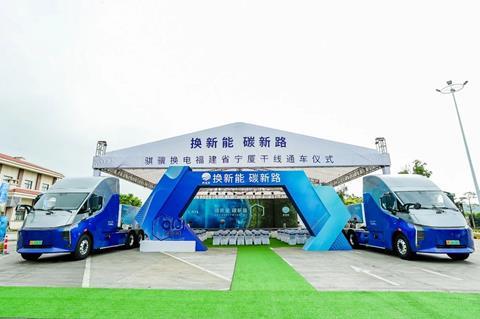
CATL has demonstrated it works at scale. Their Qiji Energy division runs 305 heavy-truck swap stations in China, compatible with over 30 truck models from more than ten manufacturers, using a standardised 171 kWh block the fleet never owns. The operator buys the chassis at roughly diesel truck cost, pays per kilowatt-hour, and CATL charges flexibly, captures the energy arbitrage, and sets it against station capital. Per their figures, operators save around 60,000 RMB (~£6600) per 100,000 km against diesel.
This isn’t theoretical in the UK either, which is what made me look at it again. Octopus Energy and CATL are working on swap robotics and type approval at MIRA, targeting the high-density logistics corridors where trucks already congregate, with a stated aim of live network nodes by the end of 2027. Separately, Aegis Energy is in a feasibility study led by Imperial College London alongside Zeti, working through what the swap proposition means for commercial fleets rather than assuming it. One side is building, the other is assessing. Both are serious, and that’s the bit that should give a sceptic pause.
So here’s the case, properly.
It starts with standardisation. Swapping only scales if multiple OEMs accept the same battery form factor. CATL forced that in China through sheer dominance. No European equivalent exists, and European OEMs have been explicit: megawatt charging, not battery pooling. Every manufacturer has legitimate reasons to optimise its pack for its own vehicle.
But the counter holds more weight than it used to. Chinese OEMs are entering Europe. And for captive, high-utilisation applications, broad alignment isn’t needed. One manufacturer willing to supply a swap-compatible chassis, one operator running a defined route, one energy provider owning the battery pool. That’s enough for a specific site. Standardisation is the blocker for a public network. For port drayage or an aggregate shuttle, it’s just a procurement decision.
The harder objection is engineering direction. Cell-to-pack and cell-to-chassis designs integrate the battery as a structural, load-bearing element, gaining energy density and cutting cost at the price of making the pack physically inseparable from the vehicle. Daimler, Volvo and Scania are heading that way. It isn’t a commercial stance against swapping; it’s the architecture that wins on its own merits, and a drop-out pack runs straight against it.
One distinction matters more than any of this, because most coverage gets it wrong. Treating the battery and chassis as separate financial assets does not require physical swapping. The operator buys the truck without owning the battery, pays per kilowatt-hour, and the energy provider handles health monitoring and second-life. All of that works with a cable. The financial logic of asset separation belongs to battery-as-a-service generally, not to swapping. Physical swapping adds exactly two things: fast refuelling, and the ability to recharge the packs slowly and flexibly at the hub. If your duty cycle has overnight dwell time, you get most of the BaaS upside without ever building a station.
Which brings it back to the UK, where the honest answer is that nobody knows. The charging mix is unresolved and will stay that way for years. Depot charging hits a wall the moment the grid connection won’t come, and for most large fleets that’s well before the last truck is electric. Shared hubs depend on someone funding the site and the demand turning up. Opportunity charging needs a network that barely exists. MCS needs a corridor build-out that’s years off. Each has advocates who’ll tell you it’s the answer. None of them is, on its own. The reason battery swapping is back in the conversation isn’t that it’s proved itself, it’s that the alternatives haven’t closed the gap. Anyone telling you the model is settled, in either direction, is selling something.
The engineering is genuinely impressive. Swapping three 171 kWh packs from a laden artic in five minutes is a hard robotics problem, solved at industrial scale. The grid flexibility model, viewed as a system, is elegant. Neither fact resolves the OEM alignment question or the station economics. But they’re reasons to watch closely, not to write it off.
The objections to battery swapping haven’t gone away. Neither has CATL.
Jamie Sands, head of solutions, Welch Group