







![Mercedes-Benz_eActros_600_(1)[1]](https://d2cohhpa0jt4tw.cloudfront.net/Pictures/274x183/8/1/8/17818_mercedesbenz_eactros_600_11_556244.jpg)





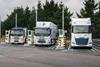
Battery-electric truck demand accelerated sharply in 2025, even as the wider HGV market contracted amid economic headwinds.
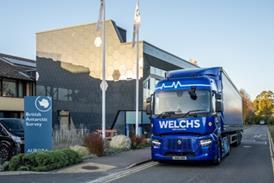
Latest figures from the Society of Motor Manufacturers and Traders (SMMT) show new zero-emission HGV registrations rose 170.5% year-on-year, with demand in the fourth quarter alone up 251% compared with the same period in 2024.
The surge takes the UK past 1,000 cumulative zero-emission truck registrations — a symbolic milestone for a sector still in the early stages of decarbonisation.
However, the headline growth in electric volumes sits against a shrinking overall market. Total new HGV registrations fell 10% in 2025 to 40,504 units, with every quarter recording a year-on-year decline. SMMT attributed the slowdown to a “challenging economic backdrop” and a levelling-off following three years of post-pandemic fleet renewal.
Tractor unit demand slipped 4.4% to 17,758 units, although the final quarter delivered a modest 6.9% rebound, leaving artics accounting for 43.8% of the total market. Box van registrations saw the sharpest decline, down 28.1% to 3,949 units, while tipper and curtain-sider volumes dropped 11.1% and 26.2% respectively. Refuse collection vehicles were a rare bright spot, up 22.6% to 2,459 units.
Against that backdrop, zero-emission trucks still account for just 1.4% of new registrations — equivalent to one in every 71 HGVs entering service — underlining how early the transition remains.
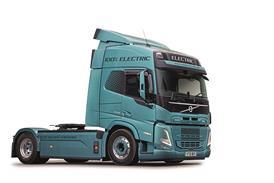
SMMT pointed to a growing range of available products, with 21 zero-emission truck models registered last year across multiple duty cycles, alongside enhanced public grant support. But it warned that structural barriers continue to dampen wider adoption.
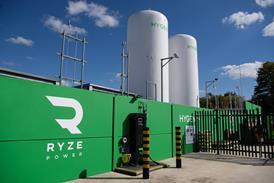
Operators, it said, face tight margins and significant uncertainty around infrastructure readiness. In some cases, depot-to-grid connection delays stretch as long as 15 years — a timeframe widely viewed as incompatible with commercial fleet planning.
Looking ahead, SMMT said improvements to the Plug-in Truck Grant and the introduction of a Depot Charging Scheme last July should provide further impetus. However, without faster grid connections and streamlined planning processes, uptake risks stalling before it reaches mass-market scale.
SMMT chief executive Mike Hawes said innovative new vehicles are helping stimulate demand, but warned that infrastructure reform is now critical to unlocking sustained growth in zero-emission HGV adoption.
For the freight sector, the data presents a clear dual narrative: a cooling diesel market shaped by economic constraint, and a fast-growing — but still nascent — zero-emission segment waiting on the grid to catch up.