







![Mercedes-Benz_eActros_600_(1)[1]](https://d2cohhpa0jt4tw.cloudfront.net/Pictures/274x183/8/1/8/17818_mercedesbenz_eactros_600_11_556244.jpg)




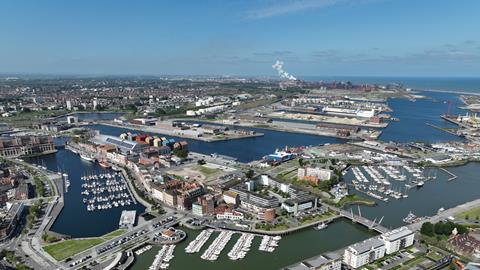

The Port of Dunkirk is anticipating installation of new charging points for trucks at and around the site, as well as passenger vehicles and ferries, although numbers will remain low this decade.
Dunkirk celebrates its 60th anniversary this year, with a plan for the port and the surrounding area in the next five years that could see areas transformed into clean energy assets. The port area aims to be an energy hub, with “a unique combination of low-carbon electricity production, distribution and security capabilities, supporting the region’s energy transition and economic development”.
In an introduction to its transformation project, the Port of Dunkirk said it had to adapt its infrastructure and model to respond to “changes in maritime trade, industrial and energy transitions, and societal expectations”. The strategic project “is driven by a need to diversify activities at and around the port, value-added logistics and industrial solutions, and rising sectors such as mobility, sustainable maritime transport and low-carbon energies”.
Sébastien Ghesquière, Operations Director of the Port of Dunkirk, said the port’s electric vehicle initiatives, which include light and heavy vehicles and shipping “are fully aligned with Dunkerque-Port’s 2025-2029 strategic plan, which identifies sustainable mobility and decarbonisation as key structural priorities”.
Charging Infrastructure for Heavy Goods Vehicles
The port said the plan extends to heavy road transport. Ghesquiere said that the first concrete example is the local carrier Bogaert, which has invested in electric trucks that are recharged at its site in the western port area. Bogaert currently operates five electric trucks and five charging stations at the Port Ouest.
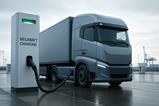
In the next step operator MOOCOO is developing a two-hectare service and waiting area for truck drivers in the western port. Commissioning is scheduled for 2027-2028. The site will include charging stations for electric heavy goods vehicles, described as “a strategic asset particularly for cross-Channel traffic, and especially for the Dunkerque-Rosslare route”. It will include ten ‘fast’ truck charging stations for trucks (400kWh) and 10 ‘slow’ truck charging stations for trucks (200kWh).
Meanwhile the port is progressing other electric mobility sectors. It has committed to ensuring that the port traction service is fully electric by 2027.
The port is progressively expanding its network of charging stations for passenger electric vehicles and light vans. Infrastructure has already been made available to companies operating within the port area, as well as to government services including the French and British border police. Other operators, such as pilotage services, have also expressed interest, and their requests are currently under review. To date, 10 charging stations with 16 charging points are operational.
At the same time, the port is gradually converting its own vehicle fleet, and installing suitable infrastructure across the port area for both employees and port operators. The objective set out in the strategic plan is to double capacity by 2029.
The energy transition also extends to maritime transport. The port is supporting the shipping company DFDS in the progressive deployment of fully electric or hybrid vessels by 2030.
This requires new electrical infrastructure, to support a capacity of 40MWh at two berths dedicated to the Dunkirk-Dover cross-Channel route (3 and 6). The objective is to enable vessels to recharge during port calls, which last on average around one hour.
Two RoRo berths (4 and 7), currently dedicated to unaccompanied freight transport to the British Isles, are also being upgraded in partnership with DFDS. Two 6MWh connections will be installed, with completion planned by the end of 2027 for berth 3 and by the end of 2028 for berth 7. These will allow vessels to be supplied with electricity during port calls lasting between 10 and 24 hours, thereby avoiding the use of auxiliary engines and significantly reducing CO₂ emissions while at berth.
This significant additional electricity capacity at the port and restructuring of parts if te port network raise the question of whether the electricity supply could be accessed for other charging (ie trucks). However the port said that for this installation the berths’ “future level of occupancy will not allow this capacity to be shared”.
Industrial plan
The Port’s EV plans complement industrial initiatives in the region, several of which are centred on electric vehicles, such as new ‘gigafactories’ to manufacture batteries for electric vehicles.
The first operational gigafactory in the Dunkirk area and the third in the region was inaugurated in December. Mid 2026 is expected to see work begin on another Gigafactory, for Taiwanese group ProLogium, which specialises in solid-state batteries.
A potential SUEZ Group project would be dedicated to the recycling and recovery of critical metals from electric batteries.