










![Mercedes-Benz_eActros_600_(1)[1]](https://d2cohhpa0jt4tw.cloudfront.net/Pictures/274x183/8/1/8/17818_mercedesbenz_eactros_600_11_556244.jpg)





In an unprecedented show of unity at IAA Transportation, the CEOs representing 97% of the European commercial vehicle market warned that electric truck uptake stands at just 2% against a 35% target by 2030 — and that OEMs alone cannot be penalised for systemic failures in infrastructure and policy support.
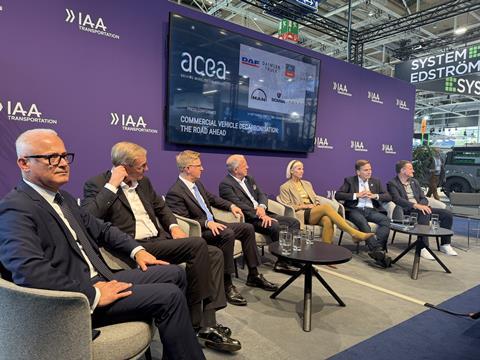
Europe’s leading truck manufacturers have called for the EU’s 2030 CO2 compliance deadline to be delayed by three years, warning that the conditions needed for operators to switch to zero-emission trucks are developing far too slowly.
In an extraordinary show of unity at IAA Transportation in Hanover, the CEOs of all seven ACEA commercial vehicle members appeared together to argue that manufacturers have delivered the vehicles needed for the transition, but charging infrastructure, grid connections and the financial case for operating them are lagging behind.
Together, the manufacturers represent 97% of the European commercial vehicle market.
Speaking on behalf of the group, Daimler Truck CEO and ACEA Commercial Vehicle Board chair Karin Rådström said manufacturers remain committed to decarbonisation, but warned there is now an enormous gulf between electric truck sales and the level required to meet the 2030 targets.
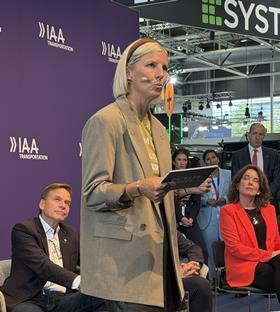
More than 60 zero-emission truck models and 25 zero-emission bus models are already available in Europe. Despite this, just 2% of heavy-duty trucks registered last year were electric, rising to 2.4% during the first half of 2026.
ACEA says 35% of newly registered trucks will need to be zero-emission by 2030 to meet the current CO2 targets.
“Jumping from 2% today to 35% in just three and a half years is an enormous challenge,” said Rådström.
She identified infrastructure and cost parity with diesel as the two principal barriers.
Grid connections for truck charging sites can currently take up to seven years in some parts of Europe, while the EU’s Alternative Fuels Infrastructure Regulation (AFIR) calls for 20,000 truck-dedicated charging points by 2030.
According to ACEA, fewer than 2,000 suitable heavy-duty charging points are currently available. Since AFIR was agreed in 2023, installation has been progressing at the equivalent of about 50 chargers a month. To hit the target, Rådström said this must increase tenfold to around 500 a month.
“Customers need infrastructure,” she said. “They need to know that they can charge or fuel the vehicle when and where they need to. They need access to the grid.”
ACEA also argues that operators cannot reasonably be expected to replace diesel trucks unless electric vehicles offer a viable total cost of ownership.
Measures to close the gap could include CO2-based road tolling and targeted incentives. However, only 13 of the EU’s 27 member states have introduced CO2-based tolls, and fewer than a handful provide what ACEA regards as a meaningful cost difference between diesel and electric trucks.
“Infrastructure and TCO will determine whether a customer buys an electric truck or a diesel truck or bus,” said Rådström. “It’s as simple as that.”
The manufacturers’ frustration centres on the fact that many of the factors determining electric truck uptake are outside their control, yet OEMs alone face financial penalties if the CO2 targets are missed.
“Imposing penalties will not solve the problem,” said Rådström. “Penalties will not build a single charging station. It will not make energy cheaper or e-trucks more profitable.”
For Daimler Truck, the potential fines could be “absolutely existential”.
Rådström said every percentage point by which Daimler Truck misses its target could result in a penalty of around €120m. A 10 percentage-point shortfall could therefore mean a €1.2bn penalty, roughly equivalent to Mercedes-Benz Trucks’ entire global earnings in 2025.
ACEA believes the “enabling conditions” required for the transition are already at least three years behind schedule and wants the 2030 compliance deadline moved to 2033 unless progress accelerates dramatically.
The manufacturers stressed that this is not an attempt to abandon the transition to zero-emission transport.
Scania and TRATON CEO Christian Levin, former chair of ACEA’s Commercial Vehicle Board, said nobody would be happier than the manufacturers if the required electric truck volumes were achieved in 2030, 2031 or 2032.
“We don’t want to sit with our half-empty factories, with our over-invested balance sheets, with potentially stranded assets,” he said. “The fine thing has to get off the table.”
The CEOs were also challenged over growing competition from Chinese truck manufacturers, which have a significant presence at this year’s IAA.
They said any changes to the CO2 rules should not be used to protect European manufacturers from competition, but called for a level playing field.
Asked specifically about possible trade measures against Chinese truck imports, Rådström said the seven manufacturers had no common position, adding: “All of us are for a level playing field, and none of us are in favour of measures that limit trade.”