








![Mercedes-Benz_eActros_600_(1)[1]](https://d2cohhpa0jt4tw.cloudfront.net/Pictures/274x183/8/1/8/17818_mercedesbenz_eactros_600_11_556244.jpg)



With eHGV uptake flatlining, subsidy support fading and infrastructure barriers unresolved, Turntide Technologies CEO Steve Hornyak makes the case for range-extending hybrid powertrains as a commercially viable route to decarbonisation — while the government’s HGV CO2 consultation response looms large.
The business case for eHGVs hasn’t yet started stacking up in the way some hoped it would to stimulate the market. In increasingly challenging economic times, faced with uncertainty about the reality of achieving net zero targets, switching to electric trucks seems like a huge hurdle that’s fraught with far more complexity than the car or LCV sectors.
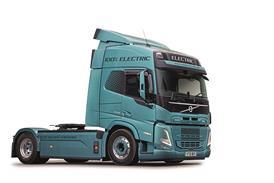
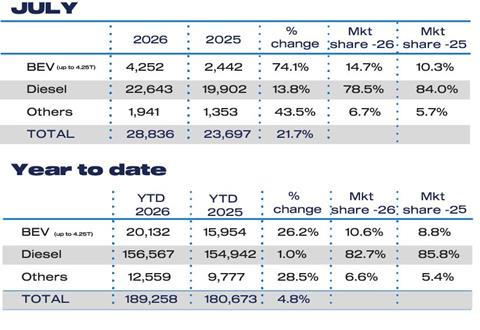
Electric vans have seen the greatest progress, with the SMMT reporting record market share of 10.6% in year-to-date figures so far, but this still falls short of mandated target levels at 24%. In comparison eHGV market share this year currently stands at 0.9% with registrations in Q2 up by 4.7% accounting for 90 trucks.
“After three bumper years of fleet renewal, the HGV market is now under pressure,” says Mike Hawes, SMMT chief executive. “The fact that zero emission truck uptake is outperforming the market is a crumb of comfort but at less than 1% of the market it is not a cause for celebration.
“Government support has helped incubate this emerging market, but if the sector is to decarbonise at pace, operators need confidence – and that means addressing key barriers to investment and a technology-neutral approach that recognises the diversity and complexity of HGV use.”
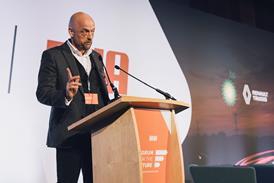
What this technology-neutral approach could look like is vast and varied. While the government is focusing on zero tailpipe emissions solutions like battery electric vehicles (BEV) and hydrogen fuel cell electric vehicles (FCEV), low carbon technologies include CNG and LNG-powered engines and HVO. Steve Hornyak, CEO of the electric motor manufacturer,Turntide Technologies argues the industry has skipped over a key powertrain option - hybridisation.

“There’s been a lot of pressing and pushing to go straight from ICE over to BEV and there’s significant limitations in BEV,” Hornyak says. “The larger and heavier duty the truck gets, it gets significantly harder to do. It’s cost, range, charging infrastructure and speed of charging. I think the biggest opportunity in commercial vehicles is to go back to the area that was skipped: hybridisation.
“I’m a big proponent of ‘and’ not ‘or’, so it’s going to be ICE and hybrid and full BEV and it’s going to coexist for a long time. I don’t think ICE is going anywhere any time in the near future.” Even in the next 10 to 15 years, Hornyak believes ICE will still have a role to play for certain applications. “One of the main reasons why I joined Turntide was I saw a massive gap in where the market jumped over what it shouldn’t have jumped over and is now rushing back,” he adds.
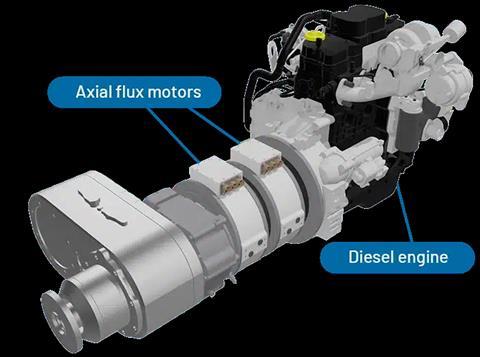
In theory, hybridisation can address a number of limitations of fully electric platforms, namely weight, cost and eliminating the need for charging infrastructure. “Axial flux motors are incredibly energy dense and smaller in size, so you can fit them into existing platforms versus having to re-engineer entire platforms,” Hornyak says.
He notes that OEMs can leverage existing ICE platforms and add an electric motor and small battery into the mix rather than needing to develop a hybrid-specific architecture which helps to keep integration costs and development time to a minimum. Weight can be managed to a certain extent by using a smaller diesel engine.
Unlike plug-in hybrid solutions found in cars and vans, Hornyak suggests a range-extending hybrid configuration. The diesel engine acts as an on-board generator to charge a battery pack and the wheels are driven by an electric motor. This solution offers the benefits of electric driving such as regenerative braking, instant torque and acceleration and quieter running but doesn’t limit the vehicle’s range to its battery capacity.
“The people that are driving electric vehicles in the field love them but it’s just making it where it’s economically feasible to deploy at scale – economic feasibility being the key thing,” Hornyak says. “Companies are not going to make moves that impact their shareholder value en masse.”
A range-extender system is fuel agnostic to the onboard generator which could be powered by diesel, HVO, LNG, CNG, hydrogen ICE, hydrogen fuel cell or any other emerging fuel type. Since the engine is not driving the wheels, its operating domain can be optimised for fuel efficiency rather than addressing peaks in the truck’s power demand.
Depending on the size of the battery used, the vehicle would have an electric-only range which could be utilised in urban areas, for example. In stop/start work, urban and regional haulage, range extending technology could help fleets to benefit from electrification without needing to invest in charging infrastructure or limit vehicles to dedicated routes.
This is of course the technology Tevva Motors initially proposed before dropping the idea in favour of BEV and ultimately collapsing into adminsitration.
But Hornyak sees hybridisation as a part of the long-term powertrain mix and is also excited about its near-term viability. He says: “There’s evolutions and revolutions happening. I love revolutions and I want to be part of that. Evolution typically takes a long period of time, the revolution being a shorter period of time where we can leverage existing platforms but get them to be more efficient with an ROI of two to three years.
“Take these current platforms and modify them from a pure ICE into a hybrid vehicle and your operating costs drop radically because you’re using less fuel and electric moving parts in a vehicle are incredibly easy and lower cost to maintain. Since you’re not using the engine all the time and when you are, it’s typically running in an idle mode, you’re going to radically decrease the amount of overall maintenance and wear and tear on that system and extend its life.”
While mainstream truck manufacturers remain committed to ICE, BEV and hydrogen powertrains, suppliers like Turntide Technologies believe hybrid could be a viable bridging solution but its regional success will depend on local legislation. As yet, the UK government hasn’t budged on its commitment to zero tailpipe emissions but with the EU softening its ZEV mandate, there could be changes on the horizon.
Earlier this year, in the “new HGV CO2 emissions regulatory framework for the UK“ consultation, questions posed to the industry seemed to lack the flexibility many fleets are calling for to allow them to decarbonise through multiple means such as low carbon fuels and carbon reduction thresholds. The government’s response to the consultation has yet to be published but it’s expected to give an insight into whether any leniency might be on the cards.
“Europe has always been ahead of the US relative to battery electric technology,” Hornyak says. “I think in this instance the US will be ahead based on creative hybridisation approaches in various applications and then ultimately the UK will adopt it.”
Since government subsidies for electric trucks have dried up in the US, fleets have pulled back on eHGV investment. “If companies want to be green conscious, they’re going to make sure they’re also being green conscious from an internal balance sheet and P&L perspective,” Hornyak adds. “It’s got to be green for the economy and green for the environment. Without being green for your personal economy as a business, unless someone is subsidising that, companies just won’t do it.
“The massive win is that delicate balancing act between green for the environment and green for the company’s economic value of deploying these vehicles. Those that are able to meet that balance where BEVs cannot meet it today will start grabbing market share away from pure ICE.”
HGV registration figures for 2025 and 2026 show the influence of government funding through the likes of the ZEHID project and plug-in truck grant. Compared to last year, eHGV registrations were down 6.6% in the first half of the year, since early last year saw a flurry of activity linked to ZEHID consortia getting their vehicles on the road. While the plug-in truck grant has helped some operators to invest in more vehicles, external factors like energy prices, grid connection timelines and limited public charging availability present challenges which fall outside of the scope of grant schemes.
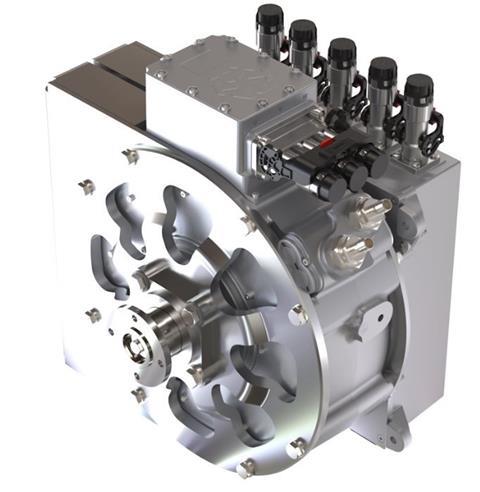
As some of the wider barriers to electrification are being addressed, there are opportunities beyond traction applications where electric motor technology can help to reduce emissions. “A lot of times where a PTO is needed, you’re closer to people or areas that from an environmental perspective, it would be much better to be able to run that in a quiet mode with an ePTO,” Hornyak says.
For the likes of refuse applications, truck-mounted cranes and tippers with grabs, ePTOs minimise the localised impact of engine idling and offer a more energy efficient solution than a traditional hydraulic setup. Again, the compact packaging of an axial flux motor makes it well suited for an ePTO and auxiliary battery size, if needed, can be configured to suit energy demands from on-board equipment.
ePTOs can be paired with diesel, hybrid or BEV powertrains with slight tweaks made depending on which battery the system will use. Turntide Technologies is also agnostic when it comes to battery technology and Hornyak remains hopeful for improved battery characteristics in the coming years. He says: “The batteries are getting there. Over the next five to 10 years, you’re going to see another titanic shift in speed of charging, cost, weight, size, etc. It’ll continue evolving.”
Despite expected advancements in battery technology, Hornyak believes fleets will end up adopting multiple powertrains. “There’s going to be applications that pure BEV is going to be great for, there’s going to be applications where you’ve got to keep using ICE,” he says. “Even within fleets you could see BEV, hybrid and ICE living harmoniously depending on the use case of that specific vehicle for that specific customer.”
Outside of technical feasibility, if unresolved, infrastructure, weights and dimensions and cost will continue to hinder the progress of BEV solutions. The RHA’s payload loss survey report, for example, highlights the knock on effect of restricted payloads which currently cut into the profitability of eHGVs. As a result, the RHA is calling on the government to introduce a 2-tonne derogation on 44-tonne combinations and increase drive axle limits from 10.5-tonne to 12.5-tonne to help alleviate the financial pressure on eHGV operators.
“I think that until it gets to a normalised rate where there’s enough high-speed charging infrastructure and the cost of purchasing eHGVs becomes reasonable from a P&L perspective, you won’t see massive adoption in large heavy-duty vehicles,” Hornyak says. “I do think there’s an opportunity in those vehicles for on-board range extension.”
For now, regulation and innovation are competing in an economic environment that makes any form of risk highly unattractive. The future fuel mix in the UK will depend on how decarbonisation is defined and what, if any, carbon reduction milestones are set out along the way. The consultation response could be a pivotal point to provide the certainty that fleets are looking for but ultimately, market forces must fall into place to allow the organic growth of alternative powertrains.