











![Mercedes-Benz_eActros_600_(1)[1]](https://d2cohhpa0jt4tw.cloudfront.net/Pictures/274x183/8/1/8/17818_mercedesbenz_eactros_600_11_556244.jpg)




With the ZEV Mandate requiring 33% zero-emission van sales this year and public charging still unevenly distributed, Formula Space’s Ruben Pollard sets out three targeted policy interventions that could unlock faster fleet electrification without open-ended public spending.

The UK’s net zero plans rely significantly on the continued adoption of EVs and the electrification of fleets. A strong public charging landscape matters, when drivers know they can charge reliably wherever they live and travel, they have the confidence to make the changeover to EV, and more of them switch.
However, the UK’s Zero Emission Vehicle (ZEV) Mandate, the legally binding rule that requires van makers to sell a yearly increasing percentage of zero-emission vehicles, has a headline target for this year of 33%, and there’s increasing concern that the market alone cannot deliver everything we need to hit our upcoming low emission targets.
It’s time for the government to step up and deliver where commercial businesses will not. And here are three key areas to start in.
Fill the gaps in the map
The UK’s public charging network is still growing, but unfortunately not evenly. Charge point operators (CPO) are commercial businesses operating in a competitive marketplace, and they site chargers where utilisation, and therefore return, is highest. In practice, this means fewer charging options and longer distances between chargers for van drivers in rural areas.
If drivers can’t trust the charging network where they live, or where they regularly travel, they won’t switch to an EV. And there’s a snowball effect. The places with the least charging never generate the demand that would justify a CPO investing more effort and money – so they don’t.
Temporary funding is a well-documented approach to charger gap-filling. With ChargePlace Scotland, the Scottish government became its own operator and built chargers wherever they were needed. It then sold the network as a package, with a buyer taking on the remote sites as well as the busy ones. In Norway, the state paid a number of CPOs, sometimes the full cost, to build and run rapid chargers where none existed within a set distance. A condition of the payment was a clear agreement about when financial support would end, which was effectively once the market could stand on its own.
For the UK, a tendering model led by government or local councils would be a practical approach. A council identifies where it needs, say, 10 chargers, and proposes to cover 50% of the cost. If no operator bids, the offer rises, so public money buys only the support each location genuinely needs. Eligibility could rest on a benchmark of chargers per electric vehicle, so every district has a target.
Fund the connection, not just the charger
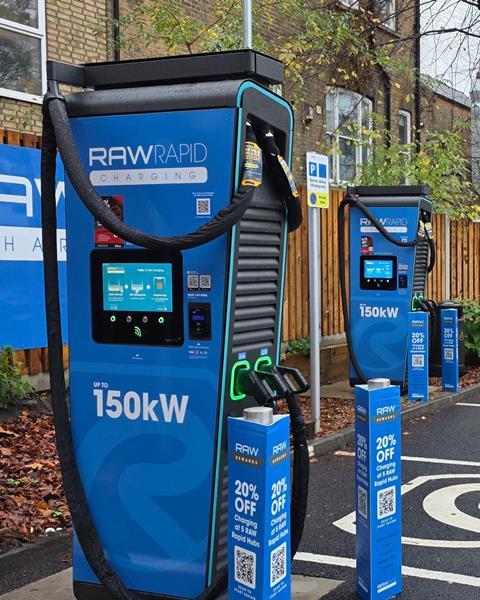
Grid access is often a real barrier to high-power charging. For example, the Depot Charging Scheme funds up to 70% of charger and installation costs, but not the electrical network connection. That sits in a queue with a 12- to 36-month timeline, and reinforcement costs (to upgrade the local network so it can carry the extra power a high-power charging site needs) can reach six to seven figures and fall on the operator.
The government could choose to fund grid connection, and reinforcement for high-power charging, with regional timelines and costings. One option is to make reinforcement an optional layer within the Depot Charging Scheme, so applicants who need it can claim it and those who don’t are unaffected.
Europe offers other useful models for the UK to consider. Germany’s federal motorway company orders grid connections at rest areas in parallel to the tender process for charger installation, so that charging can start sooner. Winning bidders access these connections under a separate contractual arrangement.
Charging schemes in the Netherlands have previously offered additional funding for on-site battery storage. This helps manage grid capacity limits, with the batteries charging while the grid has headway and powering vehicles when it is stretched, as a workaround for congestion.
Put electrification obligation on fleets, not just manufacturers
The ZEV Mandate requires manufacturers to sell increasing numbers of low emission vehicles. The government has also committed to making its own van fleets fully zero emission by the end of 2027. But there is currently nothing that obliges people – or private fleet operators – to do the same.
The result of this is that demand for depot charging is voluntary. Yet some fleets are ideal candidates for electrification: vans that rarely stray more than 20 miles from base can charge overnight at the depot and head out again in the morning.
Fleet incentives already exist, but an incentive can be ignored; a mandate can’t. Amending the ZEV Mandate to put the obligation on the fleet as well as the manufacturer would make electrification the default, and we may see fleet electrification accelerate.
France shows how this can work. Companies with more than 50 employees and 100 light goods vehicles face rising quotas for low-emission vehicles, calculated on purchase or renewal. If the company falls short, it pays a penalty for each vehicle it should have bought, but didn’t. The quotas rise, and the penalties increase, every year.
The backing the UK needs
Filling the gaps in the map, funding the grid connection and putting an obligation on fleets all do the same job: they back the EV transition where the market alone will not. None needs open-ended spending. Each can be targeted, time-limited and measured by the extra EVs it delivers per pound. With the Budget approaching, that is the test government should apply, so drivers in every region can switch with confidence.
Policy takes time, and CPOs need to deliver for their customers now. Formula Space helps by acting as a single point of contact for the physical side of a charging site, from design and infrastructure to ongoing maintenance, so chargers reach drivers sooner. F
Ruben Pollard, director of strategic partnerships, Formula Space