


![Mercedes-Benz_eActros_600_(1)[1]](https://d2cohhpa0jt4tw.cloudfront.net/Pictures/274x183/8/1/8/17818_mercedesbenz_eactros_600_11_556244.jpg)



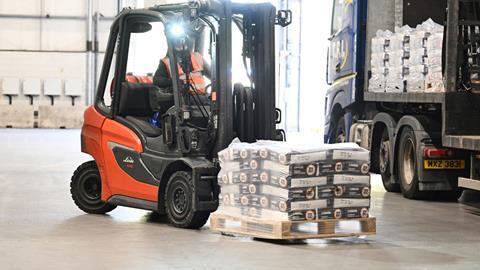

Wolverhampton-based Pallet-Track has switched its entire fleet of forklift trucks to run on BioLPG, in a move which has delivered a “significant” cut in carbon emissions, the pallet network announced this week.
The company has switched the 150-strong forklift truck fleet from liquified pertoleum gas (LPG) to BioLPG - a renewable gas made from organic waste, sustainable plant materials, and used cooking oils.
Pallet-Track said the move has cut the fleet’s CO2 emissions by 84%, saving a forecasted 1,376 tonnes of CO2.
The pallet network added that the impact of the change has already cut the company’s entire operational carbon footprint by 15.25%, based on its current emissions.
The changes have been delivered in partnership with Calor Gas and form part of Pallet-Track’s new Environmental, Social and Governance (ESG) strategy.
Pallet-Track has committed to achieving multiple targets by 2028, including reducing absolute Scope 1 and 2 greenhouse gas (GHG) emissions by 35% and reducing and/or offsetting Scope 3 transport emissions by 20%.
The company said it aims to meet these targets through major investments in its fleet and alternative fuels.
Stuart Godman, Pallet-Track chief executive, said the conversion of the FLT’s was a positive step which could be completed without the need for costly vehicle modifications.
He added: “When we unveiled our ESG strategy, we made a firm commitment to taking swift action so our ambitions would be quickly realised.
“This is why we set short-term targets, as our 2028 goals are designed to have an immediate effect.
“With the switch of the FLT fleet to BioLPG, we are genuinely aiming to reduce emissions rather than just offsetting them.
“Offsetting has its place, but it is easy to spend money on tree planting without truly reducing emissions.
“We believe having a positive environmental impact is equally, if not more, important.”
Godman said the decision to switch to Calor’s BioLPG tariff rather than electric power was taken with the bigger picture in mind.
“Converting to electric can theoretically yield higher savings, but infrastructure challenges and operational difficulties can reduce its impact.
“You need to review the entire supply chain if you have electrification in mind,” he added.
Alastair Lovell, Calor head of sustainable fuels, said: “Our focus has been on making the transition as smooth and practical as possible, while helping the team take a positive step towards reducing emissions across its operations.
“For a busy logistics business, it’s important that any change works day-to-day, and this project demonstrates how sustainability improvements can be delivered in a way that’s both effective and operationally realistic.”
Kirsty Cox, Pallet-Track head of ESG and strategic projects, said: “The switch of our FLT fleet is the first major stepping stone on our ESG journey.
“It has made an immediate impact to our carbon emissions – but we’re only really getting started.”