





![Mercedes-Benz_eActros_600_(1)[1]](https://d2cohhpa0jt4tw.cloudfront.net/Pictures/274x183/8/1/8/17818_mercedesbenz_eactros_600_11_556244.jpg)





The food sector can be an important player in transport system decarbonisation, the Institute of Grocery Distribution (IGD) says in a recent review. IGD said companies in the food system should engage with broader programmes for electric vehicles and plan for their widespread uptake, subject to policies being in place, from the early 2030s.
IGD chief executive Sarah Bradbury said the group commissioned the Food System Net Zero Transition Plan “as an independent, evidence-based review built from the broadest, most robust and proven data available, to align the conversations and progress”. The analysis was conducted by consultants EY with the support of specialists at the Scottish Rural Agricultural College and global environmental organisation WRAP.
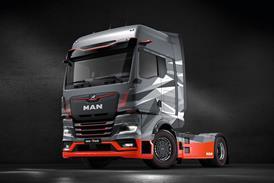
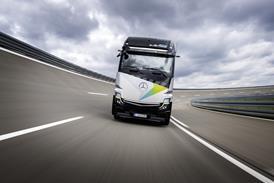
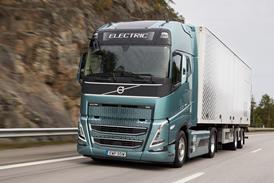
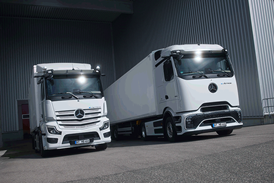
The review said that in the transport part of the food system, emissions are primarily driven by heavy goods vehicles (HGVs) transporting goods between farms, factories, distribution centres and retail outlets. As the transport sector moves towards decarbonisation, the role of low-carbon HGVs in the food industry’s net zero strategy becomes increasingly prominent.
It says transitioning HGVs to cleaner energy sources “is a key pillar of broader food system decarbonisation” and would eventually be via electric (and possibly hydrogen) vehicles.
However, the report said there are two phases to the HGV low-carbon transition: “the first occurs in the short-term and is driven by efficiency gains; the second occurs over the medium and long-term and is due to switching from conventional to low-carbon vehicles”.
The activities highlighted in the first phase are incremental changes, although they require coordination across the industry and a programme of action. The review anticipates a 10% reduction in HGV emissions from new vehicles between 2020 and 2030, due to advances in fuel efficiency, translating to a fleet average efficiency improvement of around 7.5% due to the industry’s five-year vehicle turnover rate. It says this might be complemented by “niche use of biofuels”, but it notes these are more expensive than alternatives and are unlikely to be a long-term solution, “given lack of feedstocks and relatively high value of these in other sectors”.
Meanwhile, the review says logistics fuel efficiency is undermined by 40% empty running (identified in previous work for the IGD). Coordinating across networks and efficiency improvements could reduce fuel consumption by 20%. The IGD investing in this programme would be justified, given the opportunity to reduce carbon emissions and costs.
The review says phase two “lays the foundations for more significant emissions reductions beyond 2030, with electrification as the primary lever. Subject to continued innovation and policy support, all new HGVs for the food system could be zero-carbon from the mid-2030s”. However, “this shift is dependent on continued technological innovation and robust policy support to overcome the challenges associated with electrifying heavy-duty transport”. It calls on the industry to “proactively engage with programmes to decarbonise HGVs, trialling new technologies in the 2020s and planning to roll these out in the 2030s, subject to continued innovation and policy support”.
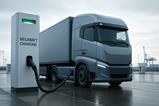
It says e-HGVs (and hydrogen HGVs) face various challenges and limitations that prevent them being rolled out further. Among them:
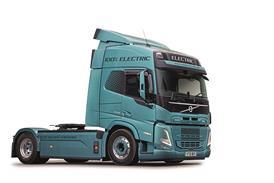
- • The current range of battery HGVs is just 200 miles.
- • The payload for a battery electric HGV is around 20% lower than for conventional HGVs, reflecting the weight of batteries.
- • The upfront cost of battery HGVs is currently around £300k, and hydrogen fuel cell vehicles are about £500k, compared to £100k for a conventional HGV.
- • While battery HGVs have slightly lower operating costs than conventional ones, hydrogen vehicles are more expensive to operate due to the cost of hydrogen production.
Models for battery HGVs deployment are ambitious, it says: the assumption is that they account for the vast majority of new vehicle purchases from 2035, so the five-year turnover means the fleet becomes decarbonised by 2040. But, “In reality, the take-up of battery HGVs may well start later than this. It may also be the case that there is a role for hydrogen vehicles, depending on innovations for this technology and for battery HGVs”.
It adds, “While there is uncertainty over the precise path through the 2030s, the key points are that significant penetration of low-carbon HGVs across the fleet is unlikely in the early 2030s; while full decarbonisation should be achieved well before 2050”.
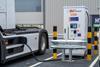
The review says further financial incentives may be needed to support rollout, depending on the extent of cost innovation. Electrifying the full HGV fleet could require charging capacity of 5GW. “This capacity is likely to be required in part where power networks are currently constrained, and a policy driven prioritisation of connections would be required.”
The review also notes that grocery delivery vans are key to the UK food industry’s commitment to reducing its carbon footprint. Here the transition to electric is already under way, and economic analyses suggest that electric vans are cost-effective. It says the van fleet may be decarbonised by 2035.