









![Mercedes-Benz_eActros_600_(1)[1]](https://d2cohhpa0jt4tw.cloudfront.net/Pictures/274x183/8/1/8/17818_mercedesbenz_eactros_600_11_556244.jpg)




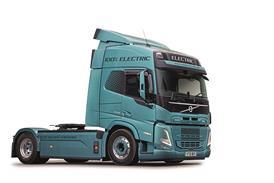
Battery-electric trucks could be cheaper than diesel across up to 90% of the European road-freight kilometres modelled for 2030, according to a new study. But being cheaper does not necessarily mean that they can actually do the work.
The study, “Cost competitiveness of alternative heavy-duty truck technologies under real-world utilisation profiles”, published in Nature Communications, used operating data from conventional trucks between 2011 and 2020. The records covered the weekly journeys of more than four million vehicles. The researchers modelled what would happen if battery-electric trucks expected to be available in 2030 had to perform the same work.
Looking only at ownership and running costs under the study’s 2030 assumptions, the smaller-battery truck was cheaper than diesel for 91% of the kilometres studied, while the larger-battery model was cost-effective for 69%.
But cost alone does not determine whether a truck can do the job. Rather than considering only annual mileage, the researchers also examined each truck’s longest working day. These peak days were typically 1.5 to 2.5 times longer than the daily average. A truck that appears economical to electrify based on its annual mileage may therefore still occasionally need to travel beyond its battery range.
Once range and public charging were included, the proportion that was both economical and operationally feasible fell to 21% for the smaller-battery truck and 25% for the larger model. By 2035, longer ranges and wider charging coverage could raise these shares to 63% and 77%, respectively.
The researchers describe infrastructure rollout as “decisive” to achieving the projected savings and warn that delays “could critically undermine heavy-duty truck decarbonisation”.
High annual mileage helps an electric truck recover its higher purchase cost through lower running costs, but also makes en-route charging more likely on its longest shifts. A larger battery provides more range but increases purchase cost, weight and energy consumption, so it is not automatically the more economical choice.
The model assumes that battery-electric trucks obtain 80% of their electricity from depot charging and 20% from public fast chargers, with mid-shift charging taking place during the driver’s statutory 45-minute break. However, it excludes grid upgrades, charger installation, queuing and diversions, all of which could affect an individual fleet’s business case.
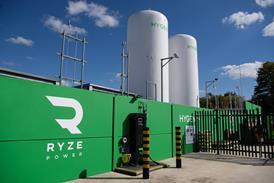
Hydrogen trucks face fewer range constraints but a weaker cost case. In the 2030 model, fuel-cell trucks consume roughly twice as much energy as large-battery models: 227kWh/100km compared with 110kWh/100km. They reach cost parity with diesel only under the most favourable hydrogen-price assumptions and beat battery-electric trucks only if hydrogen is cheap and reductions in battery costs stall.