







![Mercedes-Benz_eActros_600_(1)[1]](https://d2cohhpa0jt4tw.cloudfront.net/Pictures/274x183/8/1/8/17818_mercedesbenz_eactros_600_11_556244.jpg)





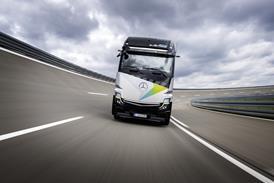
Battery electric and hydrogen fuel cell drivetrains are emerging as the most viable options for mass market adoption, according to a report from the Faraday Institution.
The report Electrifying Freight: Battery-Powered Heavy Goods Vehicles, notes that the sharp decline in battery costs is already positioning BEVs as the most cost-effective alternative option to diesel in many applications, particularly in urban and short-haul duty cycles.
It points to research which shows that by 2040, BEVs are expected to comprise 45% of the UK commercial vehicle stock, increasing to 80% of the stock by 2050.
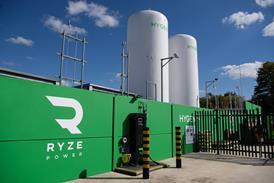
Hydrogen FCEVs, however, are likely to remain a niche solution, particularly suited to high payload and long-range applications, the report argues.
The report warns that despite the growing presence of BEVs, challenges remain in the commercial segment, especially in scenarios that require long ranges and heavy payloads. In these cases, hydrogen fuel cell vehicles present a potential alternative, offering quick refuelling times and higher energy density, the report advises.
However, the high costs associated with hydrogen fuel cell technology and the limited development of refuelling infrastructure continue to constrain their adoption.
Consequently, while hydrogen FCEVs may secure some market share in specific heavy-duty applications, BEVs are expected to remain the more practical and widely adopted choice across most commercial vehicle categories, the report says.
In addition, new battery technologies such as solid-state batteries, silicon anodes and lithium metal anodes are under development, which could help further increase the projected market share of battery HGVs by providing higher energy density and faster charging cells, the report adds.
In conclusion, the report states: “Achieving a zero-emission heavy-duty vehicle fleet by 2050 is feasible but will necessitate extensive planning, coordination and investment in infrastructure, alongside robust government policy support.
“With targeted efforts across industry and government, the transition to zero-emission HGVs has the potential to reduce dependency on imported fuels, create new jobs and position the UK as a leader in the electrification of freight.”
To support the transition to battery electric HGVs and address the operational demands of the freight industry, the report recommends a number of strategic actions. These include:
• Investment in next-generation technologies, such as solid-state batteries and silicon anodes, to accelerate advancements in battery energy density and reduce ultra-fast charging times, supporting long-haul applications and heavy payloads.
• The promotion of the UK production of HGV-specific battery systems, particularly high-capacity packs for long-haul vehicles and advancements in thermal management, cycle life and weight optimisation.
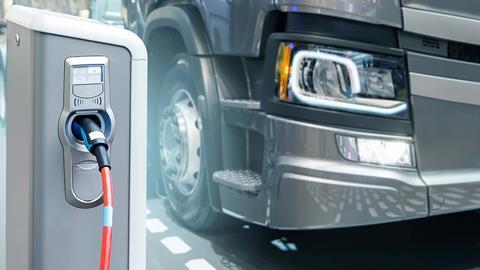
• The upgrading and expansion of the HGV-specific UK charging infrastructure, particularly strategically located public ultra-fast charging points on the SRN as well as depotbased solutions.
• Investment in grid capacity upgrades and power supply resilience to ensure the charging network meets the energy demands of an increased electric HGV fleet, with investment focused on high-demand freight corridors and urban logistical hubs.
• The integration of renewable energy sources, such as solar and wind, into charging infrastructure to reduce reliance on conventional power grids, and lower energy costs.
• Strengthening collaboration among energy providers, policymakers and industry stakeholders, such as the Road Haulage Association, Logistics UK and other industry bodies, to address technical and logistical challenges, particularly in coordinating depot and public charging networks.