






![Mercedes-Benz_eActros_600_(1)[1]](https://d2cohhpa0jt4tw.cloudfront.net/Pictures/274x183/8/1/8/17818_mercedesbenz_eactros_600_11_556244.jpg)






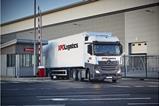
DP World has launched a trial of four electric trucks at the Port of Southampton aimed at helping container truck operators transition to zero emission vehicles.
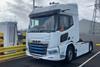
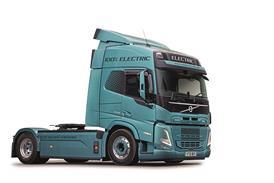
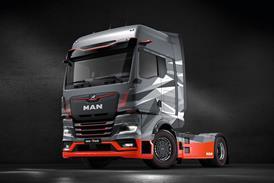
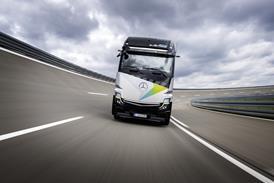
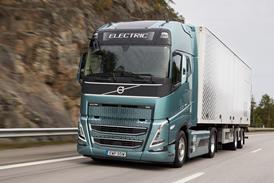
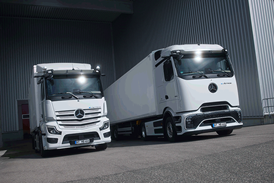
The Electric Vehicle Transition and Introduction Accelerator (EVITA) trial will see four electric HGVs tested between January and June, with two 42-tonne electric trucks already assigned to local hauliers SJG Haulage & Commercial and Port Express for container transport at Southampton.
The EVITA trial is an extension of DP World’s Low Carbon Truck Programme (LCTP), which was launched in September last year. The LCTP offers HGV operators access to HVO at no additional cost. Fleet owners can claim up to 5,000 litres of HVO per vehicle, alongside carbon literacy training aimed at reducing transport emissions across their operations.
Now DP World has launched its EVITA trial in partnership with Cambridge University’s Centre for Sustainable Road Freight (SRF) and its Project JOLT programme.
The four electric trucks in the EVITA programme will be tested by LCTP members.
John Trenchard, DP World Europe VP of sustainable international supply chains, said: “As an expansion to our Low Carbon Truck Programme we have launched our Electric Vehicle Transition & Introduction Accelerator trial – a pragmatic approach to support container truck operators to trial zero tailpipe emission vehicles for container work.
“Earlier this month we made another small but important step to support customers with lower carbon containerised supply chain solutions in the UK, by assigning two 42 tonne electric HGVs to local hauliers for container transport at Southampton,” he added.
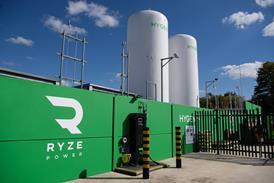
Driver welfare facilities and twin electric truck charging stations with 360kWh capacity have been installed at Southampton to support the trial.
DP World said that with more than 4,000 trucks arriving at its two UK ports daily, both LCTP and the EVITA programmes aim to help cut emissions and meet longer-term electrification goals.
It added that the programmes could provide a model for how large logistics players might support smaller operators in navigating the costly transition to sustainable transport.
David Cebon, director of the Centre for Sustainable Road Freight and professor of mechanical engineering at Cambridge University, praised DP World’s aim to help smaller hauliers transition to zero emission trucks.
He said: “The focus on helping small fleets to decarbonise and finding practical solutions to their electrification problems is critically important to the energy transition for trucking. Small family run businesses are the backbone of the industry and run most of the world’s trucks.
“They also do the most difficult logistics tasks, need flexible vehicles with large ranges and extensive charging infrastructure and of course, small companies have the least resources available to fund the transition.
“DP World is one of very few large companies in logistics that are taking positive steps to help SMEs. This lines-up perfectly with the objectives of Project JOLT - so we are delighted to collaborate on this project.“