





![Mercedes-Benz_eActros_600_(1)[1]](https://d2cohhpa0jt4tw.cloudfront.net/Pictures/274x183/8/1/8/17818_mercedesbenz_eactros_600_11_556244.jpg)




DLR operator KeolisAmey Docklands will finish electrifying its 45 cars and commercial vehicles in January 2026, beating its TfL franchise target by four years through a partnership with Ford and DriveElectric that has delivered 41% fuel cost savings.
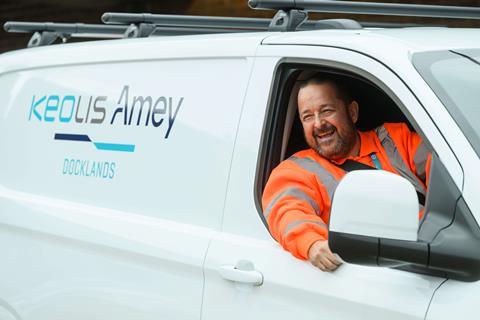
Docklands Light Railway (DLR) operator KeolisAmey Docklands (KAD) will complete the electrification of its fleet of 45 cars and light commercial vehicles next year, four years ahead of schedule, in a “unique” partnership with EV leasing company DriveElectric and Ford of Britain and Ireland.
The delivery of three E-Transit dropsided vehicles in January 2026 will see the fleet of 39 vans and six cars based at the Beckton and Poplar depots in East London fully transition from petrol and diesel to battery electric in less than a year.
KAD secured a new eight-year franchise from TfL to operate and maintain the DLR in April 2025, with a target to go fully electric within five years.
The fleet includes specialist vehicles that have typically been challenging to electrify, such as vans with tail lifts and flatbeds. Ford has supplied all 45 Puma Gen-E cars, E-Tourneo people carriers and E-Transit and E-Transit Custom vans, including variants with double cabs, tail lifts and dropside flatbeds in a deal described as “unique among train operating companies” by KAD MD Richard Graham.
“Delivering a fully electric fleet over four years ahead of schedule is a testament to our team’s commitment and the strength of our partnerships with Ford and DriveElectric,” he said. “We’re proud to champion sustainability, operational excellence and community wellbeing in East London.”
Ford was selected as the sole supplier after an extensive series of trials and the Ford Pro telematics package that allows real time monitoring of the vehicles’ performance was “key”, Graham added. The EVs have been supplied by DriveElectric on four year leases and R&M is provided by Ford.
The transition to an electric fleet has delivered significant operational cost savings on fuel and maintenance, creating opportunities to reinvest those savings into future carbon reduction initiatives. Between January and July 2025, diesel consumption fell 21%, avoiding the emission of 2 tonnes of CO2 and reducing fuel costs by 41%. Diesel use for the road fleet will end with the delivery of the last three EVs in January.
Despite the large electrical power requirement to operate the trains, securing enough power to charge the vehicles overnight at the two depots was a significant challenge. As well as investing £60,000 in two 50kW, two 22kW and two 7 kW chargers at Poplar, KAD is contruting an unspecified sum towards the upgrade of a UK Power Networks transformer supplying Beckton. This is also needed because a new fleet of trains now entering service use more electricity than the older units.
KAD is in the process of applying for grant funding to support the introduction of further charging units, working directly with charge point provider Enable Mobility. The approximate cost for a further 25 units is expected to be £120,000. KAD is also looking at solar power and battery storage at the Beckton depot, partly to enhance resilience to energy market volatility.
DriveElectric senior business development manager Ellie Vujasevic said that while the range and payload of EVs had improved greatly in the last six years, OEMs were failing the hit the government’s ZEV Mandate targets. In 2024 EVs took a 6.24% share of LCV sales compared with a target of 10%.
“We are lagging behind but not because fleet don’t want EVs,” she said. “The transition is proving too difficult for many operators with charging adding another layer of complexity. But the barriers are all solvable.”