











![Mercedes-Benz_eActros_600_(1)[1]](https://d2cohhpa0jt4tw.cloudfront.net/Pictures/274x183/8/1/8/17818_mercedesbenz_eactros_600_11_556244.jpg)





Corporate fleets are driving electric vehicle adoption past a key “tipping point”, according to a new report from consultants EY and electricity industry body Eurelectric. However, while electrification is rapidly becoming financially viable for car-based fleets and light commercial vehicles (LCVs), the heavy-duty truck sector still faces significant barriers.
The report, Fleet forward: powering the transition to electric mobility, focuses on the electrification of corporate fleets, arguing that their impact is far greater than that of private vehicles alone. With higher utilisation rates and faster replacement cycles, fleets can accelerate the shift to electric mobility and deliver wider benefits for operators and the electricity system.
Researchers say 2025 marked a clear turning point for EV uptake across Europe. LCV registrations rose from 6.5% in 2024 to 12% in 2025. Sales of medium and heavy electric trucks nearly doubled to reach 4.8% of European registrations, while electric buses accounted for 25.9% of new registrations.
The report said that together these trends show EV uptake is expanding rapidly beyond passenger cars.
Electrifying corporate car fleets as well as low, medium and heavy commercial vehicle (HCV) fleets could reduce operating costs by €246bn (£214bn) by 2030, with around €49bn per year benefiting fleet operators.
However, the economics of electrification for HCV fleets remain highly dependent on routes and charging strategies, driven by tolls, electricity tariffs, utilisation and maintenance costs. Savings are greatest where fleets can rely on depot charging, “avoiding the cost premium and downtime of public high-powered charging”.
The report also notes that some electric HCVs are already capable of travelling up to 500km on a single charge. With 45% of all goods transported by road in Europe travelling less than 350km per day, “a significant share of fleet operations could be electrified without the need to rely routinely on public charging”.
However, the report acknowledges that “availability is everything in the trucking industry”. Downtime carries a direct financial cost, making dependable en-route and destination charging essential.
This, it argues, “unlocks a strong economic case for electrification and creates a clear opportunity for investment in dedicated hubs with ultrafast megawatt charging along major corridors”. Given the expected growth in power demand from truck charging, anticipatory grid investment will also be critical to ensure these hubs can operate effectively.
In the EU, fast-charging stations for trucks and buses are now mandatory at 120km intervals along TEN-T core routes, tightening to 60km intervals by 2030. By the end of 2027, at least 50% of the TEN-T core network must be equipped with publicly accessible charging infrastructure for HCVs.
HCVs, buses and specialised and emergency fleet vehicles tend to follow relatively predictable duty cycles in terms of distances travelled, duration of operations, stop-start patterns, loads carried and charging or refuelling requirements.
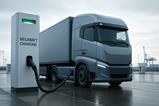
Significant progress is also being made on Megawatt Charging Systems (MCS) for large battery vehicles, with commercialisation expected in 2026. The aim is to enable 700-800kWh charging in 30–40 minutes, aligning with drivers’ mandatory 45-minute rest breaks.
Despite these developments, depot charging remains the primary solution for electric HCVs and is likely to continue playing a central role. It is typically cheaper than public charging, and improving battery capacities increasingly allow trucks to complete journeys between depots without relying on en-route charging.
While depot electrification presents space and layout challenges, innovative depot design and shared-use models could allow operators to monetise charger downtime.
The report also highlights the potential of behind-the-meter energy hubs combining battery storage and solar photovoltaics. These can help operators avoid peak-power fees and mitigate grid connection delays while creating “more investable and schedulable assets at logistics sites”.
It also calls for energy system operators to open more flexibility markets to fleets and establish standards for vehicle-to-grid technology and smart charging. According to the report, “electrifying the largest and most energy-intensive fleet archetypes creates huge opportunity for grid flexibility and load balancing”.
Complex fleet ecosystem
The report describes fleets as a “complex and fragmented ecosystem” comprising around 65 different fleet types, ranging from company cars to 18-wheel temperature-controlled trucks.
It says understanding different vehicle types and usage patterns is essential for designing effective policy, business models and infrastructure.
For HCV operators, operating costs currently account for 60-75% of total cost of ownership, compared with 45-65% for LCVs and 25-40% for cars. However, electric trucks can still cost two to three times more than diesel vehicles and currently have residual values of just 10-20%, lower than internal combustion equivalents.
Meanwhile, market participants are “just as varied as the vehicles they operate”, with many operators being SMEs. For these businesses, electrification represents a significant financial and operational shift.
The report stresses that “policy certainty and incentives are critical levers for easing SMEs’ transition to electric and de-risking their investment”.
It adds that regulatory clarity, a predictable revenue framework and harmonisation across markets are essential to unlock network investment. Europe also needs integrated planning across transport, energy and digital systems.
To accelerate progress, the report calls for action to remove structural bottlenecks, including a near-term truck strategy, reform of network charges and faster grid connections.
The report said ‘actionable next steps’ would be:
• Enforcing binding zero emission vehicle purchase targets for fleet operators.
• Maintaining purchase incentives
• Removing unnecessary taxes from electricity bills.
• Enable rapid deployment of high-power, zero-emission truck charging with fast-track permitting, grid connections and grid-capacity upgrades
• Harmonise cross-border rules and technical standards
• Provide information and education services to fleet operators to support their transition to electric
• Enforce so-called exemptions on road tolls for electric vehicles across Member States