





![Mercedes-Benz_eActros_600_(1)[1]](https://d2cohhpa0jt4tw.cloudfront.net/Pictures/274x183/8/1/8/17818_mercedesbenz_eactros_600_11_556244.jpg)


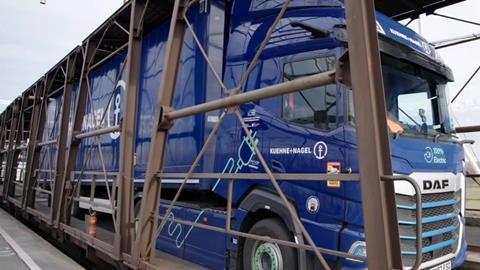

Kuehne+Nagel, LeShuttle Freight, Voltempo, and DAF Trucks have sent the first electric HGV through the Channel Tunnel, as part of a 1,700 km round trip across Europe designed to showcase the long-haul range of electric trucks.
The journey began at Kuehne+Nagel’s East Midlands Gateway depot in the UK where the DAF New Generation XF truck was loaded with 12-tonnes of freight before being fully charged using the depot’s Voltempo HyperCharger – the UK’s first megawatt-scale charging system.
The Kuehne+Nagel six-bay hub is capable of delivering charge rates of up to one megawatt (MW), or to dynamically allocate the 1MW capacity across six trucks at once.
Along the 1,700 km round-trip route to Kuehne+Nagel’s depot in Haiger in Germany, the two-person crew topped up at public charging hubs operated by Gridserve (UK), and Milence in Dunkirk, France and Maasmechelen in Belgium, showcasing the growing accessibility of fast-charging infrastructure for long-haul electric freight.
The vehicle chosen for this milestone journey was the DAF New Generation XF, which provides a real-world range of up to 500 km (310 miles) on a single charge and supports DC charging up to 325kW, enabling rapid top-ups to make long-haul daily journeys of up to 1,000 km a reality.
Eurotunnel’s LeShuttle Freight service carries a quarter of all goods traded in value between the UK and continental Europe, with over a million trucks crossing each year.
As members of eFREIGHT 2030 consortium, which is part of the Zero Emission HGV and Infrastructure Demonstrator (ZEHID) programme, Kuehne+Nagel, DAF and Voltempo will share their learnings and insights from the trip to help accelerate the sector’s shift to low-emission transport.
Keir Mather, minister for aviation, maritime and decarbonisation, said: “We’re backing British business by cutting up to £120,000 off the cost of new electric trucks and investing £120m to rollout zero‑emission lorries and the charging infrastructure needed to support them, boosting growth, UK manufacturing, and supporting jobs.
“Our support has seen companies like Kuehne+Nagel get clean delivery trucks on the road and helped fund the launch of the first electric lorry across the Channel Tunnel, showcasing the massive trading and economic opportunities that can be delivered through green freight.”
Kate Broome, Kuehne+Nagel UK sustainability and social impact director, said: “With this first‑ever electric HGV journey via the Channel Tunnel, we set out to show what’s possible - and to inspire others to accelerate their own electrification journeys.
“Planning a multi‑country long‑haul route still requires extra work to optimise our schedule for charging stops, but the rapid expansion of charging infrastructure across the UK and Europe is transforming what’s achievable.
“Today we’ve demonstrated that this effort truly pays off - and this electric‑corridor milestone shows just how quickly the future of sustainable transport is taking shape.”
Peter Roberts, LeShuttle Freight commercial strategy director, commented: “This milestone marks a major step forward towards greener supply chains and shows what’s possible when industry and government collaborate.
“Working with Kuehne+Nagel and DAF Trucks we are proving that electric heavy-goods vehicles can operate a zero-direct-emission freight corridor between the UK and mainland Europe, thanks to the Channel Tunnel.
“It’s a significant move towards decarbonising freight transport and we’re proud to be rolling out this capability to all eHGVs later this year.”
David Kiss, DAF Trucks managing director, said: “This exciting milestone demonstrates that DAF electric trucks can reliably operate on international, multi-country routes, including the Channel crossing.
“The DAF XF Electric enables daily distances of up to 1,000 km in real-world operation when utilising rapid charging. Running with a tri-axle trailer at up to 42 tonnes GCW, it delivers genuine heavy-duty capability for mainstream logistics applications.
“This cross-Channel operation proves how electric freight can be scaled on one of Europe’s busiest trade corridors, supporting both UK and EU net-zero ambitions while evidencing that sustainable international transport is practical, efficient, and commercially viable today.”