







Network operators Entsoe-e and DSO Entity have launched a digital portal showing where grid capacity exists for eHGV charging points across Europe. The move supports EU efforts to accelerate heavy-duty vehicle charging rollout, with 22,500 battery electric trucks now registered and 2,000 public charging points operational.

European grid entities representing high and low voltage network operators have launched a digital portal, Capacitypedia, showing where there is grid capacity available across Europe for eHGV charging points to be installed, as well as for other new users. The portal, jointly provided by Entsoe-e (high voltage) and DSO Entity (low voltage) works alongside national ‘heat map’ publications showing spare capacity.
Opening the portal was a key action of the EU’s Clean Transport Corridor Initiative (CTCI), highlighted in a CTCI roadmap published by the EU’s Transport Directorate on 8 June.
The CTCI has four streams of work supporting a faster rollout of HDV chargers. They are
• Grid related topics
• Permitting for recharging infrastructure for trucks, site availability and concession procedures.
• Transparency, monitoring and digitalisation
• Financing and de-risking
Some actions recommended by the CTCI require action by Member States in their own territories. They including establishing frameworks to allow for anticipatory investment, flexible connections, battery and charging asset co-location, designing a blueprint for building and other administrative permits, and facilitating the use of demand response. Member States are required to provide updates on progress with regard to these issues by the end of 2026.
Europe-wide initiatives include sharing data, such as on charging point roll-out and usage, or on traffic in freight corridors.
The new road map said that by the end of 2025 22,500 battery electric heavy and medium duty trucks had been registered in the EU, almost two thirds of them since January 2024. End-2025 also saw 2,000 truck-suitable publicly accessible truck recharging points in the EU, with 75% of them in mixed-use areas and 25 per cent in areas exclusively for trucks.
A HDV market readiness study published in 2025 suggested that “by 2030 the zero-emission vehicle fleet in the EU will comprise at least 400,000 vehicles (trucks and buses included), with a clear majority of these being battery electric”. To meet their charging needs, in March 2026, the Commission adopted new rules (the State aid Land and Multimodal Transport Guidelines and the State aid Transport Block Exemption Regulation) intended to help Member States roll out sustainable transport solutions more quickly.

The new roadmap said: “The investment needs to achieve zero-emission freight corridors and meet the expected demand along the TEN-T by 2030 will be substantial, requiring further investments and derisking.” It said private and public funded projects are bringing together logistics companies and shippers to establish commercially viable operations using electric trucks and to share best practices, which it said would incentivise new players to invest. It said: “The interplay between public charging and depot charging will be important for scaling electric trucks, with long haul operations relying more on publicly accessible charging”.
The roadmap included a map of existing and planned recharging HDV recharging infrastructure as reported by the Member States. It suggested that in the North Sea Baltic corridor there was a risk of insufficient or missing HDV recharging infrastructure in key areas including the E40 in Belgium and three routes in Poland (E30, E67 and E372).


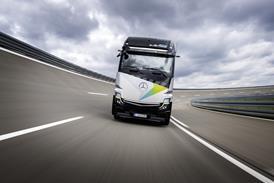
![Mercedes-Benz_eActros_600_(1)[1]](https://d2cohhpa0jt4tw.cloudfront.net/Pictures/274x183/8/1/8/17818_mercedesbenz_eactros_600_11_556244.jpg)