







![Mercedes-Benz_eActros_600_(1)[1]](https://d2cohhpa0jt4tw.cloudfront.net/Pictures/274x183/8/1/8/17818_mercedesbenz_eactros_600_11_556244.jpg)




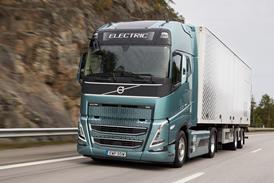
Tate & Lyle Sugars has added two new electric Volvo lorries to its London operations, which will save 55,000 diesel miles annually, as part of its wider goal of reaching carbon neutrality in the UK by 2040.
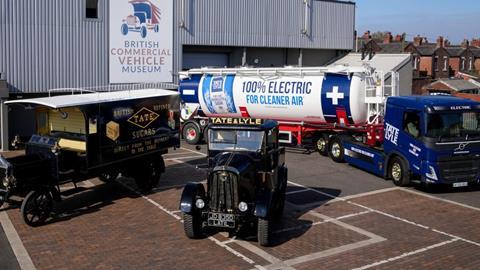
One of the trucks was recently displayed at a commemorative event at the British Commercial Vehicle Museum in Leyland in Lancashire, alongside some vintage vehicles used in the past by Tate & Lyle.
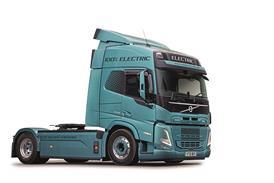
The two 100% electric Volvo trucks are now in operation at Tate & Lyle Sugars, serving key logistics routes in East London.
One truck handles palletised product transfers from the Thames Refinery to an external warehouse, while the other manages bulk deliveries to major customers within the M25 and also handles sugar movements between the Thames Refinery and Plaistow factories.
Volvo has provided comprehensive hands-on training to drivers, ensuring optimal performance and battery efficiency. They will also repurpose end-of-life EV batteries for second-life energy storage to minimise waste.
A recent survey undertaken by Tate & Lyle Sugars revealed that 67% of consumers view businesses more positively when they utilise electric vehicles, further reinforcing the necessity of sustainable operations within the supply chain.
The two vehicles will save 55,000 diesel miles annually, which Tate & Lyle has estimated as roughly the distance of driving from London to Sydney and back twice, seven round-trip flights from London to New York, 82 return coach trips between London and Edinburgh or traveling the entire length of the UK from Land’s End to John O’ Groats 63 times.
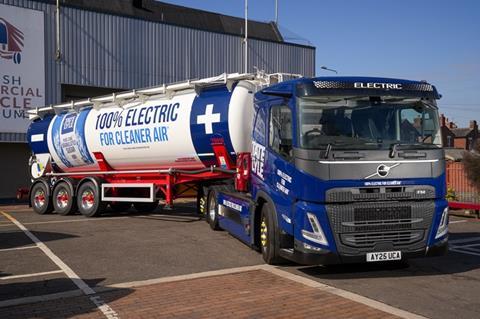
The company recently unveiled one of its new electric lorries outside the British Commercial Vehicle Museum in Leyland, Lancashire, which charts the UK’s commercial vehicle history since the 1800s and proudly exhibits a number of the company’s retired commercial vehicles.
Chorley is also a neighbouring Lancashire town where sugar merchant, philanthropist, and one of the founders of the company Sir Henry Tate, was born in 1819.
To emphasise its evolution, a number of historic vehicles were proudly lined up and displayed outside the museum, including a horse and cart, used by Tate & Lyle Sugars to move sugar within the refinery until 1954, and two vintage vehicles; a 1913 McCurd and a 1932 Latil.
The McCurd is the only surviving vehicle of its type in the world and even appeared in the film Chitty Chitty Bang Bang. It was restored as a box van in the Tate Sugars livery after being used by troops during the war.
The French manufacturer, Latil, produced the versatile Latil four-wheel drive road tractor under licence in England by Shelvoke and Drury and it was used by Tate & Lyle Sugars throughout the 1930s.
Andrew Jones, Tate and Lyle Sugars president, commented: “The introduction of our 100% electric lorries marks another step forward in our commitment to being one of the world’s most ethical and environmentally responsible cane sugar refiners.
“We continually explore ways to make our logistics more sustainable — from optimising vehicle payloads to choosing greener transport methods — and remain focused on working with our customers and suppliers to build a more sustainable supply chain.
“The commemorative event at the British Commercial Vehicle Museum also celebrated this progress, showcasing our journey from 1878 to today.
“This latest move honours our heritage while accelerating our vision for a cleaner future.”