







![Mercedes-Benz_eActros_600_(1)[1]](https://d2cohhpa0jt4tw.cloudfront.net/Pictures/274x183/8/1/8/17818_mercedesbenz_eactros_600_11_556244.jpg)




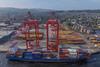
Ports should consider investment to become ‘clean energy hubs’ with a key role in helping decarbonise the transport and industrial sectors, say the authors of a report, ‘Ports as Clean Energy Hubs’.
The interaction between electrification of ports and other services, including freight, has been explored in the report produced by Arup and C40 Cities. It concludes that an electrified port could be the focus for electrification of transport such as HGVs, by making chargers available.
The report describes ports as “multimodal transport hubs” for transport services on land and sea. Ports are increasingly looking to electrify, not only to reduce carbon emissions, but also to improve air quality and improve electricity resilience. The report also highlights the role of port cities.
It says an electrified port with vessel, vehicle and equipment charging, as well as onsite (or offshore) renewables, energy storage and a microgrid could be a contributor and not just a consumer in the power network, generating and storing electricity from renewables and releasing it at times of peak demand. By integrating renewable generation and storage the port could maintain critical operations – and revenue generation - during outages.
Ports have focused up to now on reducing their own emissions, but overlooked the opportunity to maximise their impact by becoming sites that serve as centres for electrified transport networks, enable sustainable fuel trade and use, or facilitate offshore wind development, as well as handling trade.
The approach to port electrification depends on port size and traffic. Ferries may need vessel charging, while large container ports or cruise terminals might need on-shore power or links to it. The demands are large: on-shore power systems that allow vessels to switch off their engines at berth may have an annual demand of 30,000 MWh per berth. High-power charging for electric vessels may have higher requirements. The report said that by adding charging facilities for cargo handling equipment and HGVs, a port can help remove potential barriers to fleet electrification and speed up replacement of diesel trucks.
The report highlights the Port of Los Angeles and its Clean Truck Program, launched with Long Beach port in 2008 . The programme progressively banned older, high-emission diesel trucks from port terminals, so that by 2012 there was a complete ban on trucks not meeting emission standards. From 2022, charges were placed on trucks that did not meet near-zero emissions, and the funds formed a Clean Truck Fund (CTF) to subsidise purchase of zero-emission trucks.