









![Mercedes-Benz_eActros_600_(1)[1]](https://d2cohhpa0jt4tw.cloudfront.net/Pictures/274x183/8/1/8/17818_mercedesbenz_eactros_600_11_556244.jpg)





The government could increase the proportion of renewable fuel used in heavy goods vehicles (HGVs) and other heavy duty vehicles (HDVs) by increasing financial incentives for users and making the fuel easier to source. But it will also have to address the technical and operational concerns of vehicles manufacturers and operators.
That was the conclusion of a ‘Higher Biocontent Fuel Deployment Research Study’ commissioned by the Department for Transport (DfT) and carried out by WSP, the ZEMO Partnership and the Low Carbon Truck Consultancy. The DfT wanted to gain insight into how UK and international fleet operators have successfully deployed higher biocontent fuels and it asked for the research to identify operator barriers and challenges to higher adoption, and suggest solutions from industry, government intervention or experience from other markets.
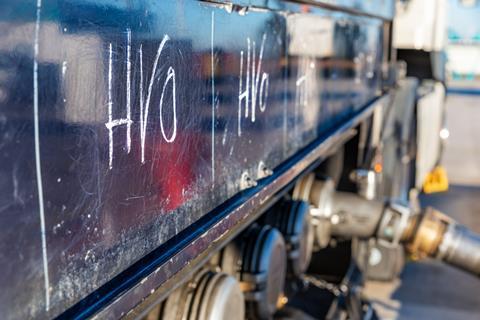
Higher biocontent fuels (HBFs) are made from biomass such as crops, residues, and biogenic wastes and include biodiesel (fatty acid methyl ester, or FAME) and renewable paraffinic diesel such as hydrotreated vegetable oil (HVO). Currently <1% of the UK HDV fleet has adopted HBFs in their existing diesel fleets (mainly biomethane with some HVO deployment). The report said that around 2200 HGVs are running on high blend FAME biodiesel, based on volumes of high blend biodiesel approved under in 2022.
There is just one UK-wide diesel specification (BS EN 590) that is available across both car & van forecourts and the separate HDV network. This product contains up to 7% of FAME biodiesel. The report said greenhouse gas (GHG) emissions from UK HDVs could fall an additional by 46 MtCO2 by 2030 if an average of 30 per cent renewable fuel were adopted.
Original equipment manufacturers (OEMs), fleet operators and the HBF supply chain shared some fears over deploying higher FAME biodiesel blends. They were:
- · Filter blockage
- · Warranties
- · Performance of the vehicle in cold temperatures
Both OEMs and fleet operators had concerns over the high cost of HVO compared with diesel (saying it had to be at price parity with B7) and price volatility, as well as limited availability.
In addition, OEMs had further concerns about to back to base bunkering and reported that there is both limited market knowledge about the fuel, and a lack of confidence in government support.
Fleet operators also raised concerns over maintenance of bulk fuel storage tanks (and subsequent costs), with additional concerns over limited availability at service stations and contradictions in estimates of its fuel efficiency.
In response, the report set out options for government intervention, saying, “Principal among these is increasing road transport fuel obligation (RTFO) targets” – it found that in many countries the government mandate requires higher biofuel percentages - and “this could be complemented by targeted fiscal incentives such as a fuel duty discount or fleet operator rebates”.
Its comments on proposals for government intervention were:
- · Fuel duty discount would be based on the GHG emissions savings, but this is a blunt fiscal measure that would affect the whole market, and is open-ended.
- · A controlled rebate for HDV operators “provides direct government control outside normal legislative frameworks, ensures it goes to the point of need and the total spend is in the government’s control.
- · An enhanced capital allowance scheme would include qualifying vehicles, plant machinery and refuelling equipment.
- · Public recognition of HBFs by government would emphasise their importance alongside zero-emission technologies, well-to-wheel and life cycle GHG savings.
Meanwhile, it said local authorities and operators can:
- · Raise awareness of reputable fuel sustainability certification schemes, boosting credibility
- · Educate stakeholders on HBF benefits and dispel misconceptions
- · Create an interactive map or app for fleet operators to find HBF refuelling stations.