



![Mercedes-Benz_eActros_600_(1)[1]](https://d2cohhpa0jt4tw.cloudfront.net/Pictures/274x183/8/1/8/17818_mercedesbenz_eactros_600_11_556244.jpg)





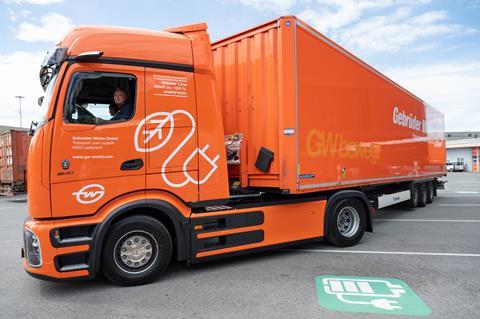
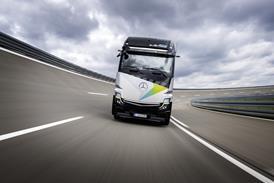
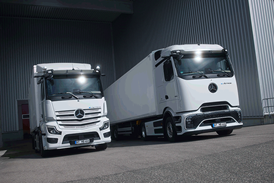
Austrian logistics company Gebrüder Weiss has invested €4m (£3.4m) in four Mercedes-Benz eActros 600 electric lorries and the associated charging infrastructure across its Austrian operations, whilst also preparing additional depots in Austria, Switzerland and Germany to reduce reliance on scarce public charging options for heavy goods vehicles.
For operators weighing up electric lorries, the lesson is clear: alongside the vehicle investment comes the need to act as their own energy providers to ensure dependable operations.
According to Gebrüder Weiss, the four eActros 600 units, two based at Lauterach (Vorarlberg) and two in Wels (Upper Austria), are equipped with a 600 kWh battery, a range of 500 kilometres and 600 kW of drive power. The company reports that charging takes between 30 and 90 minutes at company-owned facilities, enabling both regional and long-haul use.
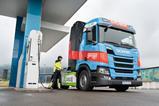
At its Lauterach headquarters, the company has installed two transformer stations with a capacity of 1,600 kVA each, supplying up to 16 fast-charging points, of which eight are already in service. According to Gebrüder Weiss, the charging equipment was supplied and installed by vlotte vkw GmbH and is fitted with CCS connectors. Crucially for operational efficiency, vehicles can be recharged whilst being loaded or unloaded, avoiding the downtime that would otherwise disrupt scheduling.
The energy independence strategy proves critical to cost control. According to the company, roughly three-quarters of electricity demand at its Austrian branches has so far been covered by its own photovoltaic systems, with the remainder purchased as certified renewable energy. This approach helps keep running costs predictable and reduces dependency on external charging networks.
“Our customers expect reliability and on-time delivery even with zero-emission transports,” said Stefan Oberhauser, branch manager of land transport & logistics Vorarlberg at Gebrüder Weiss.
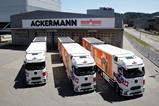
The scale of deployment gives a useful benchmark: Gebrüder Weiss operates 185 lorries in Austria; the 14 electric lorries expected to be in service by the end of 2025 will represent around 7.5 per cent of its domestic fleet, with five based in Lauterach. According to the company, the new vehicles meet current requirements for day-to-day logistics, though it acknowledges that precise payload and cost comparisons with diesel lorries remain under evaluation until full deployment is achieved.
The infrastructure challenge extends beyond single-depot operations. To enable longer-distance routes without relying on inadequate public charging networks, Gebrüder Weiss is installing charging infrastructure at facilities in Vienna, Hall in Tyrol, Altenrhein in Switzerland and Aldingen in Germany.