



![Mercedes-Benz_eActros_600_(1)[1]](https://d2cohhpa0jt4tw.cloudfront.net/Pictures/274x183/8/1/8/17818_mercedesbenz_eactros_600_11_556244.jpg)




A trial using freight trains between DPD’s hub in Leicestershire and a terminal near Glasgow demonstrated how eHGV rollout could be focused on easier to decarbonise routes, according to a rail firm.
GoExpress said its middle mile, high speed, low carbon logistics operation on the West Coast Main Line showed how rail services for the express logistics sector could be incorporated into supply chains.
And it said it also demonstrated how electric lorry deployment could be concentrated on more cost effective first and final mile legs.
The four-week trial found Anglo-Scottish transit times halved from eight hours to four hours 30 minutes, with end-to-end transit times between DPD’s depot and its Glasgow Eurocentral distribution centre completed in under seven hours.
GoExpress said the solution offered an alternative to heavy long distance road transport, currently powered by diesel or HVO fuel, and would cut transport companies’ carbon impact.
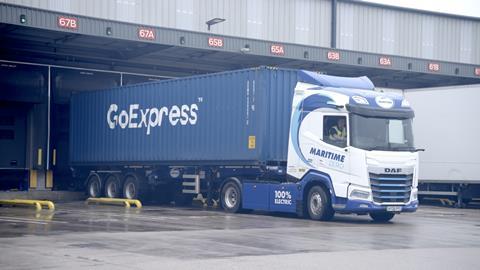
GoExpress told Motor Transport that there were approximately 9,600 trucks regularly making the journey between Scotland and England and the route was difficult to decarbonise.
A spokesman for the business explained that by incorporating electrified rail over the longer distances, haulage operators could focus their eHGV rollout on the first and final miles instead, therefore relying on lower range electric vehicles that are cheaper and rely on less energy than longer range trucks.
Adam Parkinson, GoExpress chief executive, said: “Our trial demonstrates that express logistics companies can rapidly optimise their middle-mile networks through the adoption of high-speed rail.
“For operators under pressure to take time, cost and carbon out of their networks, our reliable high-speed rail product is now a proven, commercial option which can complement existing eHGV rollout and scope 3 sustainability targets.”
DPD described the trial as a significant step towards proving the concept: “As a company, we are committed to innovating and improving every aspect of our operation to be as sustainable as possible and that means challenging how things have always been done and looking at radical alternatives like this,” said Paul Herring, DPD sustainability manager.
“The trial has helped us understand how rail could work in this context and how our operation can adapt to it.”