






![Mercedes-Benz_eActros_600_(1)[1]](https://d2cohhpa0jt4tw.cloudfront.net/Pictures/274x183/8/1/8/17818_mercedesbenz_eactros_600_11_556244.jpg)




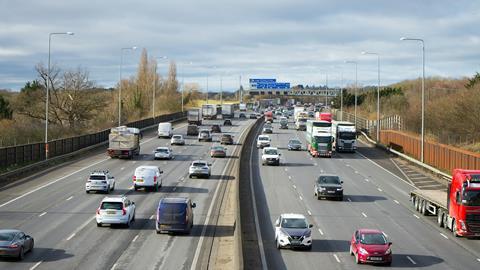

Transport researchers are using data from logistics company DHL to simulate a delivery truck’s journey from London to East Midlands Airport to identify the best locations for electric vehicle charging points along the M1 motorway.
The research is being led by TransiT, a national UK research hub focused on rapidly decarbonising transport using digital twins – digital replicas of the physical world - to understand the carbon footprint of goods that are shipped between road and air freight.
Alex Foote, a TransiT researcher at Heriot-Watt University in Edinburgh, is leading the road freight part of the research, in collaboration with air freight specialists at Cranfield University in Bedfordshire and with DHL, which is providing data from some of its UK fleet of around 6,500 trucks and vans for the research.
Dr Foote said: “We’re building a simulation which will show how a truck fleet can transition from having no electric heavy goods vehicles to 100% electric HGVs by 2050.
“Using the data from DHL, we’re starting to add in electric trucks to the fleet, to understand the impact of this, based on the frequency and volume of freight they’re moving.
“Electric HGVs can typically lead to larger fleets because the weight of batteries and the time needed to charge them can mean more trucks are required to keep delivery volumes in line with diesel trucks.
“We’re also looking at the journey of these trucks from London to East Midlands Airport, so we can identify the best places to install charging infrastructure for electric trucks. In our simulation, this involves adding in electric infrastructure at DHL depots and service stations along the M1.”
To model these scenarios, Dr Foote is using a computer simulation technique called agent-based modelling (ABM). This simulates how individual agents – like drivers and vehicles – interact with each other and their environment, and the impacts these interactions can have on the wider transport system.
These models can identify the changes needed to ensure logistics companies remain reliable and profitable – including where vehicle charging points should be located, at what speed they should charge, and which mix of vehicles would be most effective for fleets.
A key innovation has involved ‘incentivising’ these computer agent truck drivers to find the most beneficial routes and locations using a scoring system.
Dr Foote explains: “Our goal at TransiT is to identify the fastest, lowest-cost routes to transport decarbonisation, so our agents get better scores if their trucks find shorter routes that reduce the time and cost of their journeys.
“This might mean they favour charging at the depot before starting their journey, during wait times between jobs, so they don’t have to stop en route. Or if it’s a long route, they might have to charge at a service station along the way.
“The great advantage of agent-based models is that the agents can tell us what the best solution is.”
The researchers say their analysis focuses on an area of zero emission logistics that hasn’t been explored before and describe their work as a first for the UK.
Lorna Dean, DHL Express head of UK network and linehaul planning, said: “Research in this area is essential to the future of our road and air freight operations because it underpins the technologies that will help us to cut carbon at scale while keeping our customers’ goods moving.
“Supporting this work now will position us to meet the growing demand for lower carbon logistics and build a transport network that supports our climate goals.”
Dr Foote is currently simulating a 2030 decarbonisation scenario where 10% of the fleet on DHL’s London to East Midlands Airport route is electrified.
This will identify locations where grid capacity may need to be strengthened to support new charging infrastructure.
Electric fleet adoption can then be increased in the simulation to 50% by 2040 and 100% by 2050, with the addition of new electric vehicles and infrastructure.
“I’d like to try and find a way to demonstrate that electric HGVs in long haul freight are viable earlier than people expect and that they can manage the journeys quickly and reliably,” Dr Foote said.
“We’re behind the curve in the UK at the moment on electric HGV adoption, so it would be good to know that we can get the ball rolling quite quickly without too many big infrastructure changes.”
Critical next steps for the research include integrating the road freight simulation with an air freight simulation being developed at Cranfield University, in collaboration with DHL and East Midlands Airport.
This will help researchers understand the best decarbonisation pathway for air-to-road freight, as part of TransiT’s goal to build a connected network of digital twins representing the whole UK transport network.
DHL employs around 400,000 people in more than 220 countries and territories worldwide and aims to achieve net-zero emissions logistics by 2050.
East Midlands Airport is the UK’s largest dedicated express air freight hub, handling around 400,000 tonnes of cargo annually.
TransiT is a collaboration of eight universities and almost 70 industry partners, jointly led by jointly led by Heriot-Watt University in Edinburgh and the University of Glasgow, and supported by the UKRI Engineering and Physical Sciences Research Council (EPSRC), the main funding body for engineering and physical sciences research in the UK.