


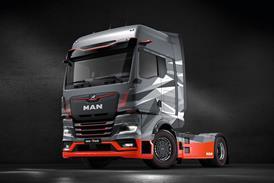
A German building-materials operator running five MAN eTGX trucks could cut total costs by around €500,000 (£428,000) over five years compared with equivalent diesel vehicles, according to a new MAN analysis.
Betonwerk Bad Lausick uses the battery-electric lorries on demanding cement and building-materials work. One representative duty is a 500km round trip between Otterwisch, Bernburg and Bad Lausick, carrying an average 14-tonne payload and involving more than 1,150 metres of elevation gain. Each truck is assumed to cover around 110,000km a year over 220 working days.
The trucks are MAN eTGX models with six battery packs. MAN says they achieve around 400km of range in winter and up to 500km in summer. The 500km duty is supported by high-power charging at Otterwisch and Bad Lausick during loading and unloading, allowing the trucks to complete the route without relying on an en-route public charging stop.
The charging system is central to the business case:three of Betonwerk Bad Lausick’s six sites are equipped with dual-point 400kW chargers, backed by a photovoltaic portfolio of 1.8MW, with another 0.4MW planned. Each site also has 430kWh of stationary battery storage, used for peak shaving, price optimisation and increasing the use of self-generated power. Around 70% of the solar electricity generated is consumed on site.
MAN’s five-year TCO model assumes diesel consumption of 31 litres/100km at €1.60/litre, compared with electric consumption of 114kWh/100km at €0.20/kWh. The calculation covers five trucks and includes charging infrastructure, site preparation and operational integration as part of the cost comparison.
On those assumptions, the electric operation comes out around €500,000 cheaper over five years, giving the BEV fleet a 9.4% TCO advantage over diesel. MAN says deeper integration of charging and energy systems could widen that advantage to 13.3%.
“The stronger the integration of depot energy systems, the stronger the battery electric truck business case becomes,” the report says.
The case also goes beyond highly predictable depot-to-depot work. One of the five eTGXs is being used on less predictable long-distance operations, including routes beyond Berlin, supported by curated lists of compatible public charging locations.
Electrification has also required changes outside the depot. Betonwerk Bad Lausick was the first operator to request 42-tonne weighbridge adjustments at major cement plants to accommodate the heavier electric combinations. The company plans to continue expanding its electric fleet each year, including into more specialised applications such as concrete mixers and vehicles requiring auxiliary power.


![Mercedes-Benz_eActros_600_(1)[1]](https://d2cohhpa0jt4tw.cloudfront.net/Pictures/274x183/8/1/8/17818_mercedesbenz_eactros_600_11_556244.jpg)