



![Mercedes-Benz_eActros_600_(1)[1]](https://d2cohhpa0jt4tw.cloudfront.net/Pictures/274x183/8/1/8/17818_mercedesbenz_eactros_600_11_556244.jpg)



Could the Midlands ‘Golden Logistics Triangle’ rely on small local nuclear power plants for electrification and vehicle charging?
Logistics was one of the sectors highlighted in a new ‘Midlands Nuclear Siting Study’, commissioned and funded by the Midlands Net Zero Hub and supported by Midlands Nuclear, which aimed to identify sites for new nuclear stations.
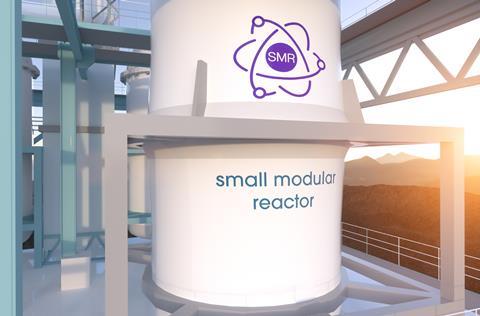
The study responded to changes in planning policy guidance on nuclear, which was previously so tightly drawn that the shortlist only included existing nuclear sites. New guidance is criteria-based and can accommodate so-called ‘small modular reactors’ (SMRs) that need less space and cooling, allowing them to be installed on industrial sites and provide heat along with power.
Midlands Nuclear argues that its region is ideally placed to house new nuclear. It previously hosted 18GW of coal-fired plant that has now closed. It has nuclear skills and technologies, including an existing licensed nuclear site in Derby and a fusion project being developed on the West Burton site. The region currently has no nuclear power plants, but the Siting Study found 21 shortlisted brown and greenfield sites that could collectively support 20GW of nuclear generation from SMRs.
Meanwhile the Midlands is known for its high density of distribution facilities, because it is within a 4-hour drive of 90% of the UK population and is easily accessible by the M1, M6 and M42 motorways. The siting study named decarbonisation of transport among other potential customers for nuclear-generated power, as well as heat that could be used to produce transport fuels.
It said, “Relying solely on renewable electricity alone would demand unprecedented renewable build-out rates” and added, “Meeting this challenge demands a vast, reliable, and low-carbon energy source with a small land footprint. In this context, SMRs and AMRs emerges as the only realistic solution.”
Professor Martin Freer, director of Midlands Nuclear, told FCZ: “The development of Small Modular Reactors (SMRs) presents a new way of thinking with the creation of distributed energy generation assets which can be aligned with local demand. For example, this would provide the generation of power, hydrogen, low carbon fuels and heat within industrial clusters or close to energy intensive regions such as ports and airports.
“These locations are also the focus for freight and logistics with the Midlands with East Midlands airport being a major freight hub.
“In developing the future Midlands energy system, which will include the electrification of transport, it is sensible to scope the scale of local generation, including potentially small modular nuclear reactors, to accommodate this evolving sector.”