Bosch Group chairman Dr. Stefan Hartung is calling for the “urgent” creation of a hydrogen economy and is urging Europe to look to China and India as an example of how this can be done.

Hartung made the plea this week as he announced the company’s nomination for a major award as a result of its work on the fuel cell power module (FCPM).

Christoffer Uhr, Kai Weeber, and Pierre Andrieu have been nominated for the prestigious Deutscher Zukunftspreis 2025 for their development of the FCPM which converts hydrogen and oxygen into electricity, allowing trucks to run long distance on electricity and, if green hydrogen is used,  to be zero-carbon.

Announcing the nomination, Bosch said it is committed to building a hydrogen economy. Several thousand trucks with the Bosch FCPM are already on the road worldwide.

However, the company added that: “In Europe and North America in particular, the further ramp-up depends on the course that politicians set.”

Hartung added: “We urgently need to start building a hydrogen economy along with the corresponding infrastructure for the production, storage, and use of hydrogen.

“China and India are showing us how this can be done. As an industry, we stand ready with technical solutions – the FCPM is a first building block.”

Referring to the nomination, Hartung commented: “This nomination for the Deutscher Zukunftspreis 2025 is an outstanding recognition for the Bosch team and everyone involved with the fuel cell power module.

“It’s also confirmation that we’re on the right track: hydrogen is indispensable for a climate-neutral world and is also a strategic business field for Bosch.

“We offer scalable solutions along the entire hydrogen value chain – from production to transportation and application.”

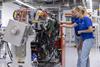
Bosch manufactures the stack and all key system components itself. With more than a thousand individual parts and weighing around 500 kilograms, the FCPM is the most complex system Bosch has ever developed in its nearly 140-year history.

Volume production of the system launched in Stuttgart-Feuerbach in 2023 and a little later in Chongqing, China.

Unlike batteries the manufacture of the FCPM requires hardly any critical raw materials. 

Another major advantage is that the module is designed to fit into the space previously occupied by the combustion engine.

The company said that for freight forwarders and logistics companies, using a truck with the Bosch FCPM is no different than with the diesel technology they are used to, delivering high robustness for the vehicle’s entire service life, short hydrogen refueling times, and a long range of up to 1,000 kilometers per tank. Moreover, the powertrain module enables almost whisper-quiet operation without vibrations, the company added.

The powertrain modules already in use by customers are also collecting data for further development. Each FCPM has a double existence: one in reality and one as a digital twin in virtual space. Bosch uses this to collect specific information on things like temperature, pressure profile, and wear, drawing key findings that have already been incorporated into the development of the second generation.

In addition Bosch is using the technology developed for the FCPM for other solutions. One of these involves reversing the principle of the fuel cell: instead of generating electricity from water and oxygen, the company also offers technology for electrolyzers that produce hydrogen from water and renewable electricity – in a climate-friendly way. In addition, the FCPM can power ships or, say, provide data centers with zero-carbon electricity.

Bosch has already received the Deutscher Zukunftspreis three times and is now hoping for a fourth win.

The key factors in the jury’s decision are the degree of innovation as well as the potential to turn the achievement into sustainable jobs and create added value for society.

The Deutscher Zukunftspreis 2025 will be awarded in Berlin on 19 November.