








![Mercedes-Benz_eActros_600_(1)[1]](https://d2cohhpa0jt4tw.cloudfront.net/Pictures/274x183/8/1/8/17818_mercedesbenz_eactros_600_11_556244.jpg)




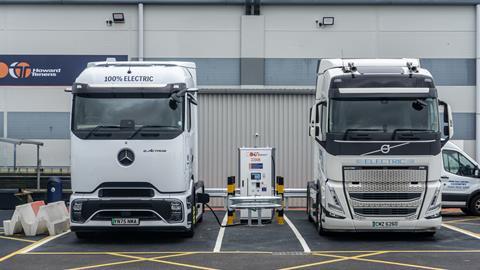

Howard Tenens Logistics has taken delivery of two new electric HGVs during a Project Jolt trial of electric trucks, after being impressed with the vehicles’ performance.
Project JOLT (Joint Operators Logistics Trial) is a three-year research project investigating the commercial and operational viability of eHGVs.
The three-month trial is allowing Howard Tenens to get first-hand experience of running electric trucks on a variety of routes out of its Swindon depot.
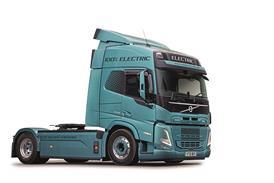
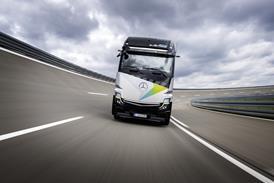
The company said it was impressed by the Mercedes e-Actros 600 and Volvo FH42TE impressive range, which have shown they are capable of a range of journeys out of the Howard Tenens Swindon depot. These tend to be under 500km and with a net payload of 22t or less.
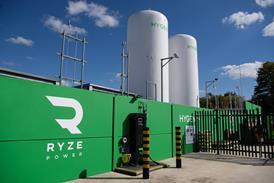
The company’s investment in its own 320kW charging infrastructure means the vehicles to be charged between shifts, allowing the trucks to be double shifted, achieving up to 750km of vehicle operation in a single day.
Based on the success of the trial Howard Tenens has decided to buy two more electric trucks, the first of which arrived in August. The new additions to the fleet will add to the company’s other low carbon technologies, such as Biomethane and HVO-powered trucks.
Alongside this, the business is using insights from the trial to model how battery electric HGVs could support its long-term strategy.
This includes assessing what percentage of the fleet could transition to electric and forecasting the energy and charging infrastructure that would be required to support a future rollout.
Howard Tenens said the trial has helped align its transport operations with a broader property and energy strategy.
The firm has already installed 7MWp of solar generation capacity across its 4.7 million sq ft estate.
It is currently exploring large-scale battery storage and Vehicle-to-Network (V2N) solutions to harvest this self-generated power to fuel its future electric fleet.
Peter Evans, strategic operations director, said: ”While we are keen to introduce more electric vehicles, our strategy is to use a range of technological solutions to decarbonise our fleet and safeguard our operations.”
At the ground level, Swindon transport manager Kristina Gough highlighted that manufacturer and dealer support remains critical to maintaining strict vehicle uptime.
Her job is to keep the fleet moving so she depends on reliability. Her immediate fleet is 30 trucks, of which one is programmed to be off the road at any one time for maintenance.
To maintain this regime, she will be dependent on the performance of the electric truck itself and the support service from the vehicle manufacturer and its dealer.
She is embracing the future and recognises that Howard Tenens will use a mix of technologies to achieve their net zero targets
”Drivers were initially concerned about the range of electric trucks, but they are more comfortable now and enjoy the driving experience,” she said.
Project JOLT is led by Professor David Cebon of the University of Cambridge and the Centre for Sustainable Road Freight.
The initiative is made up of 15 fleet operators, five OEMs, and three enablers.
The project is currently in its sixth “round robin” iteration, where participating operators receive free use of two eHGVs for two separate three-month periods.
Beyond operational trials, Project JOLT is expanding its research into the critical area of fleet procurement, notably eHGV residual values.
Prompted by the RHA, the project has launched an intensive study into the secondary market for electric trucks.
The team has already completed two rounds of industry interviews and hosted a dedicated workshop to help operators better forecast the total cost of ownership for electric commercial vehicles.