












![Mercedes-Benz_eActros_600_(1)[1]](https://d2cohhpa0jt4tw.cloudfront.net/Pictures/274x183/8/1/8/17818_mercedesbenz_eactros_600_11_556244.jpg)





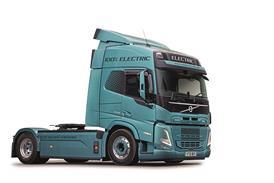
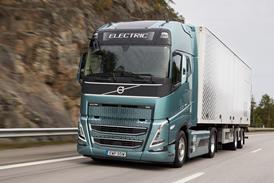
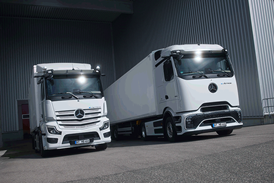
Expanding eHGV use is not limited by the availability of vehicles; instead it requires government support for risky investment in chargepoints away from home depots, as well as solutions for Europe’s overwhelming number of small fleets with five vehicles or fewer. That was the view from Staffan Rodjedal, Director Transport Industry Transition at Volvo Group Trucks Technology, who told a session on electrifying HGVs at the Enlit conference in Bilbao that although Volvo now has 10,000 eHGVs in operation “competition is hardening” among eHGV manufacturers.
Rodjedal said HGVs taking short trips and returning to the depot to charge at night (using cheap power) could have a lower total cost of ownership (TCO) than its fossil alternative. However, that was not the case for vehicles traveling longer distances that required energy of 650-750kWh per day and needed to recharge away from their home base. Where fast charging is available away from home the electricity price is higher than overnight charging at home.
He did not put his faith in regulations and charges intended to make eHGVs more attractive than the alternative, saying they varied between EU member states, because they were effected through national regulations, rather than EU-wide. He suggested the price of carbon would also remain a “weak lever”, at least in the next decade, because issues such as the continuing use of gas made it politically difficult to allow the carbon price to rise very far.
What was needed, he said, was support from governments to de-risk investment for electricity networks and charging point operators. Europe would require 15,000 350kW chargers and 35,000 700kW chargers, along with low-power overnight charging, and this would require anticipatory investment because in the early years they would be under-utilised.
He also highlighted the lack of finance available to small operators to invest in new vehicles, and their lack of forward visibility of contracts – banks would require full capacity guarantees for several years ahead but operators with a few trucks typically had six months visibility.
Rodjedal’s comments were echoed by Julio Martin, expansion director at Spanish electricity utility Iberdrola. He said MCS chargers that would charge trucks within a 40 minute driver break period “completely changes the market dynamics”. He added, “We need to put money into chargers now”, but because of the initial under-use identified by Rodjedal it required “a player who can take a five to ten year view”.
Martin claimed that role for Iberdrola, which had installed 200 MCS chargers in Spain – just the first step towards the total 5000 MCS chargers that would be needed in the country. Martin said Iberdrola had a fleet of 60 operational trucks and it planned to build a charging hub within the next three years with 20 fast-charging points. He said there had been a fundamental shift: while truck sales in the first half of 2025 were down by 15%, eHDV sales were up by 45% - “We are “seeing a decoupling in market dynamics and the pace will accelerate.”