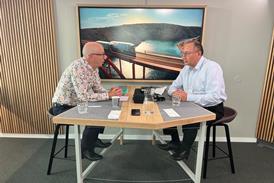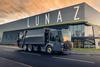


Lunaz Technology is a new entrant into the carbon zero truck space, specialising in upcycling commercial vehicles to battery electric. We went to the brand new Lunaz factory to meet Founder and CEO David Lorenz and Chief Technologist Jon Hilton to find out what’s going on.

If you’ve had reason to go to Silverstone of late, chances are you’ll have already come across Lunaz. The company has just taken up residence in a huge 18,500 square-metre factory at the Silverstone Technology Park across the road from the motor racing circuit and with its logo emblazoned over the door it’s hard to miss. The company has also been chewing through the column inches of the business and passenger car press with the work it has been doing converting top of the range sports and luxury cars to carbon zero. Oh, and yes it lists David Beckham as one of its shareholders. Which is all very well, but what has it got to do with trucks?
As well as top-end sports cars for the rich and famous, Lunaz is focusing on converting commercial vehicles to battery electric, initially giving the Mercedes Econic chassis the upcycling treatment. The business is founded by David Lorenz, an unlikely addition to the commercial vehicle decarbonisation ranks having cut his teeth running exclusive nightclubs and restaurants in London, but he has a vision and passion for the decarbonisation of the vehicle sector, which involves re-using former fossil fuelled vehicles rather than exporting them (and their emissions).
“This is the fundamental problem,” Lorenz explains. The industry is sleep walking into an issue, he says, which means we will be exporting vehicles and emissions to other countries in the world or sending them to the scrapheap. “We have all these vehicles which already exist, so I wrote a business model to upcycle these vehicles.” Armed with the business model, Lorenz recognised that, as well as money, he needed an engineer to bring his initiative to life. “I spent 11 months looking for the right engineer,” he continues, “and by chance I sat next to Jon (Jon Hilton, Chief Technologist – more from him later) on a flight and we got talking. I explained about this business idea that we should be making these vehicles electric.” A follow up meeting followed “he declined me at first” and finally Lorenz got his chief engineer. “Our one rule was, we do it with absolute quality and we don’t cut corners,” Lorenz added.

His pairing with Jon Hilton as his Chief Technologist is a similarly unlikely collaboration. Hilton’s CV is a powerful combination of motorsport and complex automotive engineering and brings an in-depth knowledge of the automotive sector, now applied to commercial vehicles which is set to ensure Lunaz performs at the highest level.
“I’m a chartered engineer by profession,” Hilton explains, “I spent 17 years working in Formula One motor racing. I was technical director of the engine division at Renault, when Alonso won the championship. Since then I’ve run my own business, making hybrid systems for race cars and diggers, trucks, buses and refuse trucks.”
As well as people, obviously you need money and Lorenz has built a powerful group of high net worth funders to bankroll the business. “I have invited individuals on board that I believe can have an influence on our future,” Lorenz says. “They believe in the long-term vision, every investor is coming on a 25 year journey as a bare minimum. I don’t want anyone with a short-term vision. For us, the only way to be successful is if we have impact, which is going to take time. It’s not about how many trucks we sell [this year]. It’s about having factories we can build and how much impact you can have around the world.
“If you’re a fleet operator and you have 2000 vehicles and you want to acquire 2000 new electric vehicles. That’s great. But the 2000 vehicles you had are likely to end up in less privileged countries and we’re in a worse position than we were 25 years ago. Open up your eyes and realise the road we’re going down. That’s the natural driving force that’s behind me and the team here.”
Upcycling
Lunaz has trademarked the phrase Upcycled Electric Vehicle and is keen to differentiate itself from the converters, upgraders and retrofitters also active in the market. There isn’t a glider chassis in site and, so far at least, the company has a unique market offer. Jon Hilton takes up the story: “Everything we do here is upcycled. We spend a lot of time talking about electrification, but our business is really about recovering the embedded CO2 that was in that truck when it was built,” he explains. “For us upcycling is something quite different from refurbished or converted. We could do an electric conversion to a diesel truck – bring it in, take out the diesel stuff, put in batteries and electric motors, and drive out without touching the rest of the truck. That could be worth doing for a truck that’s only one or two years old and you’ve got the remainder of its first life to recover the cost of the conversion.
“As soon as the vehicle is older than that, conversion is starting to look unattractive, because you’ve got to recover the money over a relatively shorter time. So now, you might say let’s refurbish it. You might replace the wheel bearings and other wear parts and put it back to how it was when it was new. We would say that was refurbished and electrified.
“Then you could go one step further, which is what we’re doing. We call it upcycling: electrified, refurbished and bring in all the other systems on the truck up to the standard one would expect in 2023: We’re adding cameras instead of mirrors; we’re updating the central dashboard; we’ve replaced the instrument binnacle with a new one of our own design. The whole plastic facia is new, partly because we need to display new information range warning lights for electrical which we’ve incorporated properly and display for our two-speed gearbox, which is one of the unusual features in our drive train.”
It’s not just the cab that gets the upcycling treatment every aspect of the truck (and body) is brought back to as-new condition. “Obviously we strip out the powertrain,” Hilton continues. “The things that are not going back on the truck are removed. We take off all the air pipes and the brakes which get replaced with new. We pull all the wiring loom off and out of the way and we bring the whole chassis back to bare metal and repaint everything. We then rebuild the whole truck with every moving joint replaced every suspension item, every flexible hose, all the brakes are replaced – new callipers, new discs, new everything.” In some cases, nylon bushes for example, Lunaz upgrades the original equipment, to brass in the case of the bushes as “it’s much harder wearing and we want the product to have a long life,” he adds.
“We install the electric driveline, which includes the main electric motor and of course ancillary motors for the air compressor that runs the brakes, the PTO, the cab heater etc. The “clean” re-build of the truck takes place on a production line, much as you would see, for any of the mainstream truck manufacturers.”

By weight, 82% of the componentry on the truck is replaced, with Lunaz refitting the remaining 18% with its battery electric driveline. “It reduces the work on our site dramatically and it makes the product much quicker to market,” Hilton continues. “We’re taking a really good, proper, reliable product that Mercedes has built and tested thoroughly. If you look at the other people doing electric trucks, we don’t have the same challenges to make the whole vehicle work. With the Econic, we’ve chosen a really well-made truck, the biggest seller in Europe, and we can enable it to live the life it was designed for. Mercedes designed this truck for a B10 design life of half a million miles, yet in certain applications, like the refuse truck, people use the first 100,000 and call it done. It’s madness.”
From afar you could be forgiven for thinking Lunaz is just another company dabbling with conversion of bin wagons. You’d be wrong! Granted, Lunaz is a business in its infancy, but it has a massive ambition. David Lorenz believes he has struck on a scalable concept which will see the business expand across the globe with five factories all doing the same thing as they are in Northamptonshire. Initially the business is working with the Mercedes Econic, but expect to see other makes and configurations coming down the line in the future.
Lunaz is a hugely impressive business and has a concept which makes logical sense. For Lorenz to have secured the financial backing necessary to bring the ambition to life, the commercial terms must be in place to ensure the business will be profitable. “I’ve got a long-term plan in my head which will ensure we maximise the life of vehicles,” he says. “When you think about upcycling the vehicle we’re currently picking up what’s available [in the market] today. For new vehicles released now and in the future, I would like to see that come to our factory in seven years, and upgrade its technology, restore it and put it back to work.”