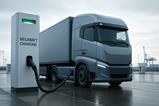
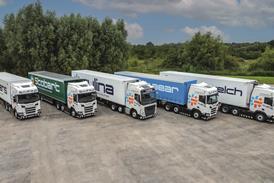





Electrification of domestic electric vehicles (EVs) is expected to spread to further transport segments such as medium and heavy-duty trucks, according to scenarios in the International Energy Agency’s annual World Energy Outlook (WEO), with China central to the expansion in all versions of the future.
Rather than making predictions of what will happen, the WEO sets out several potential scenarios for future development of the energy sector and their implications, as input for policymakers.
WEO scenarios that are a consequence of current and proposed policies both result in further electrification of HGVs, although to different extents.
The WEO’s underpinning assumptions are that road freight is responsible for around 40% of road transport energy demand today, more than 90% of which is fuelled by oil. Road freight comprises light commercial vehicles, which have a gross weight of less than 3.5t, medium freight trucks (3.5-15t), and heavy freight trucks (more than 15t). Oil’s share of energy consumption in the transport sector was over 92% in 2015, but fell to 90% in 2024, “reflecting the expanding use of electricity, bioenergy and natural gas”.
Current policies
In the ‘Current Policies Scenario’, the IEA sees rising demand for passenger and goods transport, especially in emerging market and developing economies. As a result, transport energy demand in 2035 rises more than 10% higher than the current level. The scenario sees energy use in heavy freight trucks rise nearly 25% to 2035, which accounts for over 80% of the total growth in road freight energy demand. Oil continues to dominate energy use in the sector out to 2050.
Overall for electric vehicles in this scenario, China accounts for more than 50% of vehicles sold globally in 2035, and Europe for another 30%. Elsewhere EV deployment is slower, with the EV market share remaining close to current levels through to 2050. Electric heavy freight trucks accounted for just under 3% of global heavy freight trucks sold in 2024 and this rises to around 15% of global sales in 2035, mainly in China and the European Union.
The growth of electric heavy freight trucks in these regions is driven by cost competitiveness in China and by CO2 standards in the European Union.
As regards alternatives, powertrains such as hydrogen take only 1% of global sales. However, the report says that in the current policies scenario the LNG heavy freight truck fleet more than doubles to 2035. It notes that sales of LNG heavy freight trucks have been rising, mainly in China, where around 1 million vehicles were on the road in 2024.
The scenario also suggests very little improvement in transport efficiency (for cars, trucks, aircraft and ships) as it assumes that standards are not strengthened any further after their specified policy period.
Stated Policies
The WEO’s second scenario (‘STEPS’) is based on so-called ‘Stated Policies’ that countries have floated but not yet implemented.
In this scenario, oil continues to dominate energy use in the transport sector, “but this is slowly changing”, largely due to electrification. By 2035, electricity accounts for 6 per cent of global transport energy demand, and “some parts of the world, eg Japan, United States, Canada, China and Europe as a whole, have already passed peak oil consumption in their transport sectors”.
Fuel economy standards and zero emissions vehicle mandates will combine with technology developments to increase the uptake of EVs. By 2050, half of the global light-duty vehicle fleet would be electric. Sales of electric buses would rise to 45% of total sales by 2050, helped by ‘market pull’ because electric urban buses help to improve air quality.
In this scenario, the WEO says “Electrification is also reaching vehicle types that traditionally have been challenging to progress beyond oil use. In the STEPS by 2050, nearly 25 per cent of the global heavy truck fleet is electrified, a total of around 25 million vehicles”. Growth is fastest in China (where the WEO says electric heavy trucks are already becoming cost-competitive, thanks to low electricity prices and policy support), the EU, Japan, Korea and the UK.
As with the ‘current policies’ scenario, natural gas gains in importance in transport, “particularly in shipping and long-haul trucking”. Once again China leads growth, because “policy support and a favourable natural gas price environment encourage the adoption of LNG heavy-freight trucks”.
Bioenergy remains a key alternative to oil in transport in the STEPS scenario, although it is supressed by the rise of electric vehicles. “Blending mandates continue to support bioenergy use in many regions,” so that by 2035, it accounts for 20-30% of transport energy use in Brazil and Indonesia, and close to 10% in the USA and the EU. Growth opportunities are limited by the widespread electrification of vehicles (especially for bioethanol in domestic vehicles). WEO suggested that the industry might grow if new applications were found, “particularly [if that was] in the heavy-duty transport sector, where there is a higher level of uncertainty about the lowest cost routes to decarbonisation”.