




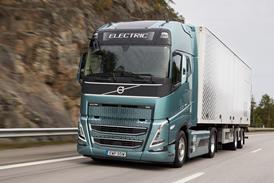
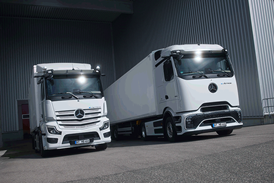

For fear of sounding like a broken record coming up with yet another barrier for the industry to overcome on its journey to decarbonisation, we feel we should raise an amber flag on the ubiquitous (in the UK at least) 6x2 tractor unit.

We raise this and other points, not as a delaying tactic on the carbon zero journey, but because it is essential we get all the issues out in the open, deal with the easy stuff and put the engineering brains to work on the tricky bits. From what we know so far, the 6x2 UK tractor unit sits in the tricky pile. To understand why, first a history lesson…

Back in 1999 the UK introduced new regulations covering the maximum weights and dimensions of commercial vehicles, broadly aligning the UK ‘Construction & Use’ regulations with EU rules. The new rules introduced the concept of ‘Road Friendly Suspension’, allowing suspension systems deemed less damaging to road surfaces to operate at higher plated axle weights than traditional steel suspension. All this was designed to offer the best payload capacities, within the confines of the UK network taking into account road and bridge strength.

This new legislation signalled the move to 44 tonnes gross vehicle weight for six-axle combinations for regular work in the UK – previously 44 tonnes was reserved for multi-modal journeys. The legislation meant a specific UK version of a 3-axle artic was required with mid-lift or steer axle, as opposed to a tag axle. The first 6x2s were built in the UK by 3rd party converters, before production volumes grew large enough for the UK 6x2 to be a full production line model from the truck builders. From the new legislation in 1999 it took around four years for all OEMs to have an ex-factory UK specific 6x2 artic. The 6x2 tractor is now the single largest category of heavy commercial vehicles on UK roads today.

Vehicle payload is not only about efficiency of course, it drives the behaviours and capabilities of other industries. Agriculture, food processing, chemical processing and aggregates, for instance, base their operations on loads or product batches of 28 or 29 tonnes. Vehicle weights and dimensions do not just affect hauliers and transport operators, they impact builders, factories, retailers and many other industry sectors.

So what has this got to do with decarbonisation and why are you worried? We hear you say - read on dear subscriber…

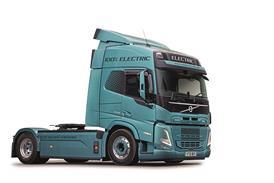
New solutions for heavier electric rigids and 4x2 tractor units are emerging. These vehicles are often touted as capable of 44 tonne operation, which they are from a power and torque perspective, but only in 6x2 tag tractor unit form, which is too long for standard ISO trailers. From what we have seen, a true UK 6x2 battery electric tractor unit does not yet exist.

Even with modern battery technology the space available is not large enough to squeeze in a battery with adequate capacity for the operations carried out today. This is a particular problem for the UK market just like it was 20 years ago when it was first introduced.

We will need a breakthrough of some kind if we want to carry on delivering loads of 25-30 tonnes in the sector. Various solutions have been suggested, such as putting the batteries (or additional batteries) on the trailer or extending overall lengths and/or allowing higher weights. Most of these suggestions come from those outside the industry who are unaware there are more than twice as many trailers as trucks or who don’t appreciate why or how the laws surrounding weights and dimensions have come about, as you have seen they are anything but arbitrary rules.

As we’ve said, in the UK the 6x2 mid-axle (steer or lift) is the single biggest vehicle class, according to the Office for National Statistics there’s over 120,000 of them on the UK roads. The potential impact on decarbonisation is huge, but similarly the impact of ignoring the challenges and getting it wrong will have a major impact on the UK supply chain. We’ll be returning to this subject in the coming weeks, but in the meantime, if you have an opinion and want to join the discussion – get in touch editor@freightcarbonzero.com

After the publication of this article, we have received the following feedback:

Hi Andy,

Good piece on the 6x2 artic in Freight Carbon Zero.

It raises the issue as always as to how many operators really need a 44t 6x2? When I drive on the motorways, a substantial percentage of 6x2s are running with the mid axle lifted. We seem to have fallen into the mindset of everybody buying 6x2s “just in case”. From memory of the annual registration figures, nearly 90% of artics each year are 6x2s. I have heard all sorts of rationale from operators that they need it for Christmas or that residuals are better. All these reasons may be the case but the reality is that they are carting round nearly 1 tonne of dead weight from the 3rd axle which will impact fuel consumption and carbon emissions significantly.

As you say in the article, technical solutions for chassis space on a 6x2 don’t exist at present and I would guess are unlikely to exist in any foreseeable future. We need the DfT to look at ways of solving the challenge of carrying the required payload with a 4x2 artic.

In practice with 19t for the tractor ( if the alternative fuels derogation were to be applied) and 24t for a 3 axle trailer, we have 43t which, taking into account the deletion of the mid lift axle, would give a payload about the same as the equivalent 6x2. You would need care in loading but vehicles that run at 44t tend to have well defined loads that can be positioned accurately.

Italy for example allows 44t with 5 axles and they don’t seem to have any issues.

Interesting times!

Best regards

Martin

Given a HFC tractor unit is over twice the price of a BEV truck which in 6x2 form may be restricted to 250-300 km range then the industry could buy two trucks and swap the tractor en route leaving the spent one to be recharged in the depot and not affecting driver hours or the truck position on its route when needing a recharge…..

Just a thought…..

I am sure the truck manufacturers would approve…!!!

Thanks

Colin R Matthews

If you have any thoughts to share on the topic don’t hesitate to join the conversation at editor@freightcarbonzero.com or get involved in the decarbonisation conversation and comment below. We are keen to hear your thoughts and feedback