







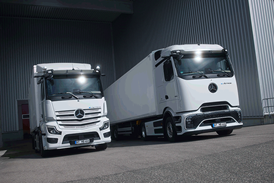

This week we welcome back Stephen Fitter to share his views about longer semi-trailers and the carbon savings going begging due to the bureaucracy associated with the approval process.

Earlier this year saw the end of a trial lasting over a decade into the use of Longer Semi-Trailers (LST). These are vehicles which are up to 2.05 metres longer than a standard trailer and, as a result, can carry 15% more volume. The trial was a success, and the Department for Transport (DfT) reported a reduction in journey numbers and emissions. Not only that, but the vehicles proved they could be operated safely. So naturally, the use of them moved out of test stage and into being a permanent operational choice for businesses and operators.
The extra capacity of an LST equates to 4 additional UK pallets on a single deck trailer, and therefore if you had 120 pallets to move, you could do that in 4 trips rather than 5 required in a Standard Semi-Trailer. To give this further context, a 100-mile trip operating 5 days a week gives a saving of 36 tonnes of CO2e, so great environmental and financial benefits to be had. It should be noted though, that LSTs can only carry the same weight as a Standard Trailer and so suitability is more aimed at lower density cargo. Even so, there are plenty of operators that can benefit from them.
However, it is not all good news, as although the trial demonstrated the benefits of the technology, the legislation introduced at the end of it is proving to hamper adoption. Paperwork requirements to operate one of these vehicles goes to the extent of risk assessing every route and the driver having to have hard copies of the assessment with them, as well as a route plan. Then after the route is done, these are legally required to be kept for two years, as well as compliance checking evidence that shows the driver followed the route and there were no deviations.
The impact of this is that for regular trunk routes, it’s a hoop to jump through but nothing too arduous. After all, the work will be worth the benefits. But for those that have dynamic routes or short-term contracts, it makes their use impractical. Of course, safety must be paramount and risk assessments are crucial in promoting that, but it does feel this needs another look in order to get more of these vehicles on the road, especially as these risk assessment requirements were waived during the trial and the safe operation of LSTs was proven.
It is understandable then that initial enthusiasm for LSTs has dwindled as the reality of operating them has kicked in. It is unclear on what the justifications for such stringent operational measures are, and although there are calls to reconsider, any changes will not take effect anytime soon. Which is a shame, because this is a leap forward in transport efficiency and emissions reduction which does not call on huge infrastructure changes or investment by those companies wanting to make a difference and that can use them. This should not be overshadowed by bureaucracy and red tape.
Let’s hope there is a rethink and LSTs can take a larger spotlight in the decarbonisation of UK road freight transport.


![Mercedes-Benz_eActros_600_(1)[1]](https://d2cohhpa0jt4tw.cloudfront.net/Pictures/274x183/8/1/8/17818_mercedesbenz_eactros_600_11_556244.jpg)