







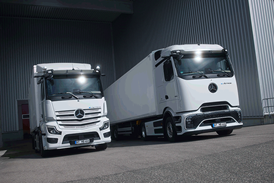

We caught up with Dominic Schofield at the CENEX LCV Show back in September, lighting the fuse for this week’s commentary looking at the role of connected autonomous vehicles in the freight sector. We sent him off to explore whether this is the holy grail for battery electric commercial vehicles…

I’ve been attending the Cenex LCV show for many years now, and in recent years it’s expanded to become LCV/CAM (with CAM standing for Connected Autonomous Mobility). To be honest, until this year I hadn’t delved into the CAM area very much – it seemed a bit too geeky, even for a self-confessed transport geek like me. However, this year I couldn’t ignore it any longer, as it was clear from the presentation programme that this was well and truly off the drawing board and onto the streets.

Since LCV/CAM this September I’ve noticed further evidence that Autonomous Vehicles (AVs) are no longer just hype. In fact, November was quite the month for AV tech. First, the government announced its AV Bill in the King’s speech, setting out a vital legal framework for further development and testing on public roads. Hot on its heels came testing of a fully autonomous shuttle bus in regular service on the roads of Milton Keynes. And finally, hidden in the chancellor’s autumn statement was the announcement that the National Infrastructure Commission was to undertake a study into how the technology can deliver growth for UK plc.

Back in April this year I blogged about the importance of level 4 autonomy, and the bus in Milton Keynes is a perfect example. As a reminder, level 5 autonomy is a vehicle that doesn’t have a driver and can drive anywhere. The ‘anywhere’ part of that definition makes level 5 extremely difficult, as the range of situations a vehicle could encounter is almost infinite. (I suspect level 5 will only be achieved with the integration of sophisticated AI.) However, level 4 vehicles also have no driver, but are capable of driving only within a constrained range of locations – a far more achievable goal.

It’s no surprise that Milton Keynes is a favourite location for testing autonomous vehicles. Unlike most UK cities, it’s streets are wide and regular in design, laid out on a grid system. Before this current bus trial, it’s seen autonomous pods ferrying people around pedestrian areas, and tiny Starship robots delivering groceries.

Level 4 autonomy has the potential to have a major impact on freight operations. At LCV/CAM I caught a presentation on the rollout of level 4 AVs in container ports, and another delivering parts to different buildings in a car plant campus. Both of these examples are running on private land, but the AV bill and the MK bus show the way is clear for trials on public roads, and this opens up more possibilities for freight.

Consider the opportunity for rail freight interchanges. At present, for road and rail to compete financially with driving all the way, the interchange generally needs to be seamless. If a short road ‘shunt’ to a warehouse or between rail heads is required, the cost of this extra handling will often be enough to make it unprofitable.

Sending rail freight north of Glasgow currently often requires containers to be transported by road for the five miles from Mossend to Coatbridge, at a cost per mile far higher than the rest of the journey. Using autonomous (and electric) trucks to carry out these short legs could cut their cost considerably and could open new viable rail paths and warehouse locations.

Going one step further, autonomous trucks could be used to create ‘virtual rail paths’ overnight on the motorway network. Consider an operation in which trucks from around the Southeast converge in the evening to drop their cargo at a depot next to the junction of the M1/M25. Overnight a fleet of autonomous trucks travels north up the M1 (without needing breaks) to drop the cargo in Leeds, while the human drivers get to go home to bed. The motorway is by definition a constrained road environment, well suited to level 4 AVs.

It seems unlikely that AVs will make all drivers redundant any time soon, but they may open up the possibility of more ‘relay’ operations like the one imagined above. By cutting down on overnight driving and nights away, this will help alleviate driver shortages, and would also be more suited to the operation of electric trucks.

Cenex has worked on the feasibility of operating level 4 autonomous vehicles. One example is building the operational and business case for city transport, see our project RUBICON report for more insights Rubicon-Report.pdf (cenex.co.uk). Next year LCV/CAM has new branding as Cenex EXPO, partly in recognition of the greater integration of the CAM part in the field of transport innovation. I for one will be looking forward to seeing what the CAM geeks bring us next.