



From AI-powered customer service and a bespoke transport management system to a waiting list of drivers, Browns Distribution is using better data to sharpen its operation and support continued growth

Walk into most transport offices and you can quickly sense the pressure points: information being chased, updates gathered and people relying on experience to keep everything moving.
At Browns, it feels different. Every movement, every scan, every customer interaction and every operational decision feeds into a wider digital picture of the business. The operation is built around visibility, systems and data, giving the team better information, faster decisions and greater control.
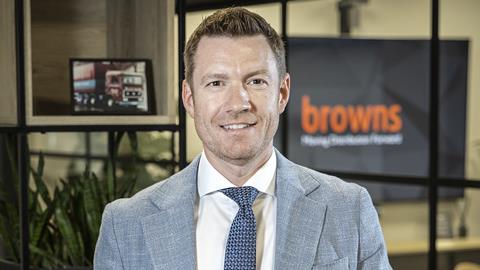
For MD David Brown Jnr, that is simply the way a modern transport company should operate. Every week, the senior management team reviews profit and loss, divisional profitability, fuel costs, agency spend, market conditions and competitor activity. Decisions are expected to be backed by evidence rather than instinct.
But despite leading a £24m business from a new, purpose-built £8.2m facility, Brown comes across as disarmingly modest. One of the more revealing moments comes when he talks about his own workspace.
After relocating to the Stoke-On-Trent headquarters in February 2023, Brown fully expected his old desk and filing cabinets to come with him. But the interior designers insisted he needed new furniture and a much larger room with space to meet customers and staff.
“I remember standing there thinking, ‘This is too big. I can’t work from here.’ I genuinely had imposter syndrome,” he laughs.
These days the office is simply another meeting space, but the story says much about Brown’s priorities. The building itself was never about creating an impressive headquarters. It was about giving the business, its customers and its staff the facilities they needed to work better.
But Brown is equally interested in what is happening beyond his own walls. “I read all the industry news so I can see what’s happening,” he says. “I look at what other people are doing. I look at what other people are not doing well.”
He is often surprised that more operators are not embracing the same approach. “What are they doing if they’re not looking two or three years ahead?” he adds. “What are we doing?”
If something catches his eye, he’ll instantly message the marketing team.
“You’ve got to have the information behind you to make the right decisions,” he says.
That mindset runs through every part of Browns’ operation. Artificial intelligence now handles the first stage of the company’s live customer chat, resolving around 70% of enquiries before they ever reach a member of staff. “If we didn’t do that 70%, I’d need nearly double,” Brown says.
The transport planning team works from live systems rather than paperwork. Vehicle movements, freight allocation and customer information are all visible in real time. Whiteboards still exist, but not for planning. “What we haven’t got is plans on the desk. We’ve not got sheets with driver names on desks; that’s all on the system,” Brown explains.
The same thinking continues in the warehouse. Every pallet is scanned, tracked and allocated, creating a detailed audit trail from arrival to dispatch. If freight does not need to be put away before leaving the site, the system identifies the most efficient route, reducing unnecessary handling.
That emphasis on connected information is now being brought together in Touchbase, Browns’ new transport management system, developed entirely by the company’s own software team.
Rather than adapting an off-the-shelf platform, Browns has built the system around the way its customers actually move freight. It links customers, drivers, warehouse teams and planners through a single live platform, giving customers self-service booking, tracking, invoicing and reporting, while providing operational teams with real-time visibility across every consignment.
“It’s fuel saving,” Brown explains. “Anything that makes us not handle and not touch freight unnecessarily. It all goes down to the bottom line.”
Perfect balance
The most striking thing about Browns is the way all the technology connects. The company is using data because transport is too complex to rely purely on instinct. A modern logistics operation is balancing vehicles, drivers, customers, warehouse capacity, compliance requirements, fuel costs, service expectations and financial pressures all at the same time.
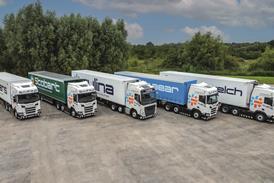
That customer-focused mindset is also helping Browns win new business. The company has recently secured a contract logistics partnership worth more than £1m a year with a Staffordshire manufacturer of commercial warewashing equipment. The agreement will see Browns operate a dedicated dual-liveried fleet, handling both palletised freight and specialist deliveries across the UK and Ireland.
Rather than simply providing transport, Browns has designed a fully managed logistics solution combining dedicated fleet operations with its pallet network capability. It’s the sort of tailored approach Brown believes customers are increasingly looking for.
The phrase is fitting because the same approach applies internally. Browns constantly looks beneath the surface of its own operation.
For some people, learning a new system or exploring artificial intelligence would feel like an additional task. For Brown, it is the opposite.
“It’s not work for me,” he says. “It’s just like, oh, we can do that.”
Brown’s enthusiasm for technology is deeply rooted. His father was an early adopter within the transport industry and went on to build a transport management software business. “Technology and marketing are just a natural interest of mine,” Brown says. “It’s not a chore.”
The design of the headquarters reflects the same philosophy. A vast undercover canopy allows freight to move between trailers and the warehouse without unnecessary handling or exposure to the weather, while trailers themselves are used as temporary holding areas to keep products flowing through the operation.
Cleaner fleet
Technology is not the only area where Browns takes a measured approach. The company has also invested heavily in keeping its fleet young and efficient.
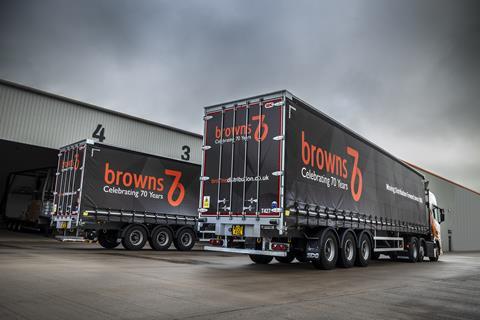
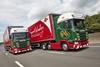
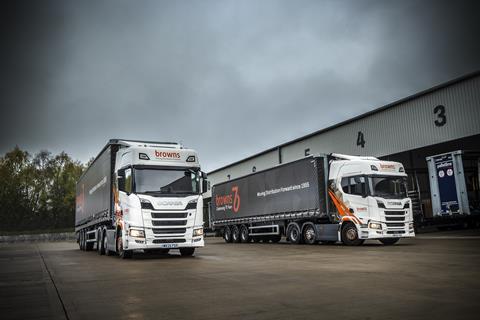
The business currently operates more than 70 artics and around 110 trailers, with an average fleet age of approximately 2.5 years.
“We’re all Euro-6,” Brown says. “We feel we’ve got the cleanest fleet in Staffordshire.”
But while Browns is willing to embrace new technology, tellingly it is not prepared to adopt it simply for the sake of appearing innovative or fashionable.
“We actually don’t run any electric trucks,” Brown says. “We tried some, but we couldn’t quite get it to stack up for our business. The cost wasn’t quite there. We don’t have any dedicated lane movements where we can allocate the risk of battery deficiency. It’s logistics, opportunities and customers.”
What also becomes clear very quickly is that this is not a business trying to remove people from the operation. The systems are there because Brown believes people perform better when they have the right information, the right support and a genuine connection with the business around them.
That philosophy is perhaps most obvious when the conversation turns to drivers. But simply increasing wages is not the whole answer.
“Everyone wants paying more money. It would be nice, wouldn’t it?” he smiles. “But we’re very open with our drivers. We say, ‘look, you see the margins. When the customers can afford to pay more, it comes through. The company benefits, you benefit, we reinvest’.”
“You have to explain it,” he says. “It’s not the operator that’s the problem. We all want to earn more money. But when there is more opportunity, everybody benefits.”
The approach appears to be working. While many operators are constantly advertising for drivers, Browns has built a position where it has a waiting list. Instead of immediately going to job boards, it uses its own network, communicating through WhatsApp and email before moving to platforms such as Indeed.
“We have to be proactive on drivers,” David says. “You can’t just sit there and wait for them to come to you.”
The business also runs open days and an expression-of-interest process for prospective drivers.
“We have guys who want to come and work with us,” he says. “That’s quite unusual, isn’t it?”
Browns has a driver committee, with representatives from the fleet feeding back concerns, ideas and suggestions into the management team. The purpose is not simply to collect complaints; it is to identify issues that can actually be acted upon.
“We don’t call them lead drivers,” David says. “We have a head of that committee, and he listens to the drivers. But we want real meaningful, actionable insight from the fleet.”
The same principle applies to the wider workforce. Browns has invested in a new HR manager, whose role is focused on developing the employee experience beyond traditional HR administration.
The company also holds family days, Christmas events and team activities, all funded by the business. It invests in facilities and tries to create an environment where drivers, warehouse staff and office teams feel connected.
“When we do anything, we want everybody to have an input,” he says.
That approach is visible throughout the site. The warehouse team has its own facilities. The workshop has its own canteen. The drivers have a dedicated reception area rather than arriving through a cramped office environment.
“You don’t want drivers and workshop together,” he says. “Because it becomes, ‘Can you do me this now?’ or ‘Can you fix me that?’ We wanted to give them their own space.”
In the office canteen, customer feedback is displayed on screens alongside recognition for high-performing employees. But David is careful about how this is done.
“We never show the bottom of the league,” he says. “We show the top.”
The team sees positive feedback, performance achievements and customer comments. It creates a visible connection between the work people do every day and the response from customers.
And this is where the technology story comes back, with the customer service team being a good example. The AI live chat system handles the straightforward questions, allowing employees to focus on more complex conversations. The transport office uses systems to remove paperwork and allow planners to concentrate on decisions rather than administration.
Mission control
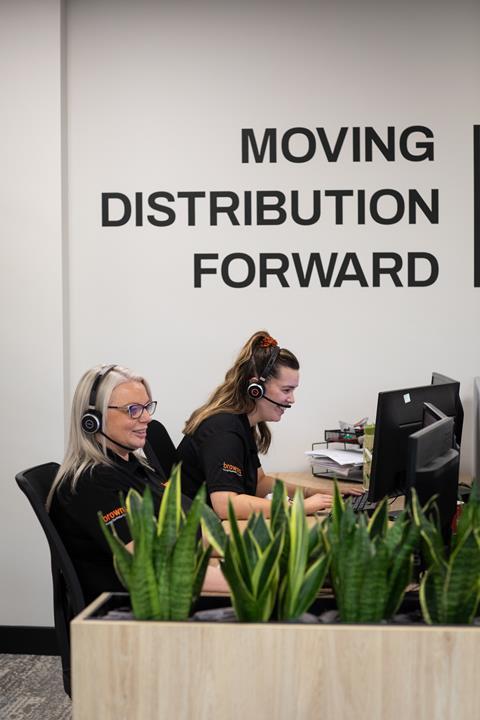
During the tour of the transport office, that difference is obvious. It is busy, but calm. People are working across different platforms, dealing with customers and managing operations, but there is no sense of panic.
“We’re busy. We’re really busy,” Brown says. “But we try and stay on top of it as best as we can.”
The company has essentially created a people-first business supported by technology. And that may be the biggest difference between Browns and many businesses looking at digital transformation. Here, technology is simply the tool allowing the people to do a better job.
He believes there is a danger in relying on traditional methods simply because they are familiar. But the old model of relying on experience alone is becoming harder to sustain.
The business has invested heavily in digital tools, but it has also invested in communication, training and relationships. It has built meeting spaces rather than just more desks. It has created separate areas for different teams. It has encouraged feedback from drivers and employees. The technology provides the information. The culture determines what happens with it.
That is perhaps why Brown is reluctant to describe the firm simply as a technology company or an innovative haulage business. For him, it is still about doing the basics exceptionally well. The technology is there to make those things easier.
One of the strongest impressions from visiting the site is that the systems have not created a colder or more automated business. Instead, they have created more space for people to focus on the parts of the job that matter. The absence of chaos is because Browns has built a structure designed to handle every challenge.
When asked what keeps him awake at night, he initially struggles to identify one single thing: “The financials, the service, keeping people happy,” he says.
But then he considers it further. The biggest challenge is staying prepared. Without resorting to the tired cliché of working smarter not harder, this is clearly a company that changed the way it thinks first, then used technology to support that thinking.
The result is a different kind of transport business: one where AI helps answer customer questions, where data guides decisions, where systems remove unnecessary work and where people remain at the centre.
The wider message for haulage is clear; the future will not belong only to the companies with the biggest fleets or the most vehicles on the road. It will belong to those that understand their operation best.