
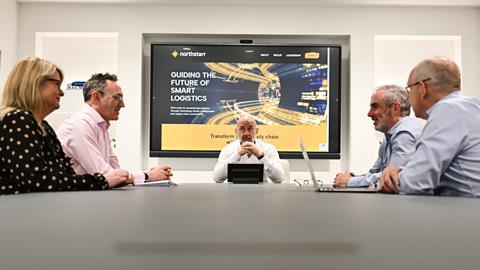

After transforming the fortunes of the Pallet-Track network, chief executive Stuart Godman has launched a new logistics group bringing together transport, warehousing, and technology. He tells Tim Wallace why he believes the future lies in connecting specialist businesses rather than simply building bigger operators
When Stuart Godman arrived at Pallet-Track in 2023, his focus was on the fundamentals: improving efficiency, raising service levels, strengthening relationships, and delivering better financial performance.
The turnaround was swift. EBITDA increased from £5m in 2023 to £7.4m the following year, before reaching £11m in 2025, while revenue grew from £138.4m to £173.2m over the same period.
But improved performance was not the end goal. Instead, the stronger results created the opportunity to ask a more fundamental question: could Pallet-Track become the foundation for something entirely new?
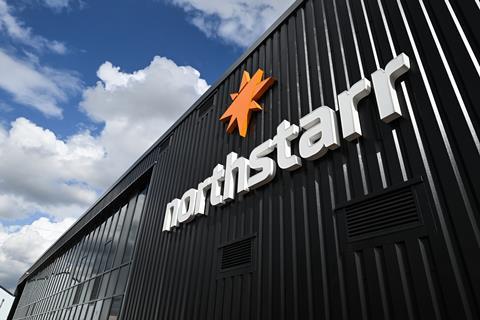
That question has led to the creation of logistics group northstarr, which brings together Pallet-Track, flexible warehousing specialist Sqrrl Solutions, cloud-based transport management provider Truckcom and 4PL operator X2.
Launched in May, the group’s aim is to connect specialist businesses, giving customers and independent operators access to greater flexibility, technology and choice while preserving the expertise and entrepreneurial culture that made those businesses successful in the first place.
On the surface, it could look like another acquisition-led logistics story. But Godman’s approach has been shaped by almost four decades in the sector, spanning large plc operators, independent businesses, and private equity-backed environments.
He understands the benefits that scale can bring but has also seen how acquisitions can fail when businesses lose the culture, customer relationships and entrepreneurial spirit that made them successful in the first place.
Godman believes the future lies in connecting specialist businesses, giving customers access to capabilities they need without forcing them to invest heavily in assets of their own.
“We wanted to build a group that gives our shareholder members and customers more tools in the toolkit,” he says.
He is also keen to stress that northstarr is not an attempt to recreate the traditional logistics “one-stop shop” model, where providers try to offer every service under one roof.
“I dislike that term,” he says. “That’s a real 1980s and 1990s mantra. You become good at some things, but you’re not necessarily excellent at everything. What we want to do is have businesses within our portfolio that people can lean into when they want them.”
It is a subtle difference, but one that sits at the heart of northstarr’s approach. The businesses within the group retain their own identities, management teams, and areas of expertise. The value comes from creating opportunities for them to work together where there is a genuine customer need.
“People are nervous about big costs,” Godman says. “They don’t necessarily always want to go and buy loads of trucks and take long leases on warehouses.
“Everybody got burned from Covid. People are now saying, ‘I want flexibility and only really want to pay for what I’m going to use.’”
The ecosystem
The origins of northstarr can be traced back to the initial stages of Godman’s time at Pallet-Track. After investment from TPA Capital in 2019, the business had already built a strong platform.
“The brief was improving the efficiency of the business, improving the service level, improving engagement and ultimately trying to improve the top line and the bottom line,” he says. “What we probably didn’t understand was just how successful we were going to be.”
That success created an opportunity. Rather than simply pushing Pallet-Track further within its existing model, Godman began looking at what other problems the business could help solve for its members and their customers.
“We felt there was so much more we could do as a team between the management of Pallet-Track and the investors,” he says.
“There was a real opportunity to build a group and look at investments to create more value into an ecosystem.”
The word ecosystem is important because it explains what northstarr is, and what it is not.
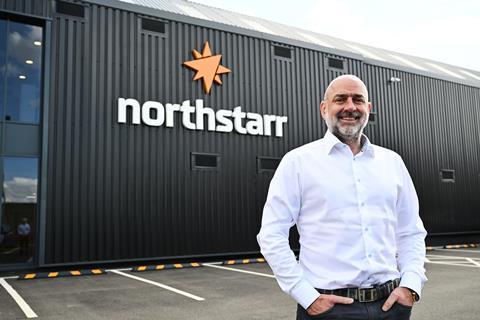
This is not about forcing businesses into a single operating structure or creating a centralised logistics giant. Instead, the idea is that each company continues doing what it does best while benefiting from being connected to complementary services.
The first acquisition was Sqrrl Solutions, a flexible warehousing specialist.
The logic was intricately linked to the realities faced by many logistics’ operators. Some businesses have customers that need additional storage capacity but do not want long-term commitments. Others have warehouse space that is not fully utilised. Sqrrl sits between those two requirements.
“What better way than buying a business that offers a solution that sits in the middle?” Godman says. “Sqrrl can feed into Pallet-Track and Pallet-Track can feed into Sqrrl.”
The company has already secured significant contracts and now occupies more than 700,000sq ft of warehousing space for customers, providing flexible storage capacity without requiring businesses to commit to long-term leases.
Truckcom followed, adding technology capability to the group.
The cloud-based transport management system has traditionally operated in container logistics, but Godman sees a wider opportunity for accessible technology that improves visibility, efficiency, and decision-making across the sector.
The attraction was not simply owning software. It was about giving customers and operators better tools.
“We wanted to invest in tech-driven businesses,” he says. “Sqrrl, X2 and Truckcom are all about enabling businesses.”
The final acquisition was X2, a 4PL transport operator based in Hinckley with 17 years’ experience and a portfolio of blue-chip customers. Again, the rationale was flexibility. Many businesses experience peaks in demand but are increasingly reluctant to invest permanently in additional fleet, vehicles or facilities that may sit unused during quieter periods.
“Now we’ve got a flexible warehousing company and a flexible transport company,” Godman says. “We can help customers deal with peaks without them having to go resource heavy themselves.”
For Godman, the key is that the individual companies remain specialists rather than being absorbed into a generic logistics proposition.
“I don’t understand why people buy brilliant businesses and then think they can run them better than the existing management team,” he says.
“They put their name above the door and expect it to continue to run well. It doesn’t.”
Smarter systems
Technology is one of the defining elements of northstarr’s strategy, but Godman is careful not to present it as a solution in itself. Almost every logistics business today describes itself as technology driven. For him, the question is not whether a company has software, platforms, or dashboards. The question is whether those tools genuinely improve the customer experience.
“Let’s be the easiest company to do business with,” he says. “If you make it easy and you have value, you keep customers. It’s difficult for them to go anywhere else.”
At Pallet-Track, technology already plays a significant role in improving visibility across the network. Scanning systems provide information on where freight is moving, customer portals give greater transparency, and business intelligence tools help operators understand performance and identify areas for improvement.
“In the old days, a trailer turned up, you opened the back doors or pulled the curtains back and thought, ‘there’s volume on here or there isn’t,’” he says.
“Now, as soon as it is scanned out from the collection depot, and it’s en route for three or four hours before it even gets to the hub, we know what’s on it, where it is going and how we can optimise it.”
Artificial intelligence, he believes, will accelerate that process further.
“The AI side is going a lot further,” he says. “It’s about scraping data and disseminating information much quicker.”

However, he is realistic about what technology can and cannot achieve.
“I don’t think there’s one silver bullet,” he says.
“It’s the power of incremental gains such as ten lots of 1% not one thing at 10%. Can we have the right software to optimise driver routes? Can we improve fuel efficiency? Can we give customers better portals? There are lots of things you must do to make that significant difference.”
That incremental approach is typical of Godman’s wider view that the biggest improvements come from a series of smaller gains that collectively make a business more efficient, more responsive and easier to work with.
“Customers expect great technology,” he says. “But they still want a relationship where they feel valued. People still buy from people.”
“It’s not the 99% that you deliver on time that adds value,” he says. “It’s how you handle the 1% that doesn’t go to plan.”
Collaboration
The launch of northstarr comes at a time when the logistics sector is facing a different kind of challenge.
For many years, pallet networks and transport businesses benefited from steady market growth. Today, however, the environment is more difficult. Costs remain high, customer expectations continue to rise, and organic growth has become harder to achieve.
“Doing nothing isn’t an option in this market,” Godman says, hinting that the future will belong to businesses that understand where collaboration can create more value than trying to build every capability themselves.
“Every business has strengths and every business has weaknesses,” he says. “If you’re a good CEO or executive, you can’t be brilliant at everything.”
It’s a philosophy he expanded on during a recent panel discussion at Road Transport Expo (RTX), where he explored how businesses can create more value by working together rather than simply competing for the same opportunities.
For Godman, collaboration only works when it delivers a genuine commercial benefit for everyone involved. He points to Sqrrl’s relationship with industrial property specialist Prologis as an example: one business brings expertise in developing logistics space, while the other understands how to connect that space with customer demand.
“They know how to build sheds and warehouses far better than we do,” he says.
“We know how to sell space in those sheds. If you can monetise and it works for both sides, you get a win-win situation.”
Godman believes pallet networks themselves provide one of the strongest examples of collaboration in logistics. Unlike a traditional corporate structure, a network such as Pallet-Track relies on independent businesses choosing to work together towards a shared objective.
“You don’t own your network,” he says. “You have got around a hundred entrepreneurs. You can’t tell them what to do. You must influence them, explain to them, and show them the bigger picture.”
Godman’s aim is not to remove independence, but to strengthen it by providing access to additional services and technology.
“If they feel they want to use one of these products, fantastic,” he says. “If they don’t, that’s fine. “All we’re trying to do is offer more solutions and create more opportunities.”
Protecting culture
Godman believes culture is the single biggest factor determining whether acquisitions work.
“The reason most M&A fails is nothing to do with strategy,” he says. “It is around culture. Culture eats strategy for breakfast.”
That belief explains why northstarr has deliberately avoided creating a heavily centralised structure.
The businesses within the group continue to operate with their own management teams and brands. There is no intention to force customers to use every service or create artificial synergies that do not make commercial sense.
“I don’t understand why people buy brilliant businesses and then think they can run them better than existing management,” he says. “The reason you bought the business in the first place is because it’s a well-run business.”
That approach also reflects his wider career experience. Having seen both successful and unsuccessful acquisitions, Godman believes the temptation to impose central control can often destroy the very qualities that made a company attractive. The foundation is having respect for the people, the brand, and the customers.
Looking through the windscreen
Northstarr is already approaching £200m in annual revenue, with further acquisitions expected as the group develops.
The ambition is for the business to become a £25m EBITDA group within three years, supported by both M&A and organic growth.
But Godman is careful not to frame success simply around size.
“I’m not interested in growth at any cost,” he says. “It’s about profit, cash generation and making sure our businesses are still here in five or ten years. We spend a lot more time looking out of the windscreen rather than the rear-view mirror.”
The business is being built at a time when traditional sources of growth are becoming harder to find, and when customers are looking for something different from their logistics partners.
They want flexibility without excessive commitment. They want visibility without complexity. They want technology that improves their operations, but they still want relationships with people who understand their challenges.
“We want to be a progressive, tech-enabled logistics group that’s thinking differently,” he says.
Whether northstarr becomes a model that others choose to follow remains to be seen. What is clear is that Godman believes the next phase will not be won simply by owning more assets or offering more services. It will be won by connecting the right capabilities, working with the right partners, and creating businesses that are easier for customers to do business with.
For all the discussion around software, AI and data, his conclusion is a remarkably traditional one. Technology can show where the problem is, but people still have to solve it.