



Trimble has launched a series of AI-powered tools designed to automate routine transport tasks, find loads for spare capacity and help smaller fleets make better use of their existing vehicles.
The technology, being introduced across Trimble’s Transporeon platform, is aimed at everything from procurement and planning to transport execution, visibility and freight settlement, with AI agents able to retrieve information, move data between systems and act on defined instructions.
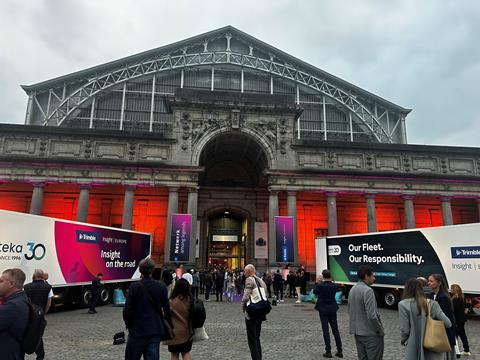
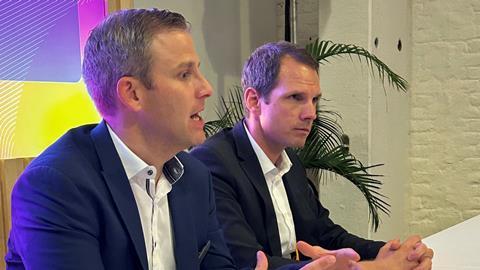
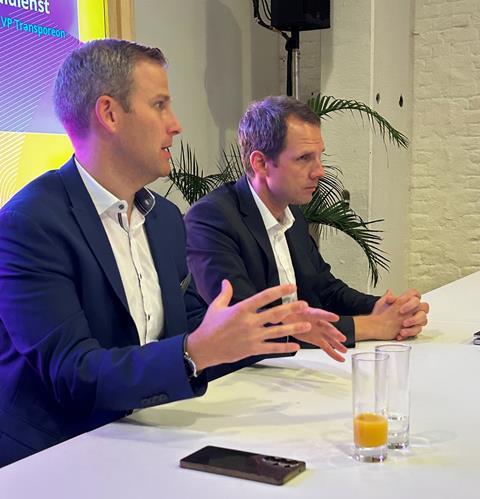
Speaking at Trimble’s Insight Europe conference in Brussels, Philipp Pfister (pictured left), vice-president of Transporeon, said the priority for transport businesses should be to identify specific problems where AI could deliver a measurable return rather than embark on large-scale transformation projects.
For an operator running 10 to 30 trucks, that could mean using Transporeon’s Freight Marketplace to access shipper demand that would otherwise be difficult to find, or using autonomous procurement to identify loads that fit available capacity.
Pfister said operators could set parameters such as lanes, capacity and acceptable prices, with AI then carrying out the work of finding and quoting for suitable opportunities.
“AI can do the work for you,” he said, allowing operators to generate additional revenue while reducing the administrative burden on already stretched office teams.
That ability to automate office work is a central part of Trimble’s AI proposition. Bernhard Schmaldienst (right), associate vice-president of Transporeon Products, said a significant proportion of office knowledge work involved moving information between email, transport management systems and other software.
“Office work is the primary focus,” he said.
Schmaldienst estimated that 30% to 40% of office knowledge work could involve shifting information between systems. AI could, for example, read an incoming email, interpret its contents and post the relevant information into the appropriate system.
That could allow transport businesses to handle more activity without increasing their administrative headcount. Trimble’s proposition goes beyond simple automation, however, with the company arguing that AI agents can increasingly operate across different systems and carry out processes that traditionally require planners or administrators to intervene.
For smaller operators, Schmaldienst said the barrier to entry was lower than it had been in previous waves of technology investment.
“The barrier to entry was never lower,” he said.
An operator could subscribe to an AI agent and connect it to systems it already has rather than embark on a major software project.
Trimble is also positioning AI as a way of increasing revenue rather than simply reducing costs. Its Transporeon platform has introduced autonomous quotation, using AI to identify spot-market opportunities that match a carrier’s available capacity.
Schmaldienst said the system could identify opportunities that a human planner might not have seen.
“Autonomous quotation is able to potentially win them a load to mesh the capacity that a human would never have seen,” he said. “There is a big chance for them to better utilise their own assets.”
The potential benefit is not restricted to large fleets.
“It isn’t an equaliser, because it’s no matter if you’re 10 trucks or if you’re 100 trucks,” Schmaldienst said. “The solution works in the guardrails that you set up for it, but it can do the work for you.”
Transporeon is allowing carriers to test autonomous quotation with a limited number of loads, according to Schmaldienst, providing a lower-risk way of introducing the technology. The financial proposition is also based on allowing customers to start with a specific problem rather than buying into a complete software suite.
Pfister said a customer could begin with an individual operational requirement and expand from there.
“If your problem today sits on your yard and you just want to implement a dock solution, then this is your project,” he said. “You don’t need to implement the whole suite of Transporeon.”
Trimble’s Arc AI offering is currently available from around €1,000 (£860) a month, although Schmaldienst said the cost of computing AI models was expected to fall as the technology matured.
The price does not necessarily represent the entire cost of adopting the technology. Trimble’s proposition also includes the software framework, integration and implementation expertise required to connect AI to an individual customer’s systems and processes.
Schmaldienst described this as building a “harness” around AI models, defining the boundaries and business rules within which they can operate. That is also why Trimble says AI should not simply be deployed wherever it is technically possible. Some transport problems, Schmaldienst said, are better suited to conventional software and mathematical optimisation.
“You want the route to be optimised, deterministic,” he said. “You can solve this mathematically.”
The challenge for operators is therefore identifying where AI provides a genuine advantage rather than simply adding another layer of technology.
Trimble is targeting value within four to 12 weeks rather than multi-year implementations.
Pfister said customers should be able to start with a specific problem, measure the result and then decide whether to extend the technology into other parts of the business.
That approach could be particularly relevant to smaller hauliers, where the financial case for major technology investments has traditionally been harder to establish.
Trimble also sees potential savings in vehicle utilisation and empty running. Pfister said better planning could, for example, combine two part-loads into a single full truckload, with one vehicle travelling a relatively small additional distance rather than sending a second truck on a much longer journey.
“The best decarbonisation is a truck that is not on a road,” he said.
The same principle could translate directly into lower fuel costs and better asset utilisation, although Trimble did not provide a typical financial saving from such an intervention.
The company is also using AI alongside market data to help operators understand how their performance compares with the wider transport market.
Its market and network insights tools allow users to examine measures including rates, carrier acceptance and operational throughput. AI can potentially use that information to support decisions around price, service and carbon, although Pfister said the technology should not be allowed to make the final commercial decision without human oversight.
“The ultimate decision maker needs to still be the one that has to drive the business itself,” he said.
The emphasis on human oversight is consistent with Trimble’s wider view that AI should support transport professionals rather than simply replace them. Pfister said AI should not simply be viewed as a way of cutting jobs, but as a means of reducing pressure on planners and helping companies make better use of scarce people and vehicles.
There are already examples of transport businesses using AI to increase the capacity of existing office teams.
UK haulier Browns Distribution has previously said that AI handles around 70% of its live customer-chat enquiries. MD David Brown said the company would need nearly twice as many staff to handle the workload without the automation. Trimble’s proposition extends that principle across more of the transport operation: taking information from one system to another, finding loads for spare capacity, benchmarking performance and helping operators make better decisions with the data they already generate.
The broader opportunity, Pfister said, is connecting individual transport systems and removing friction between shippers, carriers and customers. That could mean less waiting, better vehicle utilisation and fewer empty miles – benefits that directly affect the cost base of an operator.
But the commercial question for hauliers remains whether those productivity gains will outweigh the cost of deploying the technology.
Trimble has supplied an indicative entry price and a four-to-12-week target for returning value, but has not put a typical pound-and-pence saving on the proposition for an SME.
For smaller fleets in particular, the appeal may therefore be less about adopting AI as a wholesale strategy and more about solving individual problems that currently consume time, capacity or administrative resource.
The next stage of Trimble’s proposition is to extend that approach across more of the operation – automating routine work, finding additional loads, improving utilisation and making greater use of the information transport businesses already generate.
For operators, the question is becoming less about whether AI can be used in transport and more about where it can produce a measurable return.