
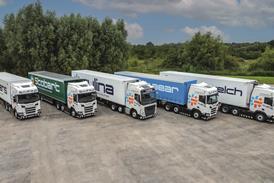





The acquisition of Alan R Jones & Sons proved a painful lesson for Fagan & Whalley, but joint MD Sam Fagan says the South Wales deal has delivered the platform the family haulier wanted as it looks to build its network and navigate a changing market
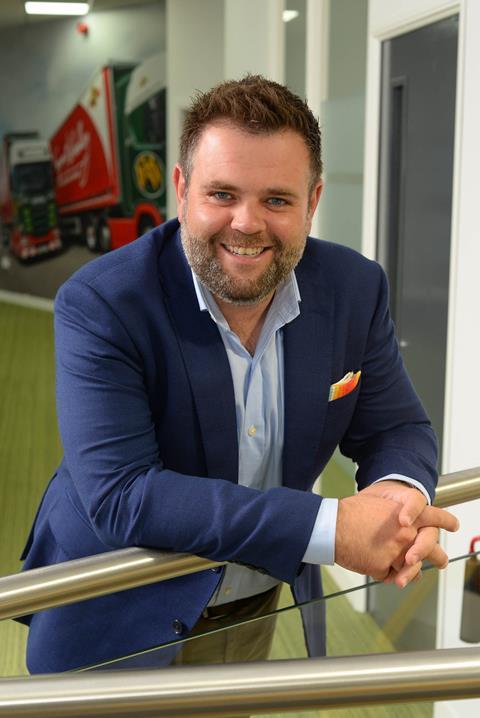
There are easier ways for a family business to understand the challenges of acquisition than by buying another family business. Fagan & Whalley found that out after taking over Alan R Jones & Sons in South Wales in 2022.
The buyout was supposed to be part of a longer-term strategy: building a wider network that would allow Fagan & Whalley to offer a broader service while reducing its reliance on long-distance trunking.
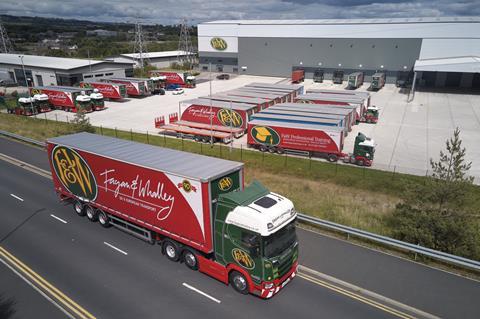
The venture brought 39 HGVs, a 40,000sq ft warehouse and a distribution depot to the group and the business was subsequently rebranded as Fagan & Whalley Newport. But integrating it into the wider operation has proved more complicated than simply putting a new name above the door.
The latest accounts recorded a £1.1m impairment against the investment, contributing to a pre-tax loss of almost £930,000 in the year to April 2025. The charge was non-cash and the operation is now contributing positively, but the experience has clearly left its mark.
“It was gutting for all of us,” admits Sam Fagan, MD – Commercial of the sixth-generation family business.
There is no suggestion that he thinks the acquisition was a mistake. Quite the opposite in fact. The business has retained its customers, safeguarded jobs and now has a functioning Fagan & Whalley operation in South Wales. The challenge was making two businesses, each with their own identity, values and way of working, feel like one.
“But we set off in a business plan and we fulfilled the business plan,” he says. “We can offer every service that the rest of our depots can offer and it contributes positively to the organisation.
“As a family business, you’re proud of your values and you’re proud of your brand and what you do, and you buy something that is equally proud of its own values and brand, but it’s different. The integration of the two is challenging.”
The experience has involved changing the brand, integrating staff and management and, ultimately, trying to make the operation feel like one business.
“What we did in South Wales worked for us,” Fagan insists. “It was a challenge, but it worked. But if you did it again, it might be completely different. It depends what the brand’s like. We bought that with a long-term concept of having a depot from our family business in South Wales. It wasn’t to make money. It was to safeguard the jobs, customers, and the longevity of the business.
“It’s not been without short-term pain but it’s now given us a level platform to grow from when and if the economy allows us to do it.”
Family Firm
Now 36, Sam works alongside Daniel Fagan, MD – Operations, and the wider senior management team as the company looks to its next phase of growth.
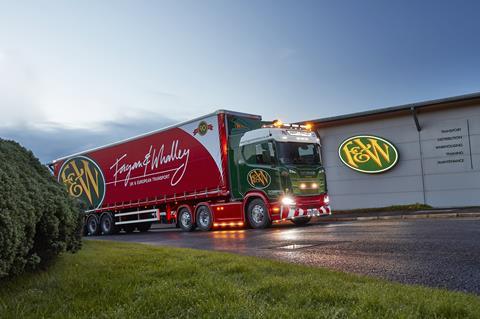
Headquartered in Padiham, Lancashire, Fagan & Whalley is now rather more than a traditional haulier. It provides transport, warehousing and logistics services across a range of sectors, with its own fleet, warehouses and customer service operations, while also working with other operators where that makes sense.
That breadth has become increasingly important in a difficult market. Fagan & Whalley has no grand plan to open warehouses across the country or embark on another acquisition spree. Growth is more likely to come from existing customers expanding, or from finding more services it can provide to them.
“We know that customers’ warehouses have grown in recent years. Logistics has grown in recent years,” Fagan says. “We have the ability to offer that service, so if it complements transport, then why not diversify?”
“It makes much more sense than going buying pie manufacturers,” he laughs.
Instead, diversification keeps the business within what it knows, while making it less dependent on any single part of the transport market.
“We can turn things on and turn things off,” he says. “That’s what keeps us going.”
Wider Network
That adaptability is also behind the thinking on the company’s future depot network.
Fagan & Whalley wants, over time, to develop a network that allows it to move freight around the country while reducing its reliance on long-distance work. A South East depot remains part of that long-term strategy, although there is no timetable attached to it.
Part of the thinking is driver welfare. A more distributed network could allow the business to put drivers on day shifts rather than asking them to spend long periods away from home.
“For any organisation to manage drivers accordingly, manage driver welfare, you’ve got to be heading towards a world where people are on day shifts,” Fagan says. “That’s the key.”
But there could be another reason for spreading the network out – and it has little to do with drivers. Electrification could eventually change the way a haulier thinks about its depots. As electric trucks become capable of longer distances, the depot becomes not just a place to park vehicles but somewhere trucks can recharge and reposition.
That is already beginning to influence Fagan & Whalley’s thinking, even if the technology is not yet suitable for every part of the fleet.
Electric Shift
“If you had spoken to me 18 months ago, I’d have said electrification wasn’t on the horizon,” Fagan says. However, the company now has an electric DAF XD operating on a dedicated automotive contract. It has been used for around 150 miles during a night shift before returning to the depot to recharge, making it a relatively straightforward application for the technology. Another electric DAF XF has now joined the fleet.
But Fagan is equally clear about the limitations.
“If you were to put that on general haulage, no, it wouldn’t work whatsoever.”
The difference is predictability. The electric truck has a defined route between automotive factories in the Midlands, a known distance and a return to base where it can charge. That is a long way from putting an electric tractor unit onto general haulage and expecting it to work in the same way as a diesel.
Yet Fagan believes that distinction will change. The charging network is developing rapidly, he says, just as it has for cars.
“The more people that adopt it, the more the manufacturers will learn, the more the grid will learn, the more the chargers will evolve,” he insists.
The biggest problem increasingly looks less like the truck itself and more like getting sufficient electricity into the depot. Fagan & Whalley already charges electric cars and forklifts and has infrastructure in place, but adding significant numbers of heavy trucks would require considerably more power.
The company is already looking at what will be required to upgrade its depots for electric trucks. It has a 150kWh charger at its Coventry operation, which is sufficient for its current needs, but is talking to distribution network operators about what would be required in future.
The problem is that the cost and timescale involved in increasing grid capacity can be difficult for a family-owned operator to absorb.
“If you’ve got a huge capital expenditure project to put new power into a depot, it’s hard for an organisation like ours to do that,” he says. “The government needs to do more.”
Diesel Debate
That infrastructure question is particularly important because the political backdrop is changing. Fagan had previously expected to still be running the business when the 2040 deadline for the end of new diesel HGV sales arrived.
“I’ll see the 2040 day,” he says. “I’ll still be here leading the business, hopefully.”
But the Conservative Party has now pledged to scrap the planned phase-out dates for sales of new diesel HGVs, putting a question mark over a policy framework that had been intended to give operators and manufacturers long-term certainty.
For Fagan & Whalley, the uncertainty does not make the technology disappear. The company is already having to make decisions about electric vehicles, chargers and depot power, regardless of what happens to a future regulatory deadline. The issue is therefore less about whether diesel is suddenly going to disappear and more about whether operators can see a commercially viable alternative.
Fagan accepts that the industry has to adapt to the direction of travel, but believes smaller operators need a realistic route to get there. The company is already using HVO, with around a quarter to 30% of its fuel purchasing accounted for by the alternative fuel, although he acknowledges that it is significantly more expensive than diesel.
The RHA’s response to the Tory pledge similarly argues for a multi-energy future, with electrification, sustainable biofuels, other low-carbon fuels and hydrogen all potentially playing a role depending on operational need. That may ultimately be closer to the reality facing operators than a simple switch from one technology to another.
Fagan is optimistic that the technology will improve.
“People have still got 14 years,” he says, referring to the 2040 deadline for new non-zero-emission heavy goods vehicles. “In 14 years, we’ll probably be there.”
The deadline may now be politically less certain, but the underlying technological question remains. Battery electric appears to be moving fastest, while hydrogen continues to be discussed for heavy, long-distance applications.
“Everyone I talk to gives me a different story on the solution but it will appear in front of us,” he argues. “And it’ll be a cheaper solution.”
That last point may ultimately prove more important than regulation. If electric trucks eventually offer a lower total cost of ownership, Fagan believes operators will adopt them because it makes commercial sense rather than because they have been forced to.
But customers will have to be part of that equation too. Fagan & Whalley is already talking to them about sustainability and whether they are prepared to pay for some of the additional cost involved.
“If you can work with customers, it’s a partnership in the sustainability journey,” he says.
Tight Margins
For now, however, the immediate pressures are rather more familiar. Fuel, fuel duty, wages, business rates, employment costs and the rising price of trucks have all put pressure on the business. The problem is that rates have not necessarily increased at the same pace, leaving operators trying to persuade customers to pay more while knowing there are plenty of competitors willing to quote less.
“The cost of everything’s gone through the roof,” Fagan says.
Customers can move because of price, service or even people. A driver may move to another company and, sometimes, a customer follows them. But the relationships that last tend to be those where the customer understands what they are actually buying.
“When you work with a customer that understands the true value of what we deliver, that’s why the partnership really works,” he says.

Fagan describes the approach to winning work as similarly “very reserved”. There is no appetite for aggressive sales tactics or chasing business simply because it is available. The company relies on reputation, service and relationships. There will always be someone prepared to do the job cheaper, Fagan says. The answer is not necessarily to follow them down.
“We always try to sell on values and brand and reputation,” he says. “And service. We’re a local organisation and we’re national scale, but head office is very much centred around Lancashire.”
Driver Focus
The company could use more drivers, particularly good-quality drivers, but the recruitment picture depends on the work involved. Day drivers are easier to attract, particularly when the company can offer decent facilities, modern vehicles and better working conditions. Distance drivers are harder.
“The people that want to live in the vehicle are getting harder and harder to find,” he says.
That is one reason the future network matters. A depot closer to customers can mean shorter routes and more day work, making the proposition more attractive to drivers while, eventually, potentially providing another charging location for electric vehicles.
Fagan & Whalley also invests heavily in training. It has a dedicated training team and will take someone who has passed their test but still needs to learn how to operate properly in the real world.
“We’re trying to grow people in the industry,” Fagan says.
Driver welfare is part of that equation too, and it is an area where he believes the industry still has a long way to go.
For Fagan, the ability to adapt is key to navigating what comes next. There is no guarantee that the next acquisition will look like Newport. There is no guarantee that battery electric will be the answer for every truck. And there is no guarantee that the political deadlines now being debated will look the same a decade from now.
But at 36, Fagan has plenty of time to see how the business develops, and how the wider road transport industry changes with it. The lessons from South Wales were painful. But they were lessons. And if there is one thing Fagan has learned, it is that there is no rule book; only the need to keep adapting.