





RHA MD Richard Smith talks to Andy Salter about his plan to put people and wellbeing at the heart of road haulage.
For decades the road haulage industry has measured success in familiar ways: deliveries made; vehicles utilised; costs controlled; and customers satisfied. Yet behind every one of those metrics sits something rather less tangible, but arguably far more important: people.
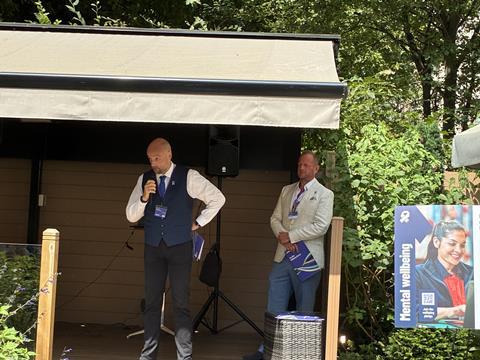
That simple observation lies behind the RHA’s latest initiative, the RHA Wellbeing Charter, which was launched in London on July 15. It is an ambitious attempt to broaden the industry’s understanding of wellbeing beyond mental health alone and establish a long-term framework for improving the working lives of everyone employed across the logistics sector.
Kaieth Mather MP, minister for aviation, maritime and decarbonisation, welcomed the charter, saying it would help the people who work hard keeping Britain supplied with everything the country relies on every day.
Speaking to Motor Transport, RHA MD Richard Smith is keen to stress that this is not another awareness campaign or a short-lived initiative. “The clue is in the title,” he says. “A charter, by definition, is a commitment. It’s a focus. It’s a direction of travel. It’s not just a campaign or a one-off event.”
The RHA has deliberately avoided creating a static programme with fixed objectives. Instead, it wants to build a framework that evolves with the industry over the next decade, responding to challenges as they emerge while encouraging operators, suppliers and stakeholders to contribute to shaping its future.
The charter is built around six broad themes: learning and development; mental wellbeing; leadership and resilience; connecting with others; exercise; and food and nutrition. Rather than prescribing solutions, the RHA intends each pillar to become both a campaigning platform and a practical source of support for operators and employees alike.
For Smith, that flexibility is one of the initiative’s greatest strengths. “We know these areas are issues and challenges, but we don’t know all the answers,” he says. “The answer in five years’ time won’t be the answer today. This is about working together and collaborating to find those answers.”
Each pillar will eventually have two complementary strands. One will focus on lobbying government and influencing policy where structural change is needed. The second will connect businesses with organisations that can deliver practical support, resources or expertise. The objective is deliberately collaborative rather than competitive.
“This isn’t the RHA saying ‘look at us, we’ve got all the answers’,” Smith explains. “It’s about bringing together the industry, trade bodies, stakeholders and members to work out what good looks like.”
Perhaps most importantly, the charter is not restricted to professional drivers. While driver welfare often dominates industry discussions, Smith believes wellbeing must encompass every role across the logistics supply chain. “It’s about everybody who works in the industry,” he says. “Drivers, planners, workshop staff, office teams, managers, business owners. Ultimately it’s about people.”
That broader perspective reflects a reality many operators already understand. Recruitment, retention and productivity are increasingly influenced by company culture, leadership and employee wellbeing rather than simply rates of pay.
Smith repeatedly returns to one central theme: “This is a people industry.”
Technology may be transforming logistics at an unprecedented pace, but the differentiator between successful businesses remains the people who run them.
“The biggest difference between one operator and another is the people,” he says. “Their knowledge, their experience, their passion and the way they work together.”
It is also why the charter deliberately extends beyond mental health, important though that remains. Today’s wellbeing conversation often begins and ends with mental health awareness. Smith argues that approach is far too narrow. “If you say wellbeing, most people immediately think mental health,” he says. “But wellbeing is much more than that.”
Healthy eating, exercise, leadership development, resilience, social connection and professional development all contribute to healthier, happier and, ultimately, more productive workplaces. Some of that thinking is shaped by Smith’s own experience. He speaks openly about supporting his son through mental health challenges and how regular conversations about wellbeing have become normal in his family.
“The first question I ask him now is, ‘How’s your mental health?’ That’s become a perfectly normal conversation.”
Smith believes the industry must become equally comfortable discussing these issues, particularly in a predominantly male workforce where difficult conversations are still often avoided. “If you walked into some truckstops today and started talking about mental wellbeing, people might still shy away from the conversation. It’s getting better, but we need to keep moving forward.”
The challenge is amplified by the nature of logistics. Drivers frequently work alone for long periods, often in isolated locations, while transport managers, planners and operators deal with relentless operational pressures behind the scenes. Incidents such as cargo theft or attacks on drivers illustrate how a single event can affect far more than the individual directly involved.
“If a driver’s curtains are slashed or they’re attacked, that has life-changing implications for the driver. But it also affects the transport manager and the business owner. It’s about recognising all of those impacts.”
The RHA hopes the charter will provide operators with practical routes to support, while helping to normalise conversations that have often remained hidden. Ultimately the association wants businesses to make formal commitments through the charter, selecting actions across each of the six pillars, making public wellbeing pledges and working towards future accreditation.
The ambition is considerable. Smith talks about creating a million moments of improvement across the industry over the coming decade and admits the RHA does not yet know exactly how every one of those moments will be measured.
That honesty is refreshing. Rather than presenting a finished solution, the association is openly acknowledging that building a healthier industry will require continuous development, regular review and input from across the sector. The launch event reflects that philosophy. Rather than simply unveiling a finished programme, it will invite operators, policymakers, commercial partners and industry stakeholders to help shape the next stage of its evolution before similar launches take place across Scotland, Wales and Northern Ireland.
The wellbeing agenda also fits neatly alongside the RHA’s wider policy priorities. Decarbonisation, infrastructure, skills, regulation and trade remain central to its lobbying activity, but Smith increasingly sees people as the thread connecting every one of those issues. “You can’t separate them,” he says. “People are the enabler.”
That thinking extends naturally into one of the industry’s biggest current debates: decarbonisation. Smith believes the conversation has become overly focused on battery electric vehicles at the expense of a much broader range of carbon-reduction opportunities. “Decarbonisation doesn’t mean electrification,” he says. It is a distinction he believes policymakers and the industry alike must make more clearly.
Electrification undoubtedly has an important role, particularly where operating conditions allow, but it is only one element of a much larger transition, he says. Alternative fuels, better driver training, improved diesel efficiency, smarter routing, higher vehicle utilisation and reducing empty running all offer immediate opportunities to reduce emissions.
“We’ve got HVO, we’ve got biofuels, we’ve got opportunities to improve today’s diesel engines, we’ve got the deployment of optimisation to improve efficiency,” Smith says. “Those are all part of decarbonisation.”
His comments closely reflect the conclusions emerging from recent industry research, which consistently suggests operators are looking for practical, commercially viable pathways rather than a single technology solution. The challenge, Smith argues, is creating the conditions that allow businesses to make sensible long-term investment decisions.
“The people who are going to invest over the next five years are already doing it,” he says. “What they need now is certainty.”
That certainty, however, depends partly on government. Smith remains frustrated by the slow progress towards a comprehensive national freight strategy. The promised freight plan has yet to materialise, while wider discussions around freight policy have repeatedly slipped down the political agenda. “We need an evidence-based freight plan,” he says. “We need the right people around the table making decisions based on data.”
Rather than creating another forum dominated by competing interests, Smith would like to see an independent chairperson overseeing a small group of experienced industry leaders capable of developing practical recommendations for ministers.
He also continues to support the creation of a dedicated logistics leadership role within government, arguing that freight deserves far greater strategic recognition than it receives. Without logistics, after all, very little else functions.
For Smith, the wellbeing charter and the wider policy agenda are not separate conversations, both ultimately come back to the same point. Road transport has always been powered by people. Technology will continue to reshape vehicles, operations and supply chains, but attracting, supporting and retaining talented people will remain the defining challenge.
If the RHA succeeds in embedding wellbeing as a permanent feature of industry thinking rather than a periodic campaign, it may prove to be one of its most significant long-term contributions. Healthier people build stronger businesses and stronger businesses build a stronger logistics sector.