
Carl Moore talks to Steve Hobson about growth, technology and the future of the UK’s leading pallet network
When Palletline set out its latest five-year vision, the objective was clear: take a well-established, service-led pallet network and prepare it for a very different future. That future will be shaped by technology, environmental pressures, shifting customer demand, and the realities of a highly competitive and often unpredictable freight market.
Stepping into the business at a pivotal moment, incoming chief executive officer Carl Moore brings three decades of logistics experience – but notably, none from the pallet network sector. His last role was as MD of efulfilment at Wincanton, leaving just as the takeover by GXO was announced. That outsider perspective is already influencing how the business is thinking about its next phase.
“I’ve been in logistics for 30 years,” he explains, “but not in pallet networks. So this is a new sector to me – but there are a lot of similarities too.”
In some ways taking the helm of a burning ship and turning it around can be easier than coming into a highly successful business already having ambitious growth plans – especially when the previous incumbent Graham Leitch has moved upstairs to become chairman of the board.
But Moore is clear that he is not seeking radical reinvention, but rather a carefully managed evolution that builds on a strong co-operative model while embracing new opportunities regarding data, diversification and decarbonisation.
Growth in a tough market
By almost any measure, the pallet network sector remains a difficult place to operate. Margins are tight, competition is intense and profitable growth requires far more than simply grabbing market share.
“It’s a tough market,” Moore says. “Unless you’re going to buy volume, you’ve got to get everything right: the members, the pricing, the volumes and the balance.”
And balance is the key word. Unlike traditional logistics operations, pallet networks rely on the constant interaction of independent members, each with their own territories, customer bases and commercial priorities. Growth that is not carefully managed can quickly create imbalances – too much inbound traffic in one region, too little outbound in another – undermining members’ profit across the system.
Despite these constraints, Palletline has continued to expand. Recent additions such as Swains, Safe and Mobile PPL represent major wins, bringing significant new input volume into the network. At the same time, overall throughput has been increasing, with periods of double-digit growth recorded during peak trading.
Yet the emphasis is not simply on adding more freight. “What matters is the type of growth,” Moore notes. “It has to work for the members.”
The network’s core “sweet spot” remains smaller consignments – typically four pallets or fewer. Larger shipments are still best handled via direct groupage or dedicated transport. But the boundaries between these segments are evolving, and Palletline is increasingly focused on enabling its members to capture a wider range of opportunities.
Beyond pallets
That shift is already visible in the network’s expanding service portfolio. While pallets remain central, Palletline is moving towards a more diversified proposition. “It’s not just about pallets now,” Moore says. “We’re looking at what services we can offer to the membership and the wider market.”
One key development is the launch of Palletline Global Logistics, designed to facilitate international flows and support the network’s European ambitions. Historically, Palletline has been primarily UK-focused, but demand for cross-border solutions is increasing, and represents a clear growth opportunity.
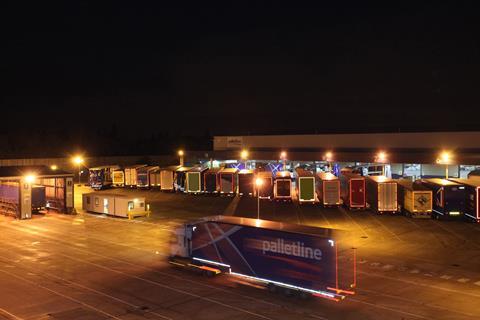
Other initiatives include measures to make more use of hub capacity outside the peak night-time hours and expanded night-time delivery operations. In highly congested urban areas, the latter is becoming increasingly important.
“Night deliveries make a lot of sense,” Moore explains. “Particularly in and around London.”
The aim is to provide tools and capabilities that allow even smaller operators to access larger accounts or more complex requirements.
Unlocking hidden capacity

Perhaps the most transformative element of Palletline’s strategy is the development of a virtual hub: a concept that reflects broader trends towards data-driven logistics.
At present, Palletline has strong visibility of the freight that flows through its hubs. But what it does not see is the much larger volume handled directly by members outside the network structure.
“We see what goes through Palletline,” says Moore. “What we don’t see is the volume our operators have that they don’t put through the network.”
The virtual hub aims to bridge that gap, using data integration to create visibility across all member operations. By linking into existing transport management systems, the platform will allow Palletline to identify potential connections – matching loads between depots and reducing the need for central handling.
“It’s about visibility,” he emphasises. “If we can see it, we can make it happen.”
The potential benefits are significant – reduced mileage, improved vehicle utilisation, and increased capacity – all achieved without major investment in physical infrastructure.
Initial estimates suggest the virtual hub could handle thousands of pallets per day once fully developed, with an initial target of approximately 1,500 daily movements.
Crucially, the approach is pragmatic rather than speculative. “We don’t want data for the sake of data,” he says. “It has to deliver something tangible.”
Technology modernisation
Supporting this initiative is a broader overhaul of Palletline’s IT infrastructure. The network is transitioning from its legacy Contrado platform to a new system, Optima, designed to provide improved integration, usability, and data visibility.
“We’re upgrading the hub platform,” Moore explains. “Optima will give us more visibility and easier interaction.”
Importantly, the system is being designed to work with – not replace – members’ existing transport management systems (TMS). Rather than imposing a single network-wide platform, Palletline will integrate with a range of TMS, allowing data to be pulled in without disrupting local operations.
This reflects a broader theme in the network’s strategy: enabling rather than dictating.
Multi-hub strategy
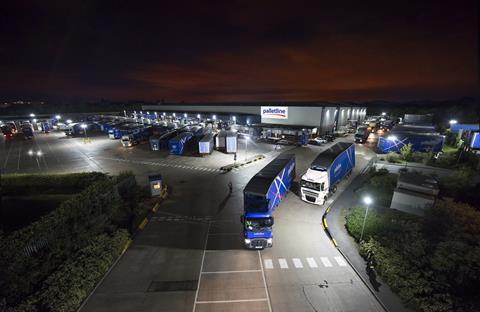
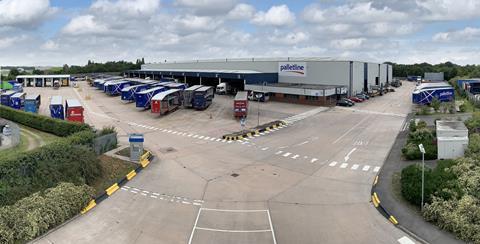
While technology will play an increasingly important role, physical infrastructure remains central to Palletline’s operations. And here, the network is firmly committed to its multi-hub model, with its national hub in Birmingham complemented by regional hubs in Glasgow, Haydock, Coventry and North London.
“We have got a big central hub – we’ve just got more than one,” Moore says.
This provides several advantages. Firstly, resilience. A single hub represents a potential point of failure; multiple hubs reduce that risk.
Secondly, efficiency. By routeing freight through the most appropriate hub, the network can reduce overall mileage and improve operational performance.
And increasingly, thirdly, sustainability. As the industry moves towards electrification, shorter trunking distances and regionalised operations are likely to become essential. “We think multi-hub works,” Moore says. “It reduces mileage and gives us flexibility.”
The network is reviewing its infrastructure as part of its growth plan, with the potential for further investment, including the acquisition of additional sites.
The co-operative model
Palletline’s identity is closely tied to its co-operative structure. Fully owned by its members, the network operates for their benefit: a model that differentiates it from all other networks. “It’s a real strength,” Moore believes. “But it can be challenging, if you let it be.”
One of the biggest challenges lies in aligning the interests of a diverse membership. Some businesses are highly ambitious, seeking rapid growth and expansion. Others are more conservative, focused on maintaining stable operations.
“You’re never going to have every member aligned,” he admits.
Yet that diversity can also be a strength. Members bring local expertise, long-standing customer relationships, and a commitment to service that is hard to replicate in more centralised models. Many are family-owned businesses, some with histories stretching back a century or more.
“They’re proud of what they do,” Moore says. “And that shows in the service.”
Governance structures are designed to balance input with efficiency. Strategic decisions are made by the board, supported by member representation through formal forums such as the commercial and operations steering groups.
“It’s not management by committee,” he stresses. “We still need to be nimble.”
Maintaining balance
One of the most persistent challenges in pallet networks is maintaining balance between input and output. Regions with strong manufacturing bases tend to generate outbound freight, while others – particularly more rural or tourist-driven areas – are primarily inbound.
“Some areas are very imbalanced,” he acknowledges. The South West, for example, often sees significantly more deliveries than collections, particularly during peak holiday periods.
Managing these imbalances requires constant adjustment. Palletline uses a combination of territory realignment, member support, and targeted business development to ensure that no operator is left at a disadvantage.
“If someone is struggling, we look at why,” he explains. “It might be volume, geography, service, and we address it.”
In some cases, this can involve bringing in new members or redistributing postcode areas to create more sustainable operations. The ultimate goal is profit across the network.
Marketing the scale
Despite its size and capabilities, Palletline remains relatively low-profile among parts of its potential customer base. That is something the leadership team is keen to address. “We’re well known in pallet world,” Moore says. “But outside that, people don’t always realise the scale.”
When the combined resources of its members are considered – fleets, depots, warehousing capacity – the network compares favourably with many major 3PLs. Yet that message has not always been effectively communicated.
Increasing brand visibility, improving digital presence and articulating a clear value proposition are all part of the plan.
Decarbonisation
No strategic discussion would be complete without addressing sustainability – and for pallet networks, this is one of the most complex challenges of all.
Palletline is taking a measured approach, investing in infrastructure while avoiding overly aggressive commitments. Solar panels are being installed across key sites, and electric vehicle charging infrastructure is being rolled out. Initial installations include six truck charging stations at the Birmingham hub, supported by government funding with another six planned.
“We’re doing this incrementally,” he explains. “We’ll prove it works, then build on it.”
Member engagement has been central to the process. While enthusiasm varies, there is broad recognition that change is inevitable. “Not everyone wants an electric truck,” Moore says. “But everyone knows it’s coming.”
The network is also exploring alternative fuels and longer-term solutions, recognising that full electrification – particularly for double-decker trunking – remains some way off.
Limits of co-operation
As the industry grapples with decarbonisation, questions are being raised about the potential for greater collaboration – even between competing networks. Shared charging hubs, joint purchasing and co-operative infrastructure development are all being discussed.
Palletline is open to some of these ideas, particularly where they deliver clear benefits to members. “We’re looking at group purchasing,” Moore says. “There are certainly opportunities within Palletline but I can’t see different pallet networks getting together to share buying power anytime soon.
“We compete as well as co-operate. We would have to understand who benefits.”
For now, the focus remains on internal collaboration, although future partnerships cannot be ruled out.
Clear direction
The wider logistics market remains difficult to predict. Economic conditions are flat rather than volatile, with no clear boom or bust cycle. “It’s a strange time,” Moore reflects. “We’re not seeing big swings, just a lot of uncertainty.”
Within that environment, Palletline’s diversity has proved valuable. The wide range of goods moving through the network helps to smooth fluctuations, while seasonal peaks – such as Easter – continue to provide predictable uplifts.
Strong forecasting capabilities are also a differentiator. “Our analytical team is very accurate,” Moore says. “Probably more so than I’ve seen before.”
Long-term growth
Looking ahead, capacity planning is a key priority. While recent peaks have been managed through operational adjustments – including shifting more freight to daytime operations – longer-term solutions are required. That includes investment in new hubs, as well as the potential for temporary pop-up operations where needed.
“We’re designing for the next five to 10 years,” he says. “Not just the here and now.”
The next phase
Palletline’s strategy is not about reinventing the pallet network model. Instead, it is about refining and enhancing it – using technology, infrastructure and collaboration to unlock new opportunities.
At its heart remains the co-operative ethos that has defined the business from the start. “We exist for the growth of our members,” Moore says.
In an industry facing economic uncertainty, environmental pressure, and rapid technological change, that clarity of purpose may prove to be the network’s greatest strength.
The challenge now is execution - turning the vision of “Palletline 2.0” into reality.
And as Moore acknowledges, there is no room for complacency: “We have to be better tomorrow than we are today.”