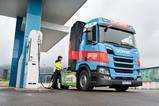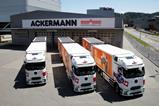




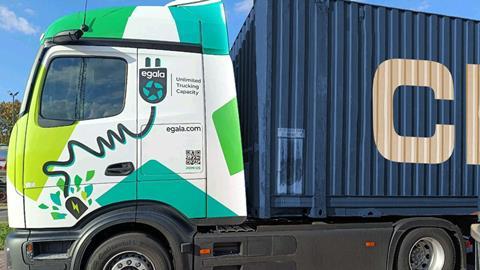

Dutch transport operator Egala is running 20 Mercedes-Benz eActros 600 electric trucks on international routes covering 420–730 km a day, without its own dedicated charging infrastructure. How is that possible?
The answer sounds simple enough: the trucks charge at customers’ depots or public stations. But charging isn’t always quite so straightforward.
Introduced as part of a larger order of 175 Mercedes-Benz trucks, the electric vehicles carry payloads of 10–24 tonnes on routes including Rotterdam–Handewitt–Rotterdam and Handewitt–Hirtshals–Handewitt. They also handle container deliveries from Rotterdam, Antwerp, Hamburg and Zeebrugge. Egala provides transport capacity to customers, allowing them to use electric trucks without buying the vehicles themselves.
Egala says its trucks average 2,300–2,400 km a week in single-driver operations, roughly matching its diesel vehicles. On high-frequency routes, they have achieved 3,500 km a week. On one regular route covering 650–680 km daily, consumption is around 89 kWh/100 km on the lighter outbound journey, rising to 100–110 kWh/100 km on the heavier return.
Depending on the contract, customers either provide charging or Egala’s dispatchers arrange stops for the electric trucks using real-time telematics data on consumption and remaining range. The company favours dedicated drive-through charging facilities and considers Germany and the Benelux countries its most reliable corridors. A typical fast DC charging stop takes 50–60 minutes to bring the battery from 20% to 80%, ideally coinciding with a statutory driver break.
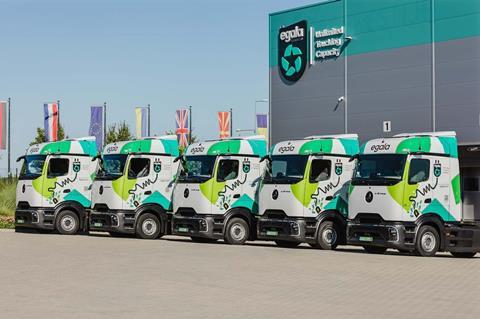
Even so, one of the biggest practical problems is finding somewhere to plug in a full articulated lorry. Many public 300–400 kW charging stations lack drive-through bays, and Egala says its drivers have occasionally had to uncouple trailers to charge.
The problem is familiar in Britain. Dave Rose, founder and CEO of electric haulage specialist Voltloader, told Freight Carbon Zero that his company operates a similar model and helps customers adopt it.
“For a tractor-trailer combination you need dedicated charging either at a depot or dedicated HGV charging facility,” he said. “There are very few of these but numbers are growing and we see increasing commitment.”
Charging costs add another complication. Egala says energy costs can be competitive with diesel at customer depots or with negotiated rates, but high-power public charging carries a premium. “On the whole, building your own capability and charging at your own depot will be cheaper over the longer term,” Rose added.
Germany’s zero-emission HGV toll exemption lasts until June 2031. Egala says these savings can make electric trucks competitive with, or cheaper than, diesel on high-mileage German routes, despite higher purchase prices.
The company is negotiating to install chargers at its bases and plans another 30 battery-electric trucks in 2027.