
Now under private ownership, DX chief executive Ian Truesdale is pursuing disciplined growth, focusing on integration, efficiency and selective investment. Tim Wallace reports
A quiet Italian restaurant in Marylebone holds a lot more appeal for our lunch meeting with DX CEO Ian Truesdale than the company’s head office in Slough. But as he sits over a modest bowl of linguine and a glass of water, there’s no sense of extravagance. That same measured discipline runs throughout the business.
Now backed by private equity firm HIG Capital, DX is generating approximately £470m in annual revenue and more than £30m in operating profit (FY2024), having emerged from a multi-year period of restructuring that restored stability and consistent profit. It is now focused less on recovery and more on integration, efficiency and restrained growth.
“I don’t have a blank chequebook,” he says, laughing at the idea that private equity ownership might trigger freewheeling expansion. “It’s not like that at all. Everything has to have a business case; everything has to stand on its own two feet.”
Truesdale is also quick to push back on any notion that his role is about turning the business around. In his view, that phase is already complete. DX, he argues, is fundamentally sound – he is now repositioning it for its next stage of development.
“I’m not coming in to fix a broken business,” he says. “It’s about repositioning it for where the market is going.”
DX entered a new phase at the end of January 2024, when HIG completed its £307m public-to-private acquisition of the group. The deal marked a decisive change in ownership structure and strategic direction, bringing with it a sharper focus on steadying performance before attention turned to longer-term planning.
Since then, the business has moved through a defined leadership transition. In June 2025, Truesdale replaced Paul Ibbetson, who led the company through the sale process. Under Ibbetson, DX consolidated its position, strengthened service levels and maintained network integrity. Under Truesdale, the emphasis has moved more explicitly towards integration, scalability and repositioning the business as a broader logistics platform. But in a tough market, he is also keeping a tight control on investment.
Truesdale’s remit represents an interesting challenge. “I’ve been an MD, I’ve been on boards, I’ve run large business units,” he says. “But this is the first time I’ve been CEO of the whole organisation. So yes, it’s a step up. I’m not getting any younger, so I thought why not have a crack at it.”
Unification
At the heart of Truesdale’s strategy is a push to move DX away from being a set of separate operating businesses and towards a unified logistics platform.
The company still operates distinct networks – freight, parcels and two-person home delivery – but he sees value in breaking down the boundaries between them. “Customers are now looking for simplicity,” he says. “They don’t want different providers for warehouse, fulfilment, transport and last-mile delivery. They want one integrated solution where it all just works together.”
That, he argues, is where DX has latent capability that has not yet been fully articulated to the market. “And we can do a lot more of that than people probably realise,” he says. “The challenge for us is making that capability visible and joining it up properly.”
That direction has been reinforced by recent strategic moves. In January 2026, DX formed a partnership with Rhenus Logistics, taking over its two-person home delivery services in the UK and Ireland and becoming the exclusive delivery partner for its European proposition. The agreement strengthens DX’s position in specialist last-mile services while extending its reach into wider European flows.
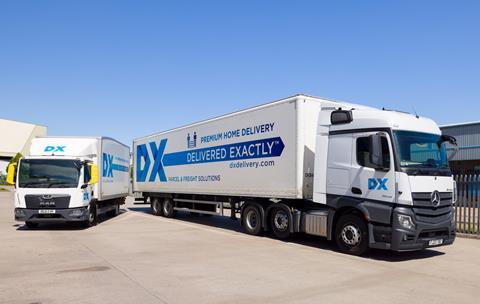
The repositioning from DX Delivery to DX Logistics is part of that shift. But it seems less a rebrand than a signal of structural intent. “We’re not just a delivery network anymore,” Truesdale says. “We can operate warehouses, manage inbound flows, process orders from multiple channels and deliver to businesses and consumers. That’s the direction we’re going in.”
It is, in effect, a move from network operator to integrated supply chain provider.
Hands-on experience
Truesdale looks a natural fit for the chief executive role. His approach is grounded in structure and operational clarity, shaped by a career spent at the sharp end of engineering, manufacturing and logistics.
“I’ve had a lot of roles that were very hands-on,” he says with a smile. “I’ve been down and dirty in the trenches.”
That practical mindset has deep roots. He grew up in Northern Ireland in the late 1970s – “what you’d call bandit country at the time,” he recalls – before his family moved to the West Country when he was nine. The shift brought an early lesson in adaptability.
He began his career as an aeronautical engineer at Westland Helicopters, arriving during the turbulence of the Westland crisis in the 1980s. It was an early introduction to the realities of working inside complex, and sometimes unstable, organisations. He went on to work at Toyota Manufacturing in Japan, where he was trained in lean production principles. Later he moved into consulting and completed an MBA at Cranfield University.
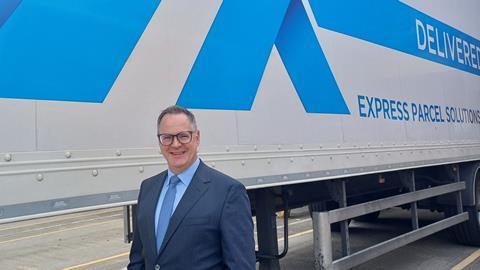
His career then shifted into logistics, beginning with Exel – later acquired by DHL – before senior roles at CEVA Logistics, Kuehne + Nagel and, most recently, Unipart Group.
That mix of engineering discipline, lean manufacturing thinking and large-scale logistics operations continues to shape his approach today. “I try to remove ambiguity,” he says. “People need to know what they’re doing and why.”
He is also sceptical of over-reliance on management theory. “You learn frameworks,” he says, referencing his MBA and exposure to strategy tools such as Porter’s Five Forces. “But leadership is about adapting them, not applying them blindly.”
Much of his learning, he adds, has come from observation rather than textbooks. “I’ve learned more from watching good leaders, and bad ones, than from reading theory.”
Disciplined growth
The restraint Truesdale describes is most visible in how DX plans to expand. HIG Capital sits on the board, alongside an independent non-executive director, while operational control remains firmly with the executive team.
“Day to day, we run the business,” he says. “But there’s a clear framework around discipline, capital allocation and performance.”
“Costs are increasing – wages, fuel, rates – and in a low-margin business you feel all of it. We try to avoid passing all of that on to customers, but you can’t absorb it all either.”
Growth targets are ambitious but structured. “We’re targeting double-digit growth,” he says. “Above 10% year-on-year. Ideally, you’d want closer to 20%, but if we end up around 15%, I’d be comfortable with that.”
That growth, he explains, will come from a mix of organic expansion and selective acquisitions. Recent activity reflects that approach. Alongside investment of more than £12m in a new regional hub in Derbyshire, DX has continued to build out its depot network, expand operations in Northern Ireland through the acquisition of Express Freight, and strengthen its same-day capability – including the launch of a nationwide DX SameDay service.
“Organic growth you can plan,” he says. “Acquisitions are different. You need the right target, the right timing, and the right price.”
And sometimes, he adds, even the right conversation is not guaranteed. “Sometimes they want to talk to you, sometimes they don’t. That’s just reality.”
Depot expansion
DX’s operational backbone remains its national depot network. It now boasts more than 100 UK sites, developed over time through a combination of organic investment and targeted acquisitions.
Recent expansion has included major facilities, such as Kettering and the new Derbyshire regional hub, alongside continued upgrades across the wider estate and selective network extensions in areas such as Northern Ireland.
But Truesdale is careful not to frame infrastructure growth as the defining metric. “The physical network is important, of course it is,” he says. “But what matters more is what flows through it.”
That distinction reflects a broader strategic shift: from asset expansion to capability utilisation.
The question is not how many depots DX operates, but how effectively they are integrated into a single system that can support warehousing, fulfilment and last-mile delivery in combination.
It is also where internal communication has become more prominent.
Since joining, Truesdale has introduced structured company-wide engagement across a business that operates continuously. “We’ve never really done company-wide communication like this before,” he says. “We ran three separate live webinars – morning, afternoon and late evening – so people on night shifts could join as well.”
The reaction, he says, was revealing. “It was the first time people had had that kind of direct update from the top. The feedback was very positive. People want clarity about where the business is going.”
He has also introduced a formal internal strategic framework built around seven pillars covering operational performance, customer service and efficiency. “It’s about removing ambiguity,” he says. “We’ve got to be very clear internally about what we’re trying to do and how we measure it.”
Mechanisation, not automation
Like many logistics executives, Truesdale is wary of overstating AI. DX uses the technology in targeted operational areas, particularly route optimisation and disruption response, but not as a central strategic pillar.
“Some of the routing systems are very sophisticated now,” he says. “They’re using real-time traffic, weather and disruption data. We’re not an AI-led business. We’re using it where it makes sense – to improve efficiency and support decision-making. That’s it.”
Customer interaction follows the same logic: digital where appropriate, human where necessary. “There are chatbots, but they’re still fairly basic,” he says. “Some customers want self-service, others want to speak to someone. We try to support both.”
If AI is incremental, automation is even more constrained. DX operates in a logistics environment defined by irregular freight, complex handling requirements and non-standard consignments. “We’re not heavily automated,” he says. “It’s more mechanisation than automation.”
He insists that the distinction is important. Unlike high-volume parcel hubs designed for uniform throughput, DX frequently handles specialist freight including industrial equipment, irregular loads and sensitive consignments.
“We ship koi carp, for example,” he says. “That’s not something you automate easily.”
The implication is clear: full robotics-led depot operations remain a distant prospect: “You still need people, judgement and care,” he says.
Automation will increase, he accepts, but gradually, and unevenly. “This isn’t a business where robots are replacing depot teams any time soon.”
Fuel strategy
Sustainability is a priority, but one constrained by infrastructure and cost. DX is pursuing a multi-pathway strategy: hydrotreated vegetable oil (HVO) for a significant portion of fuel usage, electric vehicles in subcontracted urban delivery, and Euro-6 diesel for long-haul operations.
“About half of our fuel usage is already HVO-based,” he says. “It’s a practical step forward.”
But the transition to electric HGVs remains constrained. It’s a very familiar tale, even for some of the biggest fleets. “The infrastructure simply isn’t there yet,” he says. “And at the moment, the cost of transition sits with operators.”
This creates what he describes as a structural bottleneck: demand for decarbonisation exists, but system-level investment has not kept pace. “The question is always who pays,” he says.
He has been active in industry dialogue through Logistics UK and the RHA, pressing for stronger incentives and clearer policy direction.
“There needs to be more clarity and more incentive,” he says. “Otherwise the transition is too slow.”
Hydrogen, meanwhile, remains under observation, but not operational deployment.
Cost focus
Beyond day-to-day operations, Truesdale’s thinking increasingly reflects broader economic forces shaping logistics.
He describes the sector as driven by total cost of ownership rather than simple transport pricing, where customers ultimately move towards whichever model delivers the lowest end-to-end cost.
That dynamic, he suggests, is also shaping international competition. “It’s already happening in cars,” he says. “If something is cheaper and good quality, it comes in.”
The implication is that UK logistics is operating within a global cost framework increasingly influenced by government incentives elsewhere, particularly in Asia and parts of Europe.
He is also sceptical about purely domestic policy assumptions. “You don’t really know the counterfactual,” he says of Brexit, Covid and geopolitical disruption. “It’s very difficult to separate them.”
The operating environment remains difficult: inflation, labour costs, weak demand and geopolitical uncertainty. It’s a tough market he readily agrees, but response, in his view, is not prediction but adaptability.
“You’ve got to be agile,” he says. “Try things, see if they work, and if they don’t, change them quickly.”
DX’s strategy is ultimately incremental rather than transformational: integration over fragmentation, capability over expansion, discipline over scale for its own sake.
“We’re not trying to be everything to everyone,” Truesdale says. “We’re trying to be very good at what we do.”
There is no rhetoric of disruption. No claim of reinvention. Instead, there is controlled repositioning under new ownership, shaped by operational pragmatism and private equity discipline.
In a sector where margins are thin, costs are rising and decarbonisation targets are accelerating faster than the infrastructure needed to support them, logistics leadership is becoming less about certainty and more about controlled adaptability.
The message from DX is about disciplined evolution: improving efficiency through data-led routing, investing selectively in automation, and modernising the fleet in a way that reflects operational reality rather than policy ambition.
For now, that means a mixed-energy transition rather than a wholesale switch. It means electric where it works, alternative fuels where it’s viable, and diesel still doing the heavy lifting on long-haul routes.
But the direction of travel is clear enough. As customer expectations shift towards faster, more transparent, lower-carbon delivery networks, the operators that win will not necessarily be the largest but those best able to absorb volatility while still hitting service levels. Or, as Truesdale puts it more simply: “It’s a tough market. But logistics has always been about working through constraints; that hasn’t changed.”