




Microlise chief technology officer Dean Garvey-North warns that the biggest threat to established hauliers could come from new businesses built around artificial intelligence from day one

Last year Motor Transport asked some of the industry’s leading figures to look 120 years into the future. The answers were wide-ranging: autonomous HGVs, drones, robot delivery vehicles, intelligent warehouses and AI-controlled vehicle deployment.
But an even more interesting question is not what today’s haulage businesses will look like in the future. It is who – or what – will build them?
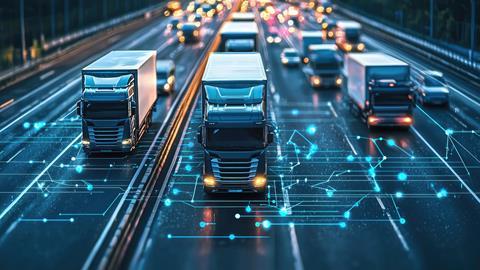
Microlise chief technology officer Dean Garvey-North believes AI could create an entirely new breed of transport and logistics company. One that doesn’t start with a fleet and then bolt technology onto it, but builds its operation around data and AI from day one.
“We will see new organisations start up, even in transport and logistics,” he insists. “Who would have thought that the book industry could be disrupted so fast when Amazon came along and built from the internet out? And now they do everything. We’ll have the same in this new AI era.”
For established hauliers, that is a much bigger question than whether AI can save a few minutes on a planning job. What happens if the next major competitor doesn’t look like a traditional haulier at all? Garvey-North believes the industry is already moving towards that point.
“A lot of operators probably don’t understand that they’re using more AI than they think,” he says. “We’ve built it into our products and I think the general AI that helps route and plan has been there for a while.
“It’s now the agentic stuff. It’s really going to kick on how it learns.”
The agentic leap
That last point is where the conversation gets interesting. There’s a difference between an AI system answering a question or producing a recommendation and one that can learn from what happens after a human acts on that recommendation.
“AI will never know the consequences of its actions, unless we teach it, and that’s where the learning comes from,” Garvey-North says. “It’s like using power tools. If you put your hand underneath a saw, you know it’s going to cut your fingers off. The saw doesn’t know that because it just cuts what’s in front of it. AI is similar. The big difference now is that we can tell AI: no, if I do this, it will result in this outcome. And we need to inform AI that’s what it will be, and then it will self-learn.
“So the more we interact, the more data we give it, the more it will then learn from the decisions that we make, based on the recommendations provided.”
For a transport operator, that could mean moving beyond a system that simply tells a planner what the most efficient route is. The system could recommend a decision, see what the planner actually does, understand the outcome and use that information to improve the next recommendation.
That sounds futuristic. But some of the more immediate applications are remarkably practical with the clearest gains currently coming through route planning and optimisation.
“We’re seeing threefold gains here,” he says.
The reason is that the AI is not simply looking at a generic map. It can understand the vehicle, its dimensions, the roads it can use and the operational data surrounding the job.
“We understand the vehicle you’re driving, the heights, and the roads that you’re on,” he explains. “So we route you the quickest, most efficient route there is. For now, alternative maps or planning may send you all the alternatives, but you’re probably going to hit a low bridge.”
Maybe that’s a more useful way of thinking about AI in haulage. It isn‘t necessarily about some dazzling new capability. It is about making fewer bad decisions. The same applies when the operation is moving in real time.
“Take John Lewis in Manchester: say fleets have been a bit slow today, they’re running about 20 minutes behind, so your schedule needs to be adjusted,” he says.
“We can start doing that now in real time. So there’s no point going to John Lewis to sit in a queue for delivery. I know I can go to Tesco’s first, drop the Tesco’s load and move on. So that’s the real value.”
For an industry operating on tight margins, those decisions are vital.
Data as fuel
There is an important caveat, however. AI is only as useful as the information it has available. The quality of what you put in determines what comes out. That’s why Garvey-North is sceptical of the idea that an operator can simply open ChatGPT and suddenly have an intelligent transport operation. That is why he sees a role for specialist transport technology, where the AI is working from operational data rather than simply answering a generic prompt.
“Because if you ask ChatGPT the same question twice, I guarantee you’ll get two different answers,” he says.
But he’s not suggesting general AI is useless. Instead, he sees an obvious role for it in back-office work, particularly wherever people are spending time processing information.
“Anything that’s analytical, number crunching, and anywhere you typically use an intern, I would say use AI. In fact, some people are using it like an intern.
“But I think there’s a risk with anything that needs reviewing,” he warns. “I’d always recommend a human reviews and questions.”
That raises a much bigger question for established transport businesses: what happens if AI becomes so fundamental that it is no longer something you can simply add to an existing operation?
“We’re building from the ground up, not having an AI bolt-on, because that’s going to cost you dearly in the long run,” Garvey-North says.
For operators, the lesson is broader than which TMS they happen to use. If the underlying systems are fragmented, the data poor and the operation dependent on manual workarounds, adding an AI layer isn’t necessarily going to solve the problem.
And that could create an opportunity for an entirely new breed of transport business.

The biggest threat from AI may not be another operator buying the same software and becoming slightly more efficient. It could be a new entrant starting with none of the baggage of the traditional industry and building an entire transport operation around data and AI.
“Look at how you could then leverage AI, routes and data in terms of how to maximise those margins,” Garvey-North says. “If you think you can’t be disrupted, then take a real hard look at what’s happened and what history tells us.”
For an industry accustomed to talking about consolidation, fleet investment and the cost of capital it’s a point worth considering. What happens when somebody comes along who doesn’t think of themselves as a traditional haulier at all?
That doesn’t necessarily mean the largest operators will automatically win. In fact Garvey-North rejects suggestions that AI could create an even bigger gulf between large fleets with the money to invest and smaller operators that can’t afford it.
“I don’t think it’s in terms of the size of the organisation,” he argues. “I think it’s the attitudes of adoption. You have the big guys going, ‘We can’t do all this AI stuff. We’ve got targets to hit. I’ve got a big business to run.’ And you’ve got the little guys going, ‘We can’t do this AI stuff. We’ve not got enough money to spend on that, like the big guys have.’
“The big guy’s going, ‘Yeah, but the little guys, they’re more agile. They can do this stuff.’
“It will be about your business culture and how you embrace yourself in a new era of technology.”
That may be the most important message for operators. AI does not have to start with a multimillion-pound transformation project. The obvious starting points are the jobs people would happily stop doing themselves: data analysis, spreadsheet work, repetitive administration, planning and optimisation.
Then the benefits can become operational: Fewer empty miles. Better vehicle utilisation. More accurate planning. Less waiting. Better maintenance decisions. Fewer unnecessary movements.
“There is more work to do when you look at how to manage a fleet and the amount of empty trucks that are travelling up and down our motorways,” Garvey-North insists. “There’s more we can do within that space, not just for the environment, but for the operators themselves.”
Five years from now
So what does the best-run haulage business look like in five years?
“Their route planning will be autonomous,” Garvey-North replies. “Their management of their fleet will be a lot sharper, so predicting and preventative maintenance over reactive. And driver performance will be more critical than ever in terms of health and safety and compliance.
“So I think the big difference will be how they utilise the data and, through our systems, how they lean into learning how to utilise the power of AI to help them drive forward.”
That doesn’t mean he expects transport managers to disappear overnight. Asked whether AI could eventually do the job of a transport planner, he gives a revealing answer.
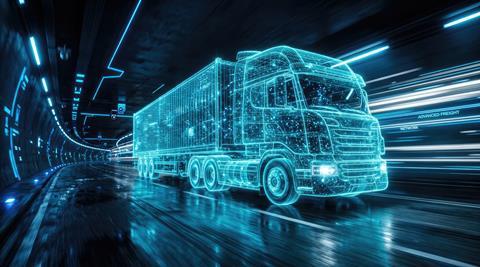
“As a technologist, my head says yes, but as a realist within the industry, I would say no. There are critical decisions that operators make on a daily basis that need a human to actually adjust. And again, it goes back to AI doesn’t know the consequences of what it’s providing. So we always need a human in the loop there to make those big calls.”
There is a point, however, at which that balance could change.
“You’ve got to get to a critical mass point where there’s more autonomous vehicles or there’s more automated planners than there are humans. Because they will learn from one another.”
“It’s not inconceivable,” he adds. “And I would say within five years, we will certainly see more of a dynamic shift.”
AI for the driver
The benefits aren’t restricted to planners and managers. AI could also make life in the cab easier. Garvey-North points to driver-monitoring cameras, safety systems, training and compliance, but then gets onto a more mundane example: stopping for a coffee.
“If you’ve got your route optimiser, you’ve got to stop within the next three hours. Do you know what? I’d like to stop at my preferred coffee shop of choice, or services of choice,” he laughs.
The same applies to compliance. AI can help detect issues, reduce the amount of manual checking required and give drivers reassurance that the necessary checks have been completed.
For drivers, the attraction is not simply that another layer of technology is watching them. It is that routine checks can be made quicker and more certain, freeing them to concentrate on the job.
The end of the big warehouse
The conversation takes a more speculative turn when we come to drones. Garvey-North believes their eventual influence could be much greater than many people currently expect.
“Look at the number of distribution centres being built,” he says. “Look at the growth in last-mile deliveries. Then consider the cost of retail space.
“If I’m a retail store, could I shrink my retail store space, because that costs me a lot of money, to have instant delivery?
“So again, if I’m sitting here in Manchester, can I get those drones from 25 miles away, Knowsley, or if they come the other side of us, the M6, so my space is drastically smaller, but I know I can get freight in almost constantly.
“So I don’t have to have big warehouses. I don’t have to have big warehousing costs. I put that all on the warehousing logistics companies, and then I just get stuff in.”
But one thing Garvey-North is surprisingly keen to protect is human creativity.
“Anyone can use a power saw. It won’t make me build a cupboard,” he says. “That’s the bit that people are missing. We’re in danger of becoming monkeys at typewriters unless we really think about what we want from AI.”
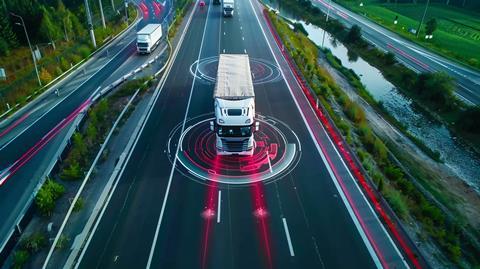
The point brings us back to the question we asked when Motor Transport turned 120: where will the industry be another 120 years from now?
Skilled labour will remain, he predicts, but high-risk work will increasingly be handled by robotics and AI. But then he moves beyond transport altogether, towards the enormous amount of computing power the world is going to require.
“Within the next 20 years, we will need to make a big shift around how we get the minerals and the elements needed to power all this. You’ve got lumps of magnesium and copper and ice just floating around in space. We’re going to have to go mine in space or destroy our planet.”
It’s quite a leap from route optimisation, but the more interesting question is who will use it to change transport most effectively?
“I’m really interested in which one of those AI companies are going to be next Google,” he says.
“When you start going to your AI app of choice to access the internet, as opposed to Google, I think that’d be the next big thing.”
And that thought brings the conversation neatly back to haulage. The next Amazon of transport may not look like a traditional transport company. It may not start with a fleet and then add technology around it. It could start with data, AI and a completely different idea of how freight should move.
For existing operators, that is both the opportunity and the warning. The technology is not going away. The question is whether they use it to make the operation they have today better – or whether somebody else uses it to build the operation of tomorrow.