





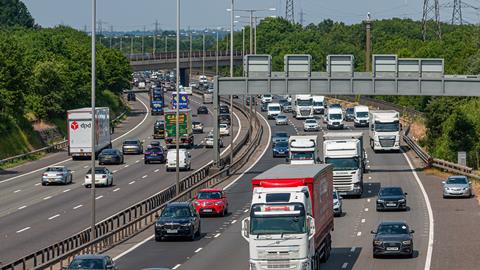

Despite the volatility brought about by disruption in the Strait of Hormuz, there was a spike in demand for transport last week as the industry scrambled to move freight before Easter, new data showed.
TEG’s Road Transport Index revealed that the dominant force last month remained domestic, with the loss of two consecutive working days and heightened consumer spending over the public holidays driving the demand for transport.
The Fintech-enabled platform said in the final week of March daily loads posted on its platform jumped 30% as businesses sought to move freight before the long weekend. Across the month, platform volumes were up 29.5% on March 2025.
And beyond this short-term spike in activity, TEG added that its data suggested a broader shift in how companies source transport capacity: rather than expanding their own fleets, more operators appeared to be turning to the open market to flex up when demand tightens and scale back when it eases.
Sam Wilkinson, TEG chief revenue officer, said: “The UK economy grew 0.1% last quarter. Consumer confidence is in deeply negative territory. Yet our platform volumes are up nearly 30%. That tells you something.
“When costs are rising and volatility is the norm, businesses can’t afford to sit on fixed capacity they may not need.
“They’re coming to the open market because it lets them scale up when demand spikes and pull back when it doesn’t. And it’s not a one-sided story. Carriers are winning too.
“They’re accessing demand they’d never reach through their own networks, and filling trucks that would otherwise run empty.”
TEG’s findings followed a warning last month from the Chartered Institute of Procurement and Supply (CIPS) that rising transport costs could drive consumer goods prices higher.
Ben Farrell, CEO of CIPS, said: “Procurement and supply professionals are on the front line of global trade disruption.
“What this situation demonstrates is that supply chains are not linear pipelines but complex global supply webs, where disruption in one critical node such as the Strait of Hormuz can ripple rapidly across industries, markets and continents.
“When energy prices rise, transport costs increase, production costs increase, and those pressures eventually work their way through to businesses and consumers globally.”