

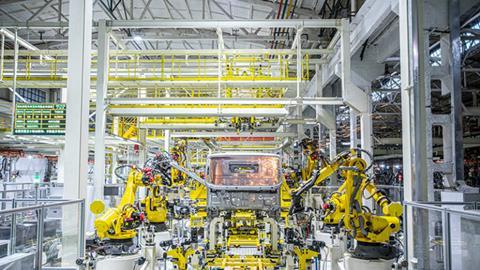

Isuzu Motors produces 320,000 units annually across four Yokohama plants with just 9,000 production staff, dominating 52 global markets. But the International Council on Clean Transportation warns Japan’s truck sector is falling behind on decarbonisation, despite Isuzu’s partnerships with Volvo, Cummins, Toyota and Honda on zero-emission technology.
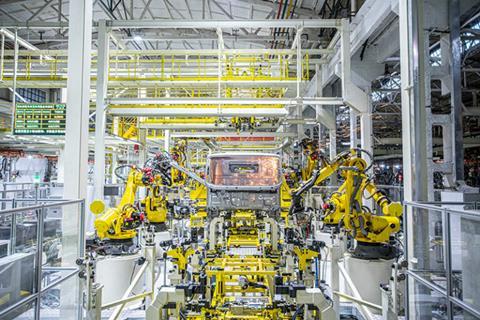
Isuzu Motors is one of the world’s largest truck manufacturers, and the oldest in Japan, having been founded in 1916 and renamed Isuzu Motors in 1949. Headquartered in Yokohama on Japan’s largest island Honshu, it is second only to Toyota in production volume, dominating the Asia-Pacific heavy truck market with a 25% share.
While Japan is recognised as a technology leader, more recently it has fallen behind the International Council on Clean Transportation (ICCT) targets for decarbonising its commercial vehicle fleet. The ICCT recommends that the Japanese government mandates a more aggressive transition to zero carbon commercial vehicles.
A recent visit to the Isuzu factory and testing ground on the northern island of Hokkaido reinforced the ICCT claim, with notably few battery electric vehicles to be seen on the streets.
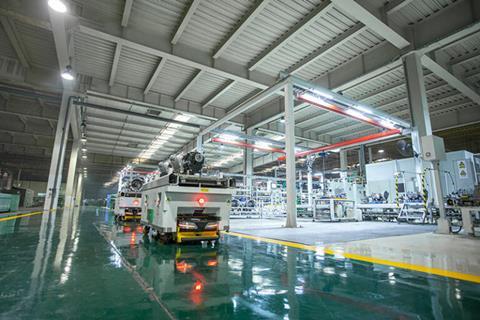
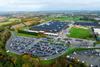
Isuzu has four manufacturing and assembly plants in Yokohama totalling 11m sq ft, making the majority of parts inhouse and offsetting high labour costs by automating 97% of production. Its annual output of 320,000 units is produced with a workforce of only 9,000 split across two shifts.
Over half of this output is knocked-down for export to more than 150 countries and Isuzu also has plants in 18 countries including China, the US, Italy, Turkey, South Africa and India. Its global sales including pickups total 680,000 units and it is market leader in 52 countries including Japan where it has 41% of the heavy and medium truck market and a dominant 45% of light duty truck sales.
Isuzu has built its reputation on producing sold, reliable trucks, using its ‘Isuzu Monozukuri’ or zero defects approach to manufacturing. Inspections and quality control procedures are an integral part of the entire manufacturing process.
Isuzu acquired UD Trucks in 2021 and recently announced it would be relocating production of its Giga heavy duty trucks from Fujisawa to UD’s plant in Ageo as part of plans to integrate their medium and heavy duty ranges.
But outside Asia, Isuzu is best known for its light and medium duty trucks; its annual production of 126,000 light trucks represents almost 40% of total output.
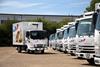
In the UK Isuzu Truck (UK) only imports N-Series light duty and F-Series medium duty vehicles between 3.5 tonnes and 13.5 tonnes GVW as Isuzu does not currently produce a heavier truck suitable for the UK market. Isuzu pickups are distributed by a separate company in the UK.
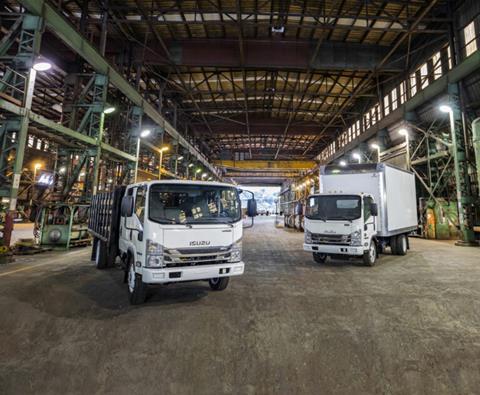
Isuzu has a 1 trillion yen (£4.7bn) R&D budget and has several partnerships with other global automotive manufacturers, many of which are designed to help it along its decarbonisation journey. It works with Volvo Group across the weight range to strengthen product and technology development and is collaborating with Cummins on engine and powertrain developments to cut carbon output. Closer to home it is working with Toyota to develop hydrogen fuel cell light commercial vehicles and with Honda on fuel cell technology for heavy trucks.
Isuzu started volume production of light duty battery electric vehicles in 2023 and aims to have a zero-emission option for all its commercial vehicles by 2030, with heavy duty fuel cell trucks expected to be on the road by 2028. It has already introduced gas-powered heavy trucks and is considering the use of hydrogen in internal combustion engines.
A shortage of truck drivers in Japan is also pushing Isuzu to develop level 4 autonomous trucks which it expects to launch for highway and hub-to-hub operation in Japan and the US in 2028.